Showing posts with label Foreign Troops in French Service. Show all posts

Sunday, May 20, 2012

Battalion du Prince de Neufchatel

Prussia ceded the Principality of Neufchatel to France in December, 1805, and Napoleon bestowed it upon Marshal Berthier in March of the following year. In 1807, a battalion of light infantry was decreed, although recruitment was slow - all the men were volunteers, enlisting for four years, and had to be from Neufchatel, Valais, or Switzerland. Small artillery and engineer companies were added in 1808. Berthier's Neufchatel Battalion joined the Imperial headquarters establishment in 1809, but did not arrive in Austria until after the battle of Aspern-Essling. Assigned to duty guarding the bridgehead at the Battle of Wagram, it evidently saw some action near the end of the fighting.

The battalion was sent to Spain in 1810, where it mostly participated in escort and counter insurgency operations, although it did participate in the siege of Ciudad Rodrigo. The Battalion was recalled from Spain for the campaign in Russia in March, 1812, but did not arrive in time for the Battle of Borodino. The Neufchatel battalion fought hard at Krasnoi, and again at the Beresina, but largely ceased to exist thereafter, like so many units of the retreating Grand Armee. The Battalion was restored by conscription in 1813, and was again attached to Imperial headquarters; it saw fighting on the last day of the Battle of Leipzig. During the retreat from that battle, many of the men became ill, and the unit effectively ceased to exist, taking no organized part in the 1814 campaign. The remaining officers and men, less than 100, were officially disbanded in June of that year.

The uniforms of the Battalion du Prince de Neufchatel were designed by Berthier himself. Reportedly a relatively ugly man himself, Berthier's personal staff were known throughout the army for the magnificence of their costume, rivaling those of Murat's staff. It is perhaps not surprising that he chose to clothe his personal unit in a very distinctive fashion, being unique in the army for wearing yellow ("chamois") coats. As one might imagine, this occasioned a fair amount of heckling, the Swiss calling them "canaries", the French "serins" (birds), and the Spanish populace "amarillos", "pasidos", or "canarios". The silver buttons were inscribed "Battalion Neufchatel" in the center, with a laurel wreath below and the words "Empire Francais" above. There is once again good information about the Battalion at the Histofig site; the bulk of the information in this post is from Dempsey's book, "Napoleon's Mercenaries", previously reviewed here.
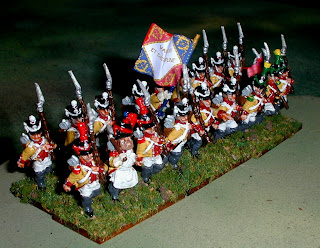

Here are "the canaries" in all their flashy glory! The exact shade of yellow used for the coats is uncertain; I used Delta Ceramcoat "Pale Straw" as the color, but probably anything from buff to light orange might be reasonable.


The unit was organized the same as a standard French Light Infantry unit, with 4 companies of chasseurs, one of carabiniers, and one of voltigeurs; the chasseurs evidently all had white pom poms and epaulets. Although I have them in shakos here, evidently bearskins (with red cords) were generally worn by the carabiniers of the Battalion, even in 1812

It is recorded that the unit was given "a small flag of Tricolor serge, inscribed on both sides with "Battalion du Prince de Neufchatel" on both sides "while it was waiting to receive 'one just like that issued to units with Eagles". It is unknown if such a flag was ever received, and if so, the details of its design. I have chosen to give my own "canaries' a standard pre 1812 French pattern standard, inscribed as above on the front. It is noted that the commander of the Battalion had crossed Marshal's batons in silver as turnback ornaments; I therefore chose to place crossed batons within the laurel wreaths of  my Neufchatel Battalion's flag (modified from Napflag).


The dilute "magic wash" worked especially nicely on these uniforms to bring out the details without dulling the colors. Quite the classy unit! I made the red of their facings comparatively dark to contrast better with the yellow uniform coats. 


The Neufchatel Battalion before flocking and the magic wash; the drummer's dress is based upon the plate at the Histofig site. These are 28mm Sash and Saber French line infantry  figures once again... soon to be lighting up a battlefield near you!

Peter

Friday, May 11, 2012

Provisional Croatian Regiments

As part of the provisions of the Treaty of Vienna in 1809, the territories of six of the former Grenz regiments of the Austrian Empire were transferred to the French Empire. These units were rechristened as the Chasseurs Illyriens in October 1809. With the approach of the planned invasion of Russia in 1812, Napoleon sought some way to make use of this manpower. Beacause of their border defense duties, entire units could not be safely removed from their districts. Thus the Regiments Provisores Croates, or Provisional Croatian Regiments were formed in 1811. Four regiments were ultimately ordered, but only three were ever formed, the 3rd in sequence being the first actually organized.

The First regiment was formed in October, 1811, and saw action in 1812 at Ostrowno, light combat at Borodino, and led the 4th Corps in action at Maloyaroslavets. They fought again at Krasnoi and the Berezina. In 1813 battalions of this unit were part of the garrisons of Glogau and Magdebourg (where it took part in the battle of Hagelsburg in August, 1813).

The Second regiment wasn't formed until February, 1813, and saw action at Bautzen as part of Bertrand's corps.

The Third regiment was formed in September, 1811. It participated in the invasion of Russia as part of Oudinot's 2nd Corps, and were brigaded with the Swiss regiments. They fought well at the first and 2nd battles of Polotsk, and the crossing of the Beresina. Remnants of the regiment served in garrison duty in 1813.

Uniforms:  The uniforms of their parent units were in a state of flux, and when Napoleon reviewed the 3rd Provisional regiment in Paris in December, 1813, "he was displeased with their appearance", and ordered a new uniform of "light infantry style" with a green jacket and pants, white metal buttons, white vest, and crimson facings. The tailors of the Guard were given the task of fabricating the new uniforms! Details of the other regiments dress are less certain, but is seems likely they were also green. Primary sources record green uniforms with *yellow* facings as well. (This information form Dempsey's book, previously reviewed). There is very useful information and plates at the Histofig site as well. It is very likely that the 1st and 3rd regiments at least received eagles and flags, most likely in the 1812 pattern.


I chose to do my small unit of Croats, once again needed for our 1812 project for Borodino and Maloyaroslavets, with yellow facings. This is what is shown on Histofig, and recorded in eyewitness accounts.... but mostly I chose it because I thought the yellow facings were more striking and unique than the crimson! The white gaiters are quite spiffy looking as well, I think.


This is the same view before the "Magic Wash"; the effect is subtle but noticeable, I think. 


Slightly out of focus;  the company distinctions were as per standard French practice. These are spare 28mm (French) Sash and Saber figures once again. 


The turquoise blue jackets of the drummer and Sapper are taken form the plate on the Histofig site. The Green epaulettes of the voltigeurs are relatively inconspicuous on the green coats, aren't they? 


A good view of the rear of the uniforms. The 1812 pattern flag is from Warflag/Napflag, with the inscription modified in MSPaint to read "au Regt Provisore Croates". There would be no battle honors on it, although doubtless some of the soldiers fought at Wagram... except for the other side!

Consider adding this or one of the many other colorful "foreign" units in French service to your French Napoleonic wargames army!

Peter

Friday, May 4, 2012

The Portuguese Legion in French service

    The French conquered the Kingdom of Portugal without significant resistance in November 1807. The result was that the French occupying force co-existed with the Royal army of Portugal, numbering roughly 30,000 men. In order to defuse this threat (and use the manpower else where), General Junot discharged all soldiers with eight or more years of service in December 1807. The remaining men were reorganized, on paper at least, into six infantry regiments, a light infantry battalion, an artillery battery, and three cavalry regiments. In March, these troops were directed to Valladoid in Spain, for incorporation into the French army. Since many deserted en route, out of a planned strength of 10,000 men, by the time of their arrival in Frace, in May, 1808, there were only about 4,00 infantry and 700 cavalry left under arms. Ultimately, five infantry regiments and two cavalry regiments were formed under the title of the Légion Portugaise.


    For the 1809 campaign in Austria, the elite companies of the Portuguese infantry regiments were organized into the 13th demi-brigade and served in Oudinot's Corps, and fought at Wagram; similarly, a select force of Portuguese cavalry was organized into the provisional regiment of Portuguese Chasseurs a Cheval. In 1811, the Portuguese Legion was reorganized into 3 regiments of infantry and one of cavalry; only the first regiment continued to be of almost exclusively Portuguese in origin and was considered an elite formation. The remaining two regiments were largely made up of Spanish prisoners of war recruited to serve in the Legion. All three regiments served in Russia in 1812, the first and second  regiments in different Divisions of Marshal Ney's 3rd Corps, and the 3rd regiment in Oudinot's 2nd Corps.  Soldiers of the Légion Portugaise fought at Smolensk, Valentina -Gora, Borodino, 1st and 2nd Polotsk, and the Beresina; the remaining 800 or so soldiers were transformed into the battalion of Portuguese Pioneers in November, 1813. There is excellent information about the Légion Portugaise here at Histofig, and also in Guy Dempsey's book, Napoleon's Mercenaries, previously reviewed on this blog. The Portuguese Legion seems to have a had a reasonable combat record, particularly considering their origin, especially the "elite" 1st regiment.


Here is my version of the infantry of the Portuguese Legion. I did up a banner for the halberd holding NCO using MS Paint; it actually says "Legion Portugaise" in white on the red background! There is no evidence that any of the units of the Legion ever received official flags or an Eagle from Napoleon. I deliberately used "dark flesh" as the base color instead of my usual "medium flesh", to represent the relatively swarthy complexion of these Portuguese men.


Another shot of the Legion; the Portguese army was originally uniformed in blue, but a shortage of Indigo dye meant that a different color uniform was needed. Sky Blue, Grey-Brown, and Red-Brown were proposed, and Napoleon chose the later. Properly, these men should be wearing the "Barentina" style shako (same as worn by the Portuguese troops that served under Wellington, and later adopted by the British themselves as well. As this is a small unit "raised" from spare figures, I've used French Line wearing ordinary French shakos instead. I'm sure that things like that *never* happened in real life either... ahem!


A shot of the Legion infantry showing the turnbacks, which were red piped in white, just like the cuffs, collars, and lapels. Silver buttons, silver ornamentation for the officers. 

Another shot of the back of these 25/28mm Sash and Saber figures. This unit is one that we needed for Borodino; as it probably won't see action too often, I built it as a four-stand, 12 figure unit, which is all we need for Field of Battle. This is much the same as I did for my Austrian Landwehr and Russian Opolchenie units, and for similar reasons. My usual infantry unit organization is 18 figures, on six stands of three each.


This unit was part of my second round of trials using the acrylic "Magic Wash". This is a picture before the wash - no shading or dry brushing was done at all, except on the faces and hands. 


Materials used in the Magic Wash process.

Following feedback from the originator of the formula I based my first trials on, I used Distilled water instead of tap water in the wash, prevarnished the finished figures with the Kamar Varnish (my usual), before re-reading the instructions which called for gloss *acrylic* varnish, so I sprayed over that with the Krylon Clear Coat, a gloss acrylic varnish. I then applied the magic wash. Unfortunately, I still couldn't find any of the "cheap acrylic drawing ink" the recipe calls for at the nearby Michaels or a local art store, so I used a fresh bottle of cheap India ink. I knew from my previous trials to use the India ink very sparingly.
So my final composition for this wash was 60ml Distilled Water, 60ml Future, 2,5ml Jet Dry (which is a surfactant made for Dishwashing Machines), and 5 drops of cheap India ink. Once again, once mixed up in the bottle, this mix looks dark as midnight, but is almost colorless on the brush. Given the dark nature of these uniforms, I used this mix on the Fusilier and Voltiguer stands, and a darker formula (Mixture "C" from my earlier trials) on the Grenadier and command stand. On these rather dark uniforms, I think I actually prefer the darker wash on these particular uniforms, which isn't surprising. Neither seemed to significantly grey the white piping this time out! After allowing the wash to dry overnight, I applied the relatively glossy Kamar varnish again (I happen to like a medium to high gloss finish). Later this month I'll be posting 2 more units where I used the current "Magic Wash" formula. 

Anyway, my Portuguese Legion is now all ready for our next Borodino playtest (the Fleches and the Utitsa sector) this weekend!

Peter