Showing posts with label Imperial Guard. Show all posts

Sunday, February 10, 2013

Young Guard Voltigeurs


    The Voltigeurs of the Young Guard were created from the two regiments each of the  earlier Tirailleurs-Chasseurs (December 1810) and Conscrits-Chasseurs (February 1811), both of which were first first formed in 1809. Details of these earlier formations can be found in my previous post about the Imperial Guard Infantry as it stood in 1809. These first four regiments were progressively augmented in parallel to the increasing numbers of Tirailleurs (as detailed in my post on their evolution), reaching six units by August 1811, thirteen units by April 1813, and 19 regiments by the end of January, 1814, at which time the Guard comprised almost 1/3 of the entire army!


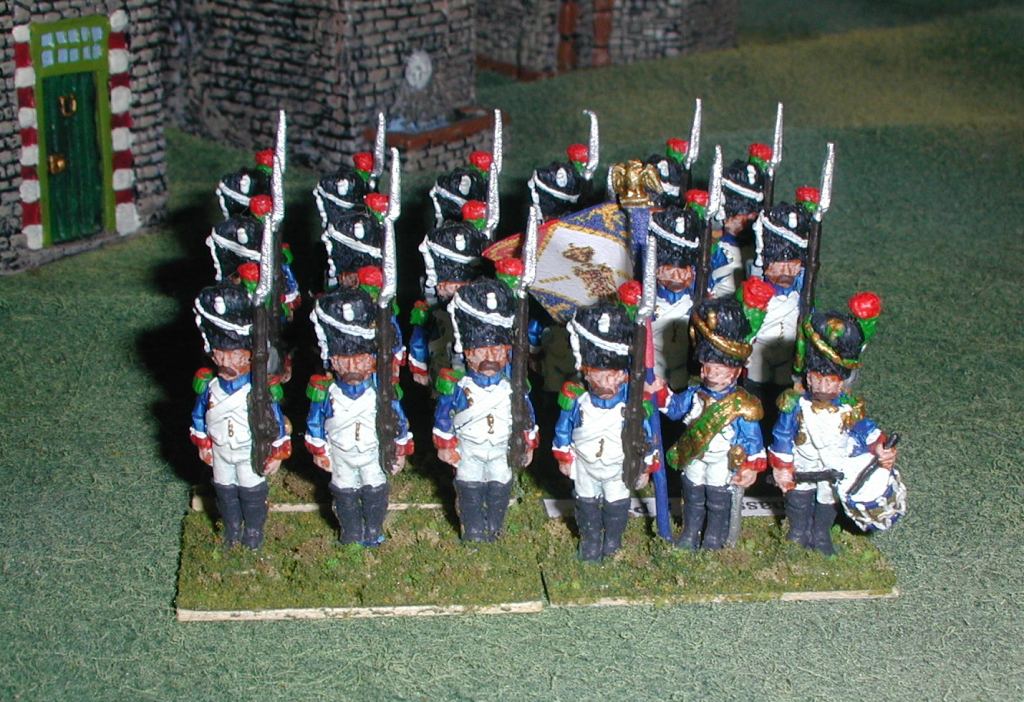
Two Regiments of Voltigeurs of the Imperial Guard; 28mm Front Rank figures.


Another view of the two units; their uniform was based upon that of the earlier-Tirailleur -Chasseurs.


1st Regiment, Young Guard Voltigeurs. Changes from the Tirailleur-Chasseur uniform include green epaulettes with yellow crescents.


Another view of the 1st regiment; these units also adopted the yellow (or chamois/buff) collars of the line Voltigeurs. 


The plumes of the Voltigeurs of the Guard were red over green, but several sources indicate roughly even proportions of both, rather then the green tipped red plumes of the Fusilier-Chasseurs (and the earlier Tirailleurs-Chasseurs). I have, of course, opted for the roughly equally colored variant!


This unit is the 2nd Regiment of Voltigeurs. The Voltigeurs were authorized to carry fanions instead of standards/Eagles; these were to be red and plain, lacking any inscription that would identify them as belonging to the Imperial Guard. 


I have painted my 2nd unit with buff collars instead of the yellow collars I used for the First regiment. The Voltigeurs seem to have lacked the white lace "chevrons" at the sides of their shakos as worn by the Tirailleurs and Fusilier-Grenadiers and Fusillier-Chasseurs of the Guard.


The plumes had a green or yellow pom pom at the base; when not in full dress (and after April 1813, when the plumes were withdrawn) the shako would be worn with just the pom-pom. I of course have chosen the more showy yellow pompoms at the base of the plumes for my units. Funken's illustration of these soldiers shows both variations

To command my Young Guard Division, we have a jumped up Colonel of Tirailleurs, assisted by an NCO of the Voltigeurs. 


The officers of the Voltigeurs generally worse the same uniform as the Chasseurs a Pied of the Old Guard (and thus also the Fusilier-Chassuers), with the shakos appropriate to the Fusilier-Chasseurs. 


The NCO shakos of the Voltigeurs had a gold lace band at the top, and the shako cords were of mixed gold, red. and green, similar to those of the more senior regiments of the Chasseur arm of the Guard infantry.

    My two Voltigeur units are both in Firing poses, with the second rank reaching for cartridges from their cartridge boxes in the First regiment, and biting open fresh cartridges in the Second regiment. I like to have some of my Napoleonic infantry units firing, even though they are a bit more trouble to store in that pose.

Ne tirez pas jusqu'à ce que vous sentez le schnitzel sur leur souffle !

Peter

Thursday, January 24, 2013

Young Guard Tirailleurs

    What would become the "Young Guard" was born in January, 1809, with the creation of  (ultimately) the 1st and 2nd Tirailleur-Grenadiers, Tirailleur-Chassuers, Conscript-Grenadiers, and Conscript-Chasseurs (See my earlier post on the foot regiments of the French Imperial Guard through 1809 for details of these units). These Young Guard units saw action in Spain after the 1809 campaign in Germany wound down. At the very end of 1810 (December 30), the 1st and 2nd Tirailleur-Grenadiers and the 1st and 2nd Conscript Grenadiers (February 10, 1811) became respectively the 1st - 4th Tirailleurs. Similarly, on the Chasseur side of the Young Guard, the 4 existing regiments became the 1st - 4th Voltigeurs of the Guard; more about then in a separate post in the near future.


My newest troops - two units of Front Rank 28mm Tirailleurs de la Garde Imperiale, just finished yesterday; the matt varnish is barely dry!


    The Tirailluers added a 5th regiment in May 1811, and a sixth Regiment in August. Following the Russian debacle of 1812, the former regiments were reconstituted, and a 7th regiment of Tirailleurs was added Feb 15, 1813, an 8th Regiment in March 1813, and then the 9th - 13th regiments in April 1813. More were to follow - 14th-16th regiments in early January 1814, and the 17th -19th regiments later the same month. Thus, in less than a year, 13 new regiments were added. Not surprisingly, by 1814, the Guard composed almost 1/3 of the Army's effective strength. most of it made up of these Young Guard units. Not surprisingly, by this point the quality of the later Tirailleur regiments was little different from that of the line.


1st Battalion, 1st Tirailleurs. You knew I had to do them in the distinctive red over white plumes, right?


  Tracing the uniforms of the Tirauileur regiments can be more than a bit confusing; their initial uniform was essentially that of the Tirailleur-Grenadiers, and coat remained essentially the same with minor differences. A shorter cut dark blue coat was worn, with the lapels blue piped in white. The pointed cuffs and turnbacks were red piped white. The collar was red, sometimes piped blue. The turnbacks were ornamented with white eagle badges, and the false pockets on the back of the jackets were piped in white. The pointed shoulder straps were red piped in white. Buttons were yellow metal. The jacket initially had the lapels cut to a point, showing the white vest; later (April, 1813, at least theoretically), the lapels were cut square and extended all the way to the bottom of the jacket front. White pants were worn (dark blue often in service dress, or even brown in Spain), along with short black gaiters. Finally, a black shako was worn, with a brass Eagle plate on the front and brass chinstraps.While the original Tirailleur-Grenadier shakos had had  white cords, when the regiments were reorganized into Tirailleurs, red cords were worn (until all cords were abolished in April 1813). White lace chevron "V'"'s were worn on the sides of the shakos as well, until they were also abolished in April 1813.


Like all of the Imperial Guard Infantry except the Old Guard, the Tirailleurs did not have or carry Eagles. They did carry fanions of unspecified design (except they were not to have an inscription or indicate in any way that they belonged to a Guard unit). In March 1812, the fanions were officially decreed to be white. Exceptions to this are definitely known, however (notably the 5th regt)!


The drummers had gold lace piping on their cuffs and lapels, and shoulder wings, as seen here, but no other distinctions. It seems the new Imperial Livery didn't apply to the Guard!.

    Then there is the matter of the plumes to be addressed! Initially  in full dress at least,  the 1st Tirailleurs had tal plumes with a white pom pom at the base, the plume being red over white in equal proportions (same as they had worn as the 1st Tirailleur-Grenadiers), and it seems the 2nd regiment wore white over red plumes over a white pompom, with the 3rd Tirailleurs (and ? probably the 4th) wearing solid red. Later all the regiments had solid red plumes for full dress, until they were abolished in April 1813 and replaced with a spherical red pom-pom (boo, hiss!) for all regiments. For ordinary dress, until April 1813, the pom poms distinguished the regiments:

1st Tirailleurs: spherical pom pom, red over white
2nd Tirailleurs: sperical pompom, white over red
3rd Tirailleurs: red lentile disc with white center
4th Tirailleurs: white lentile disc with red center (or all red)
5th Tirailleurs: white lentile disc with blue center (or all white)
6th Tirailleurs: blue lentile disc with white center


The officers wore solid red plumes, as seen here, aside from the Major and Colonel, who had white. They also had gold cords on their shakos, as well as a band of black velvet along the top of the shako, piped in gold and bearing gold five pointed starts; I have settled for just solid gold - even these superb Front Rank figures didn't have the star braiding modeled on!

A final view of the 1st Battalion, 1st Tirailleurs; this rear view shows the turnbacks; again, you will have to forgive me, as I didn't attempt to paint the white eagle badges on!

The same uniform was worn by Tirailleur regiments during the 1815 "Hundred Days" campaign, except that red epaulettes replaced the earlier shoulder straps  Michael Head's Almark book shows  the epaulettes on the jacket starting in 1812, but the text doesn't indicate this.


This picture and those that follow are of the 2nd Battalion, 1st Tirailleurs. You can see the Eagle plates on the flaps of the cartridge boxes, a cast on detail. The main difference (in my case) between the units  is the slightly different pose (Front Rank makes quite a variety of poses for the Tirailleurs, in addition to being one of the few manufacturers that actually makes a Tirailleur figure in the first place!


The figure in the front rank to the left of the fanion bearer is painted as an NCO; prior to the austerity measures of 1813, their shakos were distinguished by red mixed with gold cords (similar to Fusilier-Grenadier NCO's), and red chevrons edged in gold on the sides of the shako.


This view shows the pointed shoulder straps well. Front Rank are beautiful figures, but they are HUGE; I'd say 32mm. At least Barry's Front Rank Russians can now pick on someone their own size in the French camp!  :-)


Their Fanion is by GMB designs. Note again the details of the NCO's shako. I'm happy with how these guys came out, but they did take me considerably longer than usual to paint, in part because their surface area is just greater than that of smaller figures, LOL!


And lastly, a top down view of the 2nd battalion, 1st Tirailleurs of the Young Guard.  These fellows should see a lot of action in the upcoming 200th anniversary 1813 scenarios! Next month it will be the turn of the Young Guard Voltigeurs.


Peter

Sources:
Foot Regiments of the Imperial Guard, Micahel Head, Almark Publications, January 1973
L'Uniforme et Les Armes des Soldats du Premier Empire, Fred and Liliane Funken, Casterman. 1969
The Anatomy of Glory: Napoleon and his Guard, Henry Lachouque and Anne S. K. Brown, Grenhill Books,  London, 4th edition, 1999.
Napoleon's Guard Infantry (2), Philip Haythornwaite, Osprey Publishing Ltd, London, `1985, ereprinted 1988

Thursday, August 16, 2012

French Imperial Guard Cavalry, part 2 (Dragoons, Lancers, Honor Guards)


The first unit of Guard cavalry formed without antecedents dating back to at least the Consulate was the Empress' Dragoons, formed by decree in April, 1806, with the troopers drawn from each of the line Dragoon regiments on the recommendation of their colonels. The regiment initially had 2 very large squadrons plus one of velites; 2 more squadrons were added after the Battle of Friedland in 1807.


This side view shows the attractive uniforms of the regiment, officially renamed the Regiment des Dragons de L'Imperatrice, and presented by Napoleon to his wife, Josephine, in 1807. The men of the regiment formed a deep attachment to the Empress and her cause, and were very distraught, as were many in the Army, over the Imperial divorce in 1810. Josephine was allowed to retain the title of "Empress" even after the divorce, and I have little doubt that the Dragoons continued to see themselves as "her" regiment, rather than that of her replacement, the former Hapsburg princess, Marie-Louise!


A rear view of the regiment; which wore a somewhat more elaborate version of the helmet worn by their line counterparts, adorned with an imitation leopard skin fur turban. Chestnut mounts were used for this regiment whenever possible, aside from the trumpeters, who were mounted on grey or white horses as usual.


A side view showing the regiment's standard (by GMB designs once again), and the officer's substitution of gold for all the aurore items of the troopers (aiguillette and saddle blanket edging, mostly). 


This frontal view shows that the full dress habit coat was very similar to that of the Grenadiers a Cheval, aside from substituting dark green for the dark blue of the Grenadiers. These are Foundy figures once again; one of their best, in my opinion. I painted this unit about 4 years ago, using staining techniques and some black lining, and was very happy with the result; thus no Magic Wash seemed necessary, so I spared this unit the indignity!  


    The next regiment of cavalry added to the Imperial Guard was the Polish Light Horse (Chevau-Legers Polonais de la Guard), organized in 4 squadrons in April 1807. In 1809, they became the Regiment de Chevau-Legers Lanciers de la Garde, following the Battle of Wagram. With the addition of the Dutch Lancers (see below), the regiment was renamed the 1er Regiment de Chevau-Legers Lanciers de la Garde. In 1811, the regiment added first a 5th squadron, and then  2nd regiment (mostly recruited in Lithuania), named the 3eme Regiment de Chevau-Legers de la Garde, was raised. As a result of the disaster in Russia, in 1813 the 2nd regiment was disbanded, but the original 1st regiment added first a 6th and then a 7th squadron; ultimately the first three squadrons were designated Old Guard, the next three Middle Guard, and the last, Young Guard; by the end of that year the regiment was back down to four squadrons once again. 


A rear view of the Polish Lancers of the Guard; note the crimson portemanteau and the blackened wood of the lances; the lance pennons were always crimson over white.


This side view shows many details of what I think is arguably the most elegant uniform of the entire Napoleonic Wars; the blue is considerably darker than it appears in the pictures. Once again, an application of Magic Wash to these figures, which I originally painted more than a decade ago, really brought out the details, especially on the white cords and plumes.


The opposite side view shows the uniform of the trumpeter well; a white jacket with crimson facings, crimson pants with white stripes, and the top of the czapska white with crimson cords, and a white over crimson plume, as contrasted to the troopers who have crimson tops to their czapskas, with white cords and plumes.


The frontal view shows additional details; the aiguillette was moved from the left shoulder to the right when the lance was adopted. These are Foundry figures with a GMB flag once again. The short lived 3rd Chevau-Leger Lanciers (Polish/Lithuanian) regiment evidently wore an identical uniform to the first, except with yellow lace/piping and yellow metal buttons in place of the white ones of the 1st regiment.


    The next unit to join the Cavalry of the Guard came by a rather circuitous route; the Grand Duchy  of Cleves-Berg was bestowed upon Marshal Murat in 1806; inn 1807, Murat ordered the formation  of a cavalry unit, the Hussars of the Grand Duke of Berg. Having three squadrons plus an elite company of Garde du Corps, the unit underwent a further series of name changes including Regiment du Grand-Duc de Cleves, Chevau-Legers de la Grand Duchesse, and then Regiment de Chevau-Legers du Grand Duc de Berg. In 1808, a fourth squadron was added, and the first squadron entered the Imperial Guard. Two squadrons of the regiment were transferred to the newly formed Chassers a Cheval du Grand Duc de Berg. In January 1809, the Chevau-Leger regiment was disbanded, and the men sent to the Chasseurs a Cheval of Berg and the Guard Cavalry regiments. The unit adopted the lance in late 1809, and joined the Imperial Guard in December, 1809. In March of 1812, a second regiment was raised; both regiments were disbanded at the end of 1813, when their territory was over run by the allies and the Confederation of the Rhine dissolved. 

    The evolution of the uniforms of this unit was equally complex, but it always featured facings in amarante ( a light purplish pink hue), Murat's favorite color. This is nicely detailed on the Histofig site, including 2 plates illustrating the various changes. Suffice it to say that the original unit wore white (cream for the elite company), with amaranth facings and pants, but the uniform changed to a dark green jacket and pants with amaranth distinctions when it was transformed into Chasseurs a Cheval, and when the lance was adopted, a czapska with an amaranth top (and amaranth over white lance pennons) was adopted. The Lancers of Berg spent most of their existence fighting in Spain, but the second regiment participated in the 1812 invasion of Russia, and both regiments fought in Germany in 1813.


    With the dissolution of the Kingdom of Holland in 1810, and the incorporation of its territories into metropolitan France, the former Dutch Royal Guard Hussars became the 2eme Regiment de Chevau-Lager Lanciers de la Garde Imperiale in September, 1810. The regiment had 4 squadrons at its creation, with a 5th squadron added in 1812. In January, 1813, the regiment was increased to 8 squadrons, and then 10 squadrons in March of that year; at that point the first five squadrons were designated as Old Guard, and the second five as Young Guard. 


A rear view of the 2nd Light Horse Lancers of the Guard, often referred to as the "Dutch" or "Red" Lancers.; note the czapska of the trumpeter on the left; white top with scarlet piping and cords. Foundry figures.


A lateral view of the regiment shows the light blue jacket and pants (faced red) of the trumpeter, adorned with  mixed red and yellow cords, aiguillette, etc.  Standard once again is by GMB designs; Foundry figures. 


A view from the other side highlights the contrast between the dark blue saddle blankets with yellow edging, and the red uniform faced dark blue. This unit has also benefited from delayed application of the Magic Wash. ** 8/1/14:  Deadhead on TMP kindly pointed out that the lance pennons for the Red Lancers should be white over scarlet, the opposite of that pictured above. I'm not sure why thaty is, buit I checked several sources and he is inded correct. 


The head on view captures the full splendor of this magnificently attired unit; the "sunburst" brass plaque on the front of the czapska has a white center with a brass "N" in the center.


    A relatively obscure unit of the Imperial Guard were the Lithuanian Tartars of the Guard, raised in July 1812. Although a regiment was planned, only a single squadron was ever raised. There is a decent brief (if nationalistic) history and illustrations here. The remaining men were absorbed into the 3rd Scout Lancers of the Guard in 1813 (see below).

   Faced with the desperate need to rebuild his cavalry after the debacle of the Russian invasion, and yet severely short of both horses and funds, in 1813 Napoleon ordered the formation of four regiments of Gardes d"Honneur. These were to be raised from the sons of noblemen and the wealthy, and were to equip and mount themselves at their own expense; in return they would receive Guard pay and guaranteed promotion to 2nd Lieutenant after a year's service. "In the Guard, but not of the Guard", they were resented by the other guardsmen, and many were unwilling soldiers, deserting at the first opportunity, although they evidently fought well enough upon encountering the enemy. The Army reportedly nick-named them "The Hostages"! The four regiments wore an identical hussar style uniform, with a dark green dolman (faced scarlet) and pelisse (trimmed with black fur), and scarlet pants. The buttons, cords, and lace on the pelisse and dolman were white, as were the decorative knots on the front and the piping on the outer seam of the pants. The shako was scarlet with white upper and lower bands, cords and tassels, and white metal chin scales. The sole distinction between the four regiments was their plumes; all were dark green on the bottom, with the color of the tip varying by regiment: red for the 1st, blue for the 2nd, yellow for the 3rd, and white for the 4th regiment. Trumpeter's dress was uncertain; reversed colors, Imperial Livery, and also sky blue pelisses and dolmans (sky blue uniforms being common to most of the trumpeters of the Guard, see examples above) with scarlet pants and black fur colpacks all being possible - perhaps all three variations may have existed, especially with the men equipping themselves!

   In late 1813, three regiments of Scout Lancers were added to the Guard, named the 1er, 2e, and 3e Regiments d’Eclaireurs de la Garde Imperiale. These were a deliberate attempt to counter the marauding Cossack hordes. The First regiment was attached to the Grenadiers a Cheval, the Second to the Empress Dragoons, and the the Third regiment to the 1st (Polish) lancers of the Guard. Each unit's uniform was quite different from the others.

   On might also briefly mention the Gendarmerie d' Elite of the Guard, which had a mounted arm. The police of the Guard, these men seldom saw combat on the battlefield. This earned them the nickname of "The Immortals"! There uniform was reminiscent of that of the Grenadiers a Cheval.

This concludes our whirlwind tour of the Cavalry of Napoleon's Imperial Guard; see part 1 for the Chasseurs a Cheval, Grenadiers a Cheval, and Mamelukes of the Guard.

Peter

Sunday, August 12, 2012

French Imperial Guard Cavalry -Part 1 (Chasseurs and Grenadiers a Cheval, Mamelukes)

   Napoleon's Imperial Guard was of course the direct descendant of the Consular Guard, which was established only 18 days after the coup d' etat of 18 Brumaire (November 10, 1799)  which resulted in General. Bonaparte ultimately becoming 1st Consul (December 24, 1799); it was regularized by decree on January 3, 1800. The cavalry complement of the initial formation of the Garde Consulaire was 2 squadrons of  "light cavalry", and a company of Chasseurs a Cheval. The Chassuers a Cheval were themselves descended from the Guides of the Army of Italy (later, the Guides of the Army of Egypt).

    The Chasseurs a Cheval were increased to full squadron Jan 13, 1800, then 2 squadrons August 6th, 1801, and 4 squadrons October 1, 1802. They officially became the Chasseurs a Cheval of the Imperial Guard on May  18, 1804. The regiment continued to grow, adding velite companies and later Young Guard companies to reach 8 squadrons by 1813. Probably the most famous regiment of the Imperial Guard cavalry, it ordinarily supplied the personal escort for the Emperor and his immediate entourage. Napoleon's often depicted green coat was the undress uniform of a Colonel of the regiment.


Here is the famous regiment of Chasseurs a Cheval of the Guard in full dress uniform. Note the white fur trim to the officer's pelisse, his leopardskin shabraque, and the green leather boots.Being an officer in the Guard was an expensive proposition!


Rear view of the Chasseurs a Cheval de la Garde Imperiale. Note the trumpeter, mounted on a grey horse (the troopers were all supposed to be mounted on dark bays). The trumpeter, instead of reversed  colors, wears a sky blue dolman dark red/maroon pelisse, a white colpack with a dark red over sky blue plume; the trumpeter's lace and cords are all red mixed with yellow. 


This side view shows the shabraque better (dark green, edged with aurore, with a red border) as well as the red trimmed aurore bag or flamme of the Chasseur's fur colpacks.


A frontal view of this elite regiment. Note the sumptuous trumpet banner; figures are Foundry, flag by GMB.


    In 1799, General Kleber, left behind in Egypt by Bonaparte, formed a company of Syrian Janissaries to which were later added Mamelukes; they later became the Mamelukes of the Republic in July, 1800. A Squadron was ordered added to the Consular Guard in 1801, later reduced to a company, and attached to the Chasseurs a Cheval. The officers were French, and over time, more and more of the troopers were as well. The fashion conscious Parisians loved their exotic costume, and along with the passion for Egyptian themes spurred by collections and writings of the savants returning from Egypt, costumes inspired by the Mamelukes became the rage among the women of the capitol. 


Here's the small unit of Mamelukes that form part of my guard cavalry. The specifications for their uniforms were much looser than for standard European cavalry. Originally, the "cahouk" or cap that the turban is wrapped around was supposed to be green, "the color of the prophet", but by 1805 and later it was most commonly bright red or crimson. 


The sleeved chemise shirt could be in a variety of colors including shades of blue, green, red, yellow, and/or white, and was usually worn with a sleeve less waistcoat, heavily embroidered with decorations and piping, which could themselves be in a variety of colors, including black.


The baggy pants were invariably either red or amaranth. Note the color and design of the saddle blankets; these were fringed, rather reminiscent of an oriental rug.


In addition to a standard, the Mamelukes had four troopers bearing horse tail queues, two black, one red , and one yellow. The figures are Minifigs.


    The  "2 Squadrons of Light Cavalry" established at the formation of the Consular Guard in 1799 were swiftly transformed into the Grenadiers a Cheval de la Garde des Consuls in December, 1800, and then the Grenadiers a Cheval de la Garde Imperiale in May 1804, at which time the regiment had 4 squadrons and a strength of a little over 1,000 men of all ranks. At various times squadrons of velites and later Young Guard squadrons were added, but the regiment never had more than 6 squadrons total
.

We start with a rear view of the Grenadiers a Cheval; this shows the red patch on the back of the bearskin headdress, which bears an aurore cross, as well as the cords of the aiguillette, worn on the right shoulder, in common with all of the remaining French Guard Cavalry regiments. 


This side view nicely displays the uniform of the trumpeter, resplendent in sky blue jacket faced crimson, white bearskin with gold mixed with crimson cords and sky blue over white plume; note also the saddle blanket in crimson trimmed with gold, and the officer, whose uniform has gold items where those of the troopers were aurore.Their standard had a somewhat unique design (flag by GMB once again). 


A head on view of the Grenadiers a Cheval of the Guard; the trumpeters aside, all the men were mounted on black horses. NCO's (not shown) had the cords on the bearskin, sword knot, trefoil epaulette and the aiguillette all with mixed scarlet (2/3) and gold (1/3), similar to their foot guard equivalents.


    I painted all of these units more than 10 years ago, and my painting has improved considerably since then. A few months ago, I applied Magic Wash to these figures, and it really improved them a lot, nicely picking out the detail in the cords and especially the white bearskin and colpack of the trumpeters. The Grenadiers a Cheval also have black lining of the saddle blankets, which was done when they were originally painted. Together, they are much closer to doing justice to these very fine figures.

   Part 2 will cover the later additions to the Cavalry of  the Imperial Guard, including the various Lancer regiments, as well a a few odds and ends in passing. Until then... shout "Vive l'Empereur!"

Peter

Saturday, March 19, 2011

Imperial Guard Infantry

The French Imperial Guard originated from the units of the Consular Guard, established shortly after the Consulate itself (1800), and the subsequent maneuvering that lead to General Bonaparte becoming First Consul of the French Republic. The Consular Guard itself derived from several sources, including the respective Guards of the Directory and the Legislative Corps. It was transformed into the Imperial Guard by decree in May, 1804. Although the nomenclature wouldn't be fully established and codified until 1812,  the senior units in all branches were referred to as the "Old Guard" as the Imperial Guard expanded over time.


 Certainly when we think of the Old Guard, this is the unit that comes first to mind - the Grenadiers a Pied, 1st Regiment (there were  as many as 3 regiments by 1811, the second being raised from Frenchmen, and the third, wearing a distinctive white uniform faced crimson, from the former Dutch Royal Guards). In 1809, however, there was but the single regiment of two battalions, each of eight companies of 102 men and officers.


Note the gold  cords on the bearskin as well as the gold embroidered red leather bandoleer of the the Eagle bearer, who was usually a Lieutenant. This differed from the line where the Eagle bearer was usually a senior NCO.  The NCO drummer  has mixed red and gold cords on the bearskin, as well as mixed red and gold epaulets. These particular NCO distinctions were common to Sergeants of all of the infantry units of the "grenadier" branch of the foot guards.


This rear view of the Grenadiers a Pied is somewhat blurry, but it shows the solid red turnbacks ornamented with grenade emblems, which were aurore on a similarly shaped white patch. The infantry units of the Guard also generally had solid dark blue collars in contrast to the red collars of the line and leger regiments, and solid white lapels without piping. The cuffs of the Grenadiers were red with a white three pointed cuff flap. All buttons were yellow metal/gold for officers. These are Foundry figures. 


Here is the other unit (aside from the Marins or "sailors") of the Old Guard Infantry, the Chassuers a Pied. The regiment had two battalions, similar in organization to the Grenadiers. A 2nd was regiment raised in 1811. The red over green plumes, and green epaulets with red crescents are emblematic of the Chasseur corps of the Guard. The Chasseurs also had red pointed cuffs piped white, which was different in several details from the cuffs of the Grenadiers. All buttons were brass/gold.


This rear view of the Chasseurs a Pied demonstrates that, unlike their Grenadier counterparts, their bearskins lacked a cloth patch on the back. The French soldier's slang for this, by the way, was cul de singe, or literally "monkey's butt".  The French certainly deserve an award for original slang, LOL.  The bearskin cap of the Chasseurs also lacked the brass/gold plate on the front which was found on that of the Grenadiers. The turn backs of the Chasseurs were ornamented with grenades alternating with hunting horns, with coloration as for the Grenadiers. 


The NCO drummer wears cords of mixed red, green,and gold, and epaulets of the same threads. Once again, this was common to Sergeants of all infantry units from the Chasseur branch of the infantry of the Guard. Drummers of Guard infantry units generally had gold lace around their lapels, collars, cuffs, and turnbacks, (or mixed red/gold or green/gold for the Old Guard Grenadiers and Chasseurs, respectively). Note also the gold cords on the Eagle Bearer's bearskin (once again a Lieutenant in the Guard regiments), as well as the green bandoleer ornamented with gold.  These Foundry figures are standing in Reserve, the usual station of the Old Guard infantry. Required to be veterans of at least 10 years service with outstanding records, or promoted from the Fusiliers after 4 years service there (but only by Imperial decree!), the Old Guard were "almost too precious" be committed to battle.


The Fusilier-Grenadiers were raised originally as the Velites of the Guard (1804), attached to the Grenadiers a Pied. They were organized as a regiment in their own right in 1806, and formed what would become the Middle Guard Infantry, along with their Chasseur counterparts.


The Fusilier Grenadiers were unique in having white epaulets with 2 red stripes on the straps, and red crescents. Their turnbacks bore white eagles. These distinctions, and their shakos (substituted for the bearskins of the Grenadiers a Pied) aside, their uniform was otherwise identical to that of the Grenadiers a Pied.


The Fusilier-Grenadiers, like all the Guard infantry aside from the Old Guard, were not given Eagles or standards, but rather carried fanions of various designs and colors. The most important requirement was they bear no inscription that identified them as belonging to the Imperial Guard. These are Foundy Line Voltigeurs painted as Middle Guard.  Flags are by GMB.


The Fusilier-Chasseurs were analogous to the Fusilier Grenadiers, forming the Chasseur branch of the Middle Guard. There was never more than a single regiment.


The red-over green plumes and green epaulets with red crescents of the Fusilier-Chasseurs, along with the rest of their uniform is exactly identical to that of the Chaseurs a Pied, save only for the shako and the substitution of white eagles as the ornamentation on the turnbacks.  Note the mixed red, gold, and green cords on the shako of the NCO/Sergeant.


The Fusilier-Chasseurs, marching off into history!  By the later part of the Napoleonic Wars, it is arguable that the Fusiliers were perhaps better fighters than the Old Guard themselves, by virtue of their considerably younger average ages.


One final view of the Fusilier-Chasseurs, showing detail of the officer's dress. Both Fusilier units were frequently used as a source of cadre for the Young Guard regiments to come, as well as replacements for losses from the Old Guard. Officer uniforms from Captain and above were identical across the infantry branches (Grenadiers vs. Chasseurs), which helped avoid massive expenses for uniform changes each time an officer was transferred from one regiment to another.


This unit is the 1st Tirailleur-Grenadiers, formed in January, 2009. This unit marked the inauguration of what would become the Young Guard. Drawn from the cream of the conscript class, they were all supposed to be able to read and write. They wear a simpler uniform with a shorter dark blue coat bearing red shoulder straps piped in white in place of epaulets, but with distinctive red over white plumes. The collars, pointed cuffs and turnbacks were red, with white piping on the cuffs, pockets, and the dark blue lapels, and white eagles on the turnbacks. The Fanion, like all shown in this post, is by GMB flags. These were to be white for the Tirailleurs by a decree of 1812. These figures are by Old Glory - actually Sailors (Marins) of the Guard painted as Young Guard.

The Young Guard infantry regiments covered here generally had 2 battalions per regiment, each of 4 companies, and totaling about 800 men per battalion at full strength. Unlike the senior formations, the Young Guard were more often understrength due to battlefield losses, illness, straggling and the usual attrition of active campaigning, which generally effected them far more than their senior comrades.


A different view of the Tirailleur-Grenadiers. A second Young Guard grenadier regiment, termed Conscript-Grenadiers, was raised later, in March 1809. This was rapidly followed, in April 1809, by first a second regiment of Conscrit-Grenadiers, and then a second regiment of Tirailleur-Grenadiers. The 1st Tirailleur-Grenadiers  and the 1st Tiraileur-Chasseurs (only) joined the main army in time to see action at Aspern-Essling and  Wagram, but the Conscrit-Grenadiers and other Young Guard units did not. The uniform of the Conscrit-Grenadiers (not shown) was a dark blue short tailed coat with dark blue lapels and shoulder straps; the lapels piped white (another source says no piping) and the straps piped red. The round cuffs were red with white three-pointed cuff flaps. Turnbacks were white piped red, with red eagle ornaments. Pockets were piped in white (another source says red), and all buttons, were brass/gold, same as for the Tirailleurs. Red plumes and cords were worn on the shako for full dress, otherwise a red pom-pom.

Later, in December, 1810  the 1st and 2nd regiments of Tirailleur-Grenadiers were redesignated as just plain  Tirailleurs, the 1st and 2nd regiments. Their uniforms, aside from differing plumes and/or pom-poms by regiment, were unchanged from their original ones. In February, 1811, the 1st and 2nd Conscrit-Grenadiers were redesignated the 3rd and 4th Tirailleurs and adopted the uniform of the Tirailleurs. When Napoleon learned that it was actually considerably cheaper to raise and maintain a Young Guard regiment than a new Line regiment, he ordered more regiments formed, including a 5th and 6th regiment by later 1811, ultimately reaching as many as 19 regiments of Tirailleurs by 1814! It would seem there was probably very little elite about the later regiments, especially those formed in 1813 and 1814.


The Tirailleur-Chasseurs, shown above, were the Chasseur branch equivalent of the Tiralleur-Grenadiers, and the first regiment was raised in March 1809. In place of epaulets, they had green shoulder tabs piped in white (or red) on their short dark blue coats. Collars, cuffs, and turnbacks were red, with white piping on the pointed cuffs, and alternating green grenades and hunting horns on the turnbacks. The dark blue lapels and pockets were piped in white, and all buttons were brass/gold.

A second Young Guard Chasseur regiment was raised in early April 1809, termed Conscrit-Chasseurs. As with the Grenadier branch, second regiments of each followed by the end of April 1809.  All of these units were an attempt to shed a more glamorous light on the practice of conscription,which was becoming increasingly unpopular as the wars of the Empire dragged on. The Conscrit-Chasseurs (not shown) wore the same short dark blue coats as the Tirailleur-Chassseurs, but with dark blue turnbacks piped red, and bearing white (or green according to another source) turnback ornaments, alternating eagles and hunting horns once again. Dark blue pants were worn.


Another view of the Tirailleur-Chasseurs; they carry a red fanion (as per the later 1812 decree for the Voltigeurs). Subsequently, the Tirailleur-Chasseurs and Conscrit-Chasseurs were combined into new units of Young Guard infantry termed Voltigeurs (December 1810 for the Tirailleur-Chasseurs, and February 1811 for the Conscrit-Chasseurs). Like the Tirailleurs, the Voltigeurs of the Guard underwent rapid and extensive expansion reaching 19 regiments at their peak. The uniform of the Voltigeurs of the Guard was the same as that of the Tirailleur-Chasseurs, except that the collar became yellow (or buff) piped in dark blue, and green epaulets with yellow crescents were adopted. The plume was red over green with a yellow pom-pom at the base for full dress, otherwise a green pom-pom.

The regiments of the Young Guard fought bravely, but never attained the status or quality of the more senior formations of the Imperial Guard. Never the less, they became all but ubiquitous on the battlefields of 1812, 1813, and 1814, as well as service in Spain starting in late 1809. Napoleon commented that in war, he profited more from his Young Guard than the Middle and Old Guard. Similarly, the wargamer, while doubtless wanting some units of the Old Guard for their own collection, will probably find that the Young Guard units will find themselves on the tabletop far more often than their exhalted seniors!

As they originated after 1809, I have deliberately not covered some of the later Guard Infantry formations, i.e., the Pupilles (cadets, drawn from orphans of soldiers), The Flanquer-Grenadiers and Flanquer-Chasseurs, and the Gardes-National of the Guard. Similarly, I have also omitted the Velites of Turin and Florence, formed in 1809, but playing more of a ceremonial role in the courts of Napoleon's sister and brother-in-law.

I'll be covering the Battle of Aspern-Essling in my next post, and then perhaps we'll return to the Austrian side of the aisle!

Good gaming,

Peter