Showing posts with label Miniaturas Dos de Mayo. Show all posts

Monday, October 30, 2017

Spanish Infantry Regiment "Guadalajara", 1808

The fourth and last of my Spanish Line regiments composed of Miniaturas Dos de Mayo figures steps off (there will be quite a few to come from other manufacturers!).

Red is certainly the dominant impression of this regiment, whose origins date back to 1657; the buttons are white metal

The dynamic officer is a high point of the Regimiento de Infanteria de Linea Guadalajara!


Note the red epaulets of the sergeant; in the Spanish army, the NCO epauletes were in the facing color in the 1805 uniforms. 


The white piping on the red collars is c;early seen here. Flags coming soon!


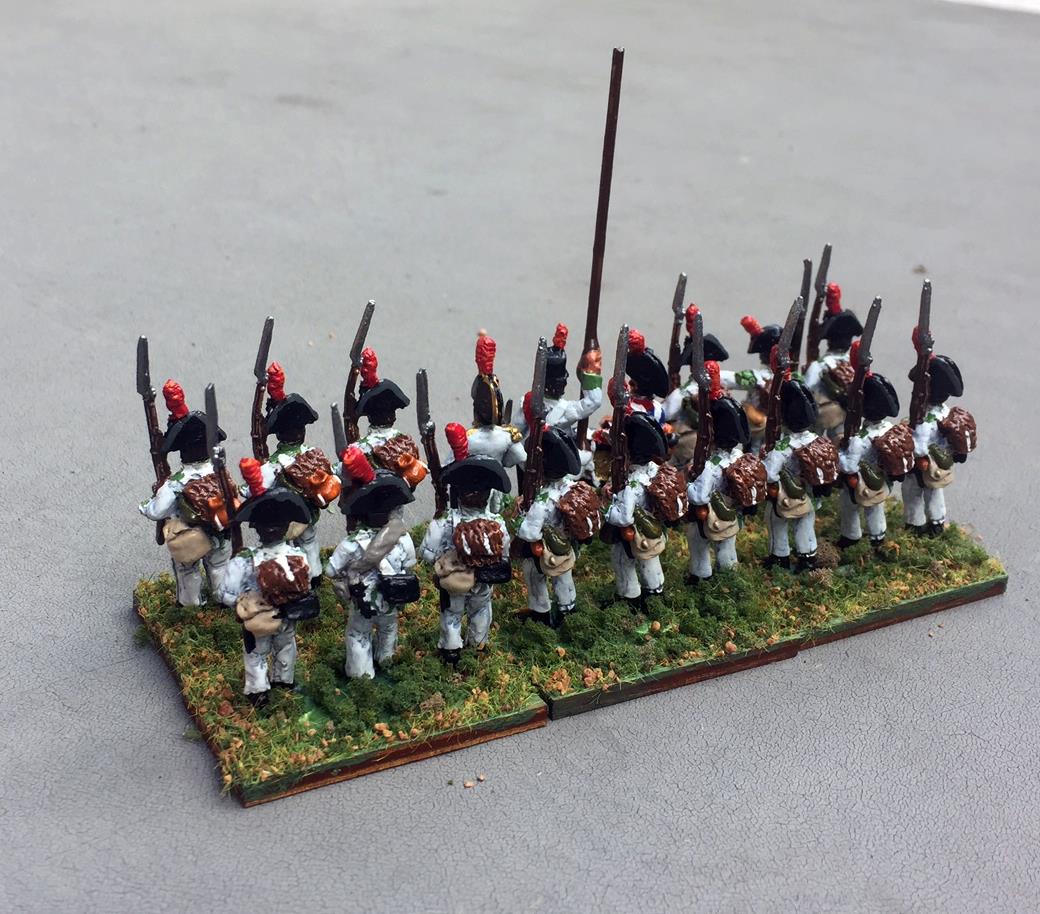
Once again, a variety of encumbrances carried by the soldiers make the figures especially interesting.


Here is the full "Division" of 4 Regiments.


On parade, awaiting their standards, which will bestowed upon them shortly, with suitable pomp!


Most Americans will think of Guadalajara in Mexico first, but it is also both a city and province of Spain, in the la Mancha region. While Gudalajara itself  not a major tourist attraction, the Palacio del Infantada, constructed in the 15th century by the Mendoza family, who held the title of Duke of Infantada, is a marvel of ornate stonework. I found this statue rather interesting, poised outside the facade of the Palacio. 


Detail of the stonewoprk in the Courtyard of the Lions; the palace itself holds a museum devoted to Guadalajara. 

Friday, October 27, 2017

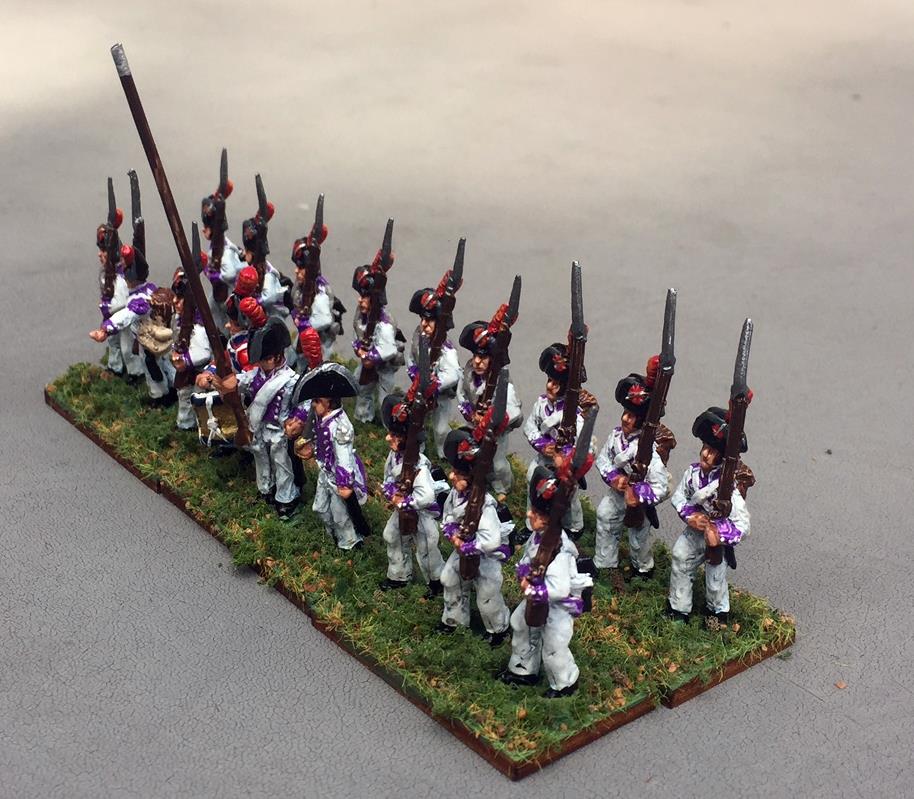
Spanish Infantry Regiment "Reina", 1808


The next Spanish line infantry regiment  completed is  Regimiento de Infanteria de Linea "Reina" - the Queen's regiment. It was first raised in 1537, along with three other regiments, and stands second in seniority only to Regimiento "Rey" - the King's regiment. 


While all of the other Spanish Line regiments have the drummers dressed in the King's Livery (dark blue coats with red facings piped in white - see the earlioer regiments Valencia and Burgos), uin this one regiment, the drummers wore the Queen's Livery instead - red coats faced dark blue, piped in white. 


In 1805, this regiment had Violet facings with silver buttons. I used Delta Ceramcoat "Pansy" for the facing color. One nice thing about white uniforms - the other colors painted over the white really pop!


Once again, these are Miniaturos Dos de Mayo figures from Spain. They had an introductory order for these figures in the Spring of 2014, and I ordered enough for 4 units of 18, 72 figures in all, at a cost of  62 Euros on 3/25/14, about $88, not a bad deal. The shipping was added when the figures were ready to ship on 5/14/14, another 23.5 Euros or about $33 - overseas shipping is a bear! Still not a bad total price even with the high shipping cost. 


I received the figures about June 14, 2014, so not too bad for overseas ordering. Unfortunately, the guys made a mistake with the order and left out about 1/3 of the figures. I got a prom[pt response and they offered to send out the missing figures without additional shipping costs. Time passed, and no more figures arrived. Evidently they were sent August 4th, 2014,  but still hadn't arrived by the end of October.  Evidently, the Spanish postal service is notoriously inept (? corrupt), and another order shipped that day had also failed to arrive, so they again offered to send out a (second) replacement package free of cost to me. 


I didn't push overly hard about the order as I didn't need the figures any time soon, and was a bit familiar with what "mañana"(tomorrow) *really* means in Spanish culture (no offense to my Spanish friends). Still when the 2nd replacement package hadn't arrived by February I contacted them again. The missing 22 figures finally arrived on 3/25/2015... a year and a day after they were first ordered! That is certainly my ball time record for completion of an order!  In defense of the company, they responded promptly to my emails each time, and I wasn't at all aggressive about prodding them. They certainly lost money on the deal, sadly. The name of the company comes from the date of the revolt against French rule, which began in Madrid on May 2, 1808, and was to continue in one frm or another until the French were expelled from Spain in 1814. 


"El dos de Mayo en Madrid", an oil painting by Francisco Goya, which is located in the Museo del Prado in Madrid. The charge of the Mamelukes. Evidently the populace saw the Mamelukes as Moors, further inflaming an already volatile situation. 


Monument to the Heroes of the 2nd of May, Madrid.
(Picture from Wikipedia)

Friday, October 20, 2017

Spanish Infantry Regiment "Burgos", 1808

A long overdue post for the second Spanish Line Regiment I painted...


This is Regimiento de Infanteria Burgos, first raised in 1694.  These are 25/28mm Miniaturas Dos de Mayo figures. 


I used Craftsmart "Shamrock Green' for the (1805) facing color, which appears on the cuffs and lapels, and on the piping of the collars and turnbacks. The buttons are yellow metal for this regiment. 


In 1791 the regiment was wearing the same pattern of facings and buttons, except in Violet instead of Green. 


That was then superseded by the short lived, universal  Medium Blue coats and Black facings of 1802, as it was for all Line regiments, before the re-introduction of regimental distinctions with the 1805 regulations. 


I bow have my Adolfo Ramos flags in hand, but need to add them to the regiments already completed, such as this one. 


Burgos was the original, historic capitol of Castile. Indeed, the Spanish language itself is said to have originated nearby. El Cid, hero of the Reconquista, was born nearby and educated in the city. Pictured above is the monument to El Cid, located in Burgos (picture from Wikimedia commons). 

Friday, September 29, 2017

Spanish Infantry Regiment "Valencia" 1808

The first of the four units of Spanish Line Infantry that I completed this month takes the stage at last!


Regimiento de Infanteria València was first raised in 1658, ranking it as the 13th such unit in the Spanish army. Valencia is the the third largest city in Spain, and was founded by the Romans in 138 BC. It was reconquered from the Moors in 1238. It served briefly as the Capitol of Spain under Joseph Bonaparte in 1812, and again in 1936 - 1937 under the Second Republic. Located on the Mediterranean coast, it is famous for orange trees and Paella!Among a great many other sights, it contains the Chapel of the Holy Grail. 


 In 1791 the unit was wearing white coats with scarlet cuffs and lapels, both with buff piping, buff collars, and Pewter buttons. 


Along with the other Line regiments, in 1802 the uniform was changed to deep sky blue coats with black collars, cuffs, and lapels, and red turnbacks. I used Delta Ceramcoat "Bluejay" as the facing color on the white coats. Note the various items hanging from the packs of these obviously veteran campaigners!


This change of dress proved highly unpopular, and in 1805, a return to the white uniforms was ordered. The new scheme had the regiment as I have painted it here - white coats and breeches, sky blue lapels, collars and cuffs, piped white, white turnbacks piped sky blue, and pewter buttons. This was the uniform worn, at least officially, when the French invaded under Napoleon in 1808. 


The drummer wears the King's Livery - a dark blue coat with red facings piped white.  
These are Miniaturas Dos De Mayo 28 mm figures from Spain; they will be equipped with Adolfo Ramos flags, also from Spain.