Showing posts with label Kingdom of Italy. Show all posts

Friday, October 30, 2015

Guardia d' Onore (Gardes d'Honneur), Kingdom of Italy

   In an era known for its spectacular uniforms, that of the Guards of Honor of the Napoleonic Kingdom Italy surely deserves special mention. Their creation was first ordered by Napoleon in June 1805 in his new role as King of Italy. There were initially 4 companies of 100 men, one each from Milan, Bologna, Brescia, and Romagne. Later a 5th company, designated Venice was added. These companies served to guard the royal palaces in peacetime, but were attached to the Royal Guard during wartime. They were recruited from the aristocratic youths of Italy, thus in some ways presaging the French Guards of Honor of 1813 - 1814.

    The early uniform consisted of a coat ion various colors by company, with facing colors on the collar, cuffs, lapels and turnbacks, much white lace ornamentation, and a bicorn hat edged in white lace.. These uniforms, as well as the later ones,  are well illustrated on the Nap Italia site.


Guards of Honor, 1805-1810
Company
Coat
Facings
Pants
Milan
Red
Dark Blue
White
Bologne
White
Dark Blue
Dark Blue
Brescia
Dark Blue
Red
White
Romagne
Dark Green
Red
White
Venice
Dark Green
Orange
White


    In 1811, a new uniform was introduced, having considerable similarity to the equally spectacular new uniforms of the French Carabiniers. A similar brass helmet with a black crest and white plume was worn, with the comb of the helmet being in the form of an eagle with outstretched wings.  and a  white metal turban bearing a brass metal "N" on the front, brass chin straps, and a back visor trimmed in brass completed this impressive and rather unique head dress. A white plume was worn on the left side for full dress. The rest of the uniform was in the style of the French Dragoons, with dark green coats, white belts, waist coats, gloves, and pants./ Each company had its own facing color, as listed below, which appeared on the collars, cuffs, lapels, turnbacks, and the edging of the pockets. There were 2 white lace bars on either side of the collar, and white lace on the button holes. There were brass scale epaulettes on a background of the facing color, and, for full dress, a yellow cord aiglette was worn on the left shoulder. The horse furniture was dark green with white trim and a white Iron Crown of Lombardy device in the rear corners. For officers, silver replaced the white of the lace and shabraque trim. Trumpeters wore yellow jackets* faced light blue, with light blue shabraque and white trim, and a white crest to the helmet.


Guards of Honor, 1811 -1814
COMPANY
FACING COLOR
Milan
Rose Pink
Bologne
Yellow
Brescia
Buff
Romagne
Scarlet
Venice
Orange

*  A nice link to multiple watercolor illustrations of the uniforms of the Guards of Honor, including several other Trumpeter uniform variations by company:
http://that-history-buff.tumblr.com/post/124883578939/uniforms-of-the-honor-guards-of-the-napoleonic


To my knowledge, no manufacturer makes a figure entirely suitable for these troops in any scale. The closest figure that I have seen is that of the 1815 Dutch Carabiniers by Perry, and that is what I used for my version.

Add 7/25/2020: Adam Elkington has kindly pointed out that Eagle figures have miniatures for this unit (25/28 mm).


Guardia Reale di Onore... a la Perry! Unfortunately, these figures have their overcoats slung across their chests. Fine for protection, but it obscures the wonderful colored lapels!  I used some artistic license and made these "steel green" instead of grey. 

The Dutch helmet has a lion on the front of the metal turban. I could have shaved it off, but it was so well sculpted and handsome that I just left it on in place of the brass "N". The "eagle comb" of the helmet of course is also absent. There are no aiglettes either, but we can just assume they were left off for field duty. Finally, the figures have full epaulettes; rather try to carve them of I left them, and painted them silver over the facing color, so not quite right but close enough!


I have painted one stand in each of the 4 company colors - Milan (pink), Bologna (yellow, includes the Trumpeter for the unit), Brecia (buff, includes the standard bearer, a minor conversion as the Perry command set lacks same), and Venice (orange). What about Romagne (scarlet)?  We'll come to that later!


The Osprey even shows a black and white photograph of a Trumpet banner of this unit, captured by the Prussians in 1813. To me it looks like it is in the facing color. On one side is the Iron Cropwn surrounded by laurels, and on the other is the inscription "GUARDIE REALI D' ONORE" (sic), also surrounded by a wreath.


The standard is as illustrated in both Keith Over's book and the Osprey on the subject - In each of the four corners is a capital "N"surmounted by an Iron Crown device. The Royal Arms are in the center of one side


and the other side has an inscription reading "GUARDIA REALI  / D' ONORE"
On Blue scrolls above and below trhaty are inscribe "valore e disciplina" above, and "1 squadrone" below. I used the infantry flag form Warflag/Napflag, edited it in MS Paint to remove the corner emblems and central inscription and add a fringe, and then painted in the inscription on the crowned "N" emblems by hand. 


Since the Perry figures come in sets of three, and my cavalry units have 8 figures, that left one figure left over. I used the officer figure and painted him in the scarlet facing color of Romagne. Here you can see the fine detail of the silver lace decorating his collar. 


Here, at least, the full epaulettes in silver are correct, I think. 


As a high ranking officer, he has replaced his black horse furniture with dark red leather, reflecting the facing color on his coat. 


This way I have both an example of the Romagne company uniform, and another Commander stand for my Italians. And, of course, he comes accompanied by his very own cane di guerra!

Wednesday, May 1, 2013

Kingdom of Italy pt 2: Cavalry, Artillery

Chasseurs a Cheval (Cacciatore a Cavallo):  

There were two regiments in 1806, the 1st (Real Italiano) and 2nd (Pincipe Reale). A third regiment was added in 1809, and a 4th in 1811. Their uniform was basically similar to the French Chasseurs a Cheval, with dark green single breasted coats, often with white lace bars across the chest, dark green pants with white Hungarian knots and/or piping down the outside seems, and white metal buttons. The facing color showed on the collars, cuffs,  and turnbacks. A black shako was worn with white metal plaque and chinscales; it seems that the first regiment retained a black Czapska with white piping until at least 1809, however. Plume was dark green with a tip in the facing color; Von Pivka says the third regiment wore a black colpack with a cockade at the top front center, and a red plume above it. The Elite companies of all regiments wore the colpack with a red plume and a bag (flamme) in the facing color, along with white epaulettes. Trumpeters generally wore jackets in reversed colors, and their plumes were in the facing color with a white tip. Shabraques were dark green with white edging when worn; the lambskin covered saddles were white (black for trumpeters) with "wolves teeth" edging in the facing color.

REGIMENT
FACING COLOR
1st
Light Yellow
2nd
Orange (or Red?)
3rd
Red
4th
Violet


Here is the 4th Regiment of Chasseurs a Cheval of the Army of Italy. I of course chose this unit for their rather unique violet facing color!

Note the hand painted flag of  French-inspired pattern. 


As usual, I love reversed colors on a trumpeter; don't ghet to do that in purple very often, though!. This regiment had white lace chevrons on the sides of their shakos, at least at one point. After 1812, the chest lace disappeared as funds became too tight for such frivolities!


Dragoons (Dragoni):  

The Kingdom of Italy had two regiments, converted from the earlier Hussars of the Italian Republic in 1806; the 1st Hussars became the Dragoni Regina, and the second, the Dragoni Napoleone. Their uniform was again very similar to their French counterparts, with green coats and white breeches. Buttons were white metal. Square shrabques were green edged in white, and the sheepskin saddle covers were one again white (black for trumpeters), with facing colored "wolves teeth" edging. A brass helmet with black horsehair was worn, similar to that of French Dragoons. The First (Regina) regiment's helmet had a turban of leopardskin and a green plume to the left of the helmet,; the second (Napoleone) regiment had a black fur turban, and their plume was carmine over black. The elite companies wore black bearskins with a red plume, cul-de-singe, and cords, as well as red epaulettes.

REGIMENT
FACING COLOR
1st  (Dragoni Regina)
Pink
2nd  (Dragoni Napoleone)
Capucine red


The Dragoni Napoleone. I chose to use a dark red shade for the Capucine hue, in part because I already had a French Dragoon regiment wearing scarlet facings, so it would differentiate them more. It seems the color can refer either to a deep red brown hue like this, or a light pinkish-red with distinct orange brown tones to it. The standard is hand painted once again.


Rear view of the 2nd Italian Dragoons.


The trumpeter wears reversed colors (of course!), with a white horsehair main and tufts on his helmet, similar to French Dragoons of the era. 


Galloping forward to action!  This unit has always performed well for me on the wargames table.


Foot Artillery

The Italian foot artillery generally was dressed similarly to their French equivalents, substituting dark green jackets and pants for the dark blue color of the French. In 1806 there were some 20 companies ([6 of gunners, plus one each of  pontonniers, bombardiers (usually manned mortars in fortresses), ouvriers (literally "workers"), and one of artificiers and armuriers (smiths and gunpowder handlers) ] in a single regiment of Foot Artillery, wearing bicornes with a red pom pom. The jackets had black lapels and collars, with red cuffs (other sources say black cuffs piped red), cuff flaps, turnbacks, and red piping on the shoulder straps, pockets, lapels and collars. Buttons were white metal. Ouvriers had red lapels, Potonniers sky blue, artificiers light grey and bombardiers dark red; by 1807, all wore the same uniforms as the cannoniers (gunners). Drummers wore the same uniforms as the men; drums brass with tricolor (re-white-green) diagonal bands painted on the drum rims.

By 1809, the shako had been adopted, with red cords and short carrot plume. The uniform was otherwise essentially unchanged. The cords were abolished in 1812. By 1812, there were 20 companies of cannnoniers, 3 of pontonniers, 3 of ouviers, 1 of armuriers, and a depot company.


A battery of Foot Artillery of the Kingdom Of Italy prepares to fire!


I have given this battery guns with their carriages painted in French Artillery Green; it appears grey was the official color for Italian artillery equipment.


A final view of the battery; I have chosen the black cuffs piped in red option.


Horse Artillery

In 1806 there were six companies of Horse Artillery in a single regiment, rising to 8 companies in 1808, but decreasing to 4 in 1812. However, it appears that the companies of artillery train were included in the Horse artillery establishment until 1811, and thus there were only 2 companies of actual Horse Artillery until the train companies were split off in 1811, and then 4 companies of actual Horse Artillery starting in 1812. The uniforms of the horse artillery were similar to the foot artillery: dark green jacket and pants, black collar and cuffs piped in red, red turnbacks, red lace bars across the chest, red piping and/or Hungarian knots on the trousers, and white buttons. Black boots with red piping and tassels. Black czapaska with a brass crossed cannons plaque on the front, changing to a black shako in 1812.; both had a tricolor cockade and a red plume. Belts were white. Officers had silver epaulettes. Trumpeter's uniforms were essentially the same as the rest of the men.


A company of Italian Horse Artillery.


The sheep looks unimpressed by the guns rolling down the road!


This picture shows the horse furniture and piping on the boots and trousers well.


Artillery Train

A battalion of 10 companies of Artillery Train was first raised in 1811. They wore a medium grey jacket with white pants, black boots, and a medium grey shako with black leather reinforcing bands on the top and bottom. The jacket was faced medium green on the collars, cuffs and turn backs, and the grey shoulder straps were piped medium green. There were bands of medium green lace across the chest as well. Saddle blankets were grey edged in medium green. Brass butons and shako plate, short green carrot plume on the shako.

   The Line and Light Infantry, as well as a good listing of on line sources was already covered in Part 1 of this series. Part 3 will cover the Royal Guard and General Officers.

Peter

Saturday, March 9, 2013

Kingdom of Italy Pt 1 - Line and Light Infantry

    General Bonaparte's successful conquest of Northern Italy Italy in his remarkable first Italian Campaign of 1796-97 lead to the establishment of sister Republics satellites of France, the Cisalpine Republic centered on Milan, and the Cispadine Republic, centered around Modena. The Venetian aristocracy gambled and unwisely backed the wrong player when they declared war on France after having given their assurances of neutrality after Bonaparte passed them by on his way to invade Austrian territory. Immediately after the preliminaries of the Peace of Leoben in 1797, the Dodge and Senate of Venice were replaced with yet another new Republic, that of Venice... at the tips of French bayonets! Although the bulk of Venice's territory was later transferred to Austria as part of the peace, a large portion of Northern Italy was ultimately incorporated directly into the territory of France. After becoming First Consul of France in 1800, Napoleon became President of a  newly reorganized Italian Republic in 1802. Following his coronation as Emperor of France on December 2, 1804, this arrangement became incongruous, and Napoleon was proclaimed King of Italy in March 1805, with his coronation taking place in Milan in May, using the ancient Iron Crown of Lombardy.

   This post concerns the army of the Kingdom of Italy; The Kingdom of Naples occupied the lower half of the Italian Peninsula  and as previously noted, a large portion of Northern Italy was incorporated directly into the territory of the French Empire. Indeed, some seven "French" Legere and twenty-three Line Infantry regiments had depots in such territories, along with nine regiments of Chasseurs a Cheval, one of Hussars, and six of Dragoons.

  By late 1806, the army of the Kingdom of Italy included six regiments of line infantry  three of light infantry  plus the Dalmatian regiment. A seventh line regiment was added in 1808, and a 4th Light Infantry regiment in 1811. In 1813 four more line infantry regiments were raised (the 8th, 9th, 10th, and 11th). in 1814, Viceroy Eugene de Beauharnais was recalled to Italy, and fought a generally successful delaying campaign against the Austrians. He ultimately abdicated in May 1814, following Napoleon's own abdication in April.

    The original uniform of the Line Infantry (Fanteria di Linea)of the Italian Republic was very similar to that of France, except with dark green replacing dark blue. In 1806, the Line infantry adopted a white uniform, with different combinations of facing colors for each regiment. The cuff flaps were three pointed. In the table below, the color of the text for each item is the color that item was piped with. The shoulder straps for all regiments were white, piped with red or green (Von Pivka cops out by saying "in the facing color", which is obviously not very helpful given the scheme below).


Italian Line Infantry, 1806 - 1813 (per Osprey of Von Pivka)

Regt
Lapels
Collar
Cuffs
Cuff flap
Turnback
Button
1st
red
green
red
green
red
Y
2nd
red
white
white
red
white
Y
3rd
red
red
red
red
red
Y
4th
white
red
white
white
white
W
5th
green
red
green
red
white
W
6th
green
white
white
green
white
Y
7th
white
green
red
(none)
white
W
The same information is on the Italian Line Infantry of the Napoleonic Wars site (see below).


Another, very different version of the distinctive colors for each regiment (as shown on the Napiltalia and Gruppo Murat sites):
Regt
Lapels
Collar
Cuffs
Cuff flap
Turnback
Button
1st
green
green
green
red
green
W
2nd
red
white
white
green
white
W
3rd
green
red
green
red
green
W
4th
red
red
red
green
red
W
5th
green
green
green
green
white
W
6th
green
green
white
red
white
W
7th
red
red
green
green
white
W
The shoulder straps are all shown as being white, and piped in the same color as the turnbacks for that regiment (as are the pockets on the tails of the jackets as well).

And just to make things perfectly muddy, the Napoleone in Italia site has a plate with still another slightly different scheme. None of these really seems reconcilable with the others.  Mamma Mia!  In any event, my own Kingdom of Italy units were painted back when the Osprey and Funken books were all I had available  and thus follow the first scheme, although I suspect that the one listed on the Italian language sites is more likely to be accurate - but maybe not!


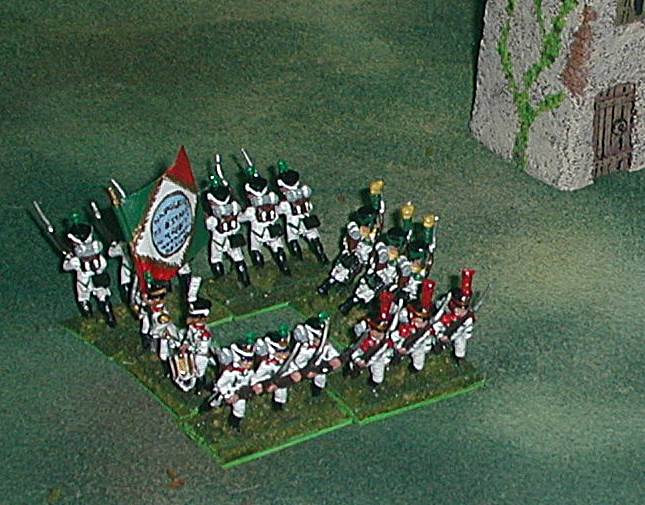
Be that as it may, this is my version of  the 1st Italian Line. The light blue sphere on the French-inspired "lozenge" style standard (hand painted) reads:
 NAPOLEONE
(Imperatore di Francesi)
RE D'ITALIA
AL 1 REGG D' INF
DI LINEA


The shako plates were brass. The colors of the company pom poms for the center companies were the same as their French counterparts, worn with white cords on the shako.


Like their French counterparts, the Grenadiers (Granatieri)had red plumes, epaulettes, and cords on the shako, while the Voltigeurs (Volteggiatori) had (usually) yellow over green plumes, green epaulettes with yellow crescents, and green shako cords.


Next is the 3rd Italian Line; like all the rest of my Italians, composed of Minifigs painted more than 20 years ago. I did update them a bit with some touch up and a coat of "magic wash".


Drummers wore red, white and green lace piping to the collars, cuffs and swallows nests (which were "in the facing color"). Drums were brass, with the rims painted with red/white/green diagonal stripes.


The grenadiers might also wear a bearskin in place of the shako, with red cords, plumes, and a red "cul-de-singe" with a white cross on the back, and a brass plate on the front.


This is my version of the 4th Italian Line regiment; note the coat of Arms of the Kingdom of Italy in the white lozenge, which appears on the reverse of the standards. 


Packs, greatcoats, belt, rank insignia, etc were all as per their French counterparts.


The Italian regiments adapted the familiar six company organization (one each of grenadiers and voltigeurs, four of fusiliers) about the same time as the French army did.


Here is my version of the 5th Italian Line Regiment. Oddly, the Osprey doesn't have a color plate with even a single figure from the Kingdom of Italy after 1806, an odd omission indeed!


Close up of the 5th Italian Line; like the French, they carried a gold Eagle at the tip of the pole, of slightly different design. Pants were officially white, but on campaign might be white or even brown, the later especially on service in Spain.

*****************************************************************

The uniforms of the Light Infantry (Fanteria Leggera) were once again inspired by their French counterparts  but with the short jacket and pants being dark green. Cuff flaps were rectangular. Buttons were yellow metal. Once again there are conflicting versions of the facing colors for the various regiments.

Von Pivka's Osprey gives the following, possibly pre-1811:
RegtCollarCuffsPipingWaistcoatTurnbacks
1stredredredgreenwhite
2ndyellowyellowyellowyellowyellow
3rdwhitewhitewhitewhitewhite
4thlt bluelt bluelt bluelt bluelt blue


While other sources give this version, at least from 1811 onward:

RegtCollarCuffsPipingWaistcoatTurnbacks
1st
yellow
yellow
yellow
yellow
yellow
2nd
red
red
red
green
red
3rd
orange
orange
orange
green
orange
4th
crimson
crimson
crimson
green
crimson


This is my version of the 2nd Italian Light Infantry, with yellow collars and cuffs, yellow piping on the lapels, turnbacks, and outer seams of the pants. In all versions, the regiment with yellow facings is noted to also have yellow waistcoats, which gives them an especially dashing appearance; the waistcoats for all other facing colors are always noted to be green. 


I have given this unit a rather elite appearance, with the Chasseur (Cacciatori) companies having green cords and plumes, the Carabinier  (Carabinieri) company in bearskins (without a plate in front), and the Voltigeurs in colpacks. 


Note the red sword straps of the Grenadiers; these were green for Voltigeurs and white for Chasseurs.  The cockade for the Italians was green within red within white, once again same as for France but substituting green for blue.  In general French figures can be used for Italians, with just a "paint conversion".


A brief note is also in order regarding the Dalmatian Regiment (no, they did NOT wear white coats with black spots!). This light infantry unit was raised from the newly aquired territories in Dalmatia in 1806. Uniform consisted of a dark green single breasted coat of Austrian style cut, with with scarlet collar (yellow for the Voltigeurs), pointed cuffs, and Austrian style turnbacks; white buttons. Pants were dark green of a tight "Hungarian" fit. Initially a round hat turned up at the side (rather like the Tyrolean Jagers) was worn, with red pom-pom for Carabiniers, Yellow for Voltigeurs, and green for Chasseurs. The hat was abandoned in favor of the shako in 1809; this had a diamond shaped white metal plate on the front bearing the initials "RRD"  (Von Pivka says RDI, probably in error - RRD is the abbreviation for "Royal Dalmatian Regiment" in Italian ) under the iron crown of Lombardy. Red epaulettes for Carabiniers, yellow epaulettes for Voltigeurs, and green shoulder straps piped in scarlet for the Chasseurs.


Part 2 will cover the Artillery  Cavalry, and Royal Guard of the Kingdom. Part one turned out to be more work than I had anticipated, largely due to the very confusing situation with conflicting sources! Troops from the Kingdom of  Italy saw action far out of proportion to the relatively small size of their army - Prussia in 1806-1807 (mostly sieges , in Spain from 1808 - 1813, against Austria in 1809, during the invasion of Russia in 1812, in Germany and Italy in 1813, and in defense of the Kingdom in 1814. A contingent of Italians will add a nice splash of color to your "French" forces, and are usable in many campaigns, as noted above. 

Sources and other sites for additional information:

Napoleon in Italy
Site has a wealth of information including the Italian Republics; sometimes hard to read the plates, etc, but well worth browsing! Also includes the Knotel plates on the Kingdom of Italy.

Italian Line Infantry 1807-12
Pretty much what bit says, no illustrations.

Troops of the Kingdom of Italy 1805-14
French language site, takes a bit of work to find what you want, but literally dozens of plates contained within the site

Hiostorex plate of Italian Line Infantry

Napitalia
Many useful plates of Line Infantry, Light Infantry, and Chasseurs a Cheval

Army and Uniforms of the Kingdom of Italy, 1805 - 1814
Italian Language site with good brief descriptions and illustrations

Hiostofig plates (5) on the Italian Royal Guard
Very well done; unfortunately nothing from them on the line troops.

Divertirsi!

Peter