Wednesday, August 17, 2011

Russian Infantry Pom-Poms and Shoulder Straps, 1812 - 1815

My posting on the Russian Jagers drew some interesting comments on The Miniatures Page, along with a brilliant graphic presentation of the Russian Pom-Pom schemes from a Russian website contributed by Bryce Allen here. I thought that the idea was so much better than just describing them that I'm going to use the idea myself to present the information on the Pom-poms, shoulder straps and related minor details of the Russian Infantry of this later Napoleonic era. So, here goes.


These are the pom pom colors for the various battalions and companies of a Russian Line and/or Jager regiment from 1812 - 1815; I'm not sure if these applied to Grenadier or Guard Regiments as I couldn't find anything on that subject, but some of the illustrations I saw in the references I consulted make me suspect that they do not apply exactly to those particular regiments. As discussed in my Jager post, the elite company in a Russian Jager battalion was called the Carabinier company, and was divided into a Carabinier platoon (corresponding to the Grenadier platoon in a Line regiment) and a Tiralleur platoon (corresponding to the Carabinier platoon of a Line Regiment).

The Grenadier companies (Carabinier companies for Jagers) as well as all companies of a Grenadier, Guard, or Jager Grenadier (established 1814) regiment also wore the tall, thin black plumes; NCO's also had the quartered pom-poms, colored as shown. The NCO's of the first platoon of the elite company of each battalion also had the plumes tipped with white, and with an orange stripe running across the tip from front to back; this evidently did not apply to the NCO's of the second platoons of the elite companies, hence the asterisk on the table. Cords on the shakos in 1812-15 were white for all except officers, who had silver cords. Finally, drummers and fifers in the elite companies (as well as all companies of a Guard, Grenadier or Jager-Grenadier regiment) had tall red plumes on their shakos; if they happened to also be an NCO they would also have the orange-red/white quartered pom-pom, and, in the appropriate platoons, the white tip to their plumes, complete with the orange stripe as well. Phew!


When the Russian Army switched from the old Inspection system and its associated facings colored according to which inspection the Line or Grenadier Regiment belonged, to the new "permanent" Division structure in 1806, the old facing colors were also gradually replaced, and all regiments had the same colors of cuffs and collars (red for line, later dark green piped red for Jagers).  In 1807 the above system of shoulder strap colors was introduced, differentiating the regiments by which position they occupied within their Division. The Divisional number was embroidered on the strap in Yellow upon Red straps, and in Red on all others.


In 1814, it was decided to change the shoulder straps of all the Grenadier Regiments (as well as the newly raised Jager-Grenadier Regiments) to yellow, with the initial letter of their Regiment's name (in Cyrillic) embroidered on the strap in red; at the same time the yellow straps in the old scheme were replaced, resulting in the new system as illustrated above. Confusing enough, eh?  Hopefully the graphic illustrations make the system much clearer than words alone. 

Many thanks again to Mr. Allen of the UK for the idea of using a graphic presentation of this information!

Peter


Friday, August 12, 2011

Russian Jagers, 1812

    The number of Russian Jager (Light Infantry) units increased dramatically over the course of the the French Revolutionary and Napoleonic Wars. There were roughly 20 battalions when Paul became Czar in 1797, then 19 regiments of 2 battalions each in 1801, 20 in 1805, 32 in 1808, and 50 by 1812 (Nafziger). Many of these were converted from  Musketeer Regiments; by 1812 there was roughly 1 Jager regiment for every 2 Musketeer/Infantry regiments; indeed, a standard Russian Infantry Division in 1812 had one brigade of 2 Jager Regiments, and 2 brigades each of 2 Line regiments.  Exactly how much difference there actually was in practice between the Jager units (especially the newer ones) and the Line units is open to question. The Jagers evidently did receive training in skirmishing at the battalion level, but it was not standardized until 1818; Russian skirmish tactics were generally inferior to those of the French and later Prussians. In 1812, there were three and sometimes even 4 battalions per Jager regiment; however, only the 1st and 3rd battalions served with the front line divisions; the 2nd battalion was a depot unit, and the 4th battalions, when raised, were entirely conscripts and served seperately in Reserve Divisions.

    Each 1812 Jager battalion had 4 companies of , 3 of Jagers and one elite company of Carabiniers (analogous to the Grenadier companies of the Line regiments). Each company nominally had 141 privates plus assorted other ranks; Russian infantry units were notorious for being understrength. The Carbinier companies wore the tall thin black plume on their shakos. To make matters more confusing, the Carabinier company was broken into 2 platoons, one of Carabiniers and one of Tiralleurs. In 1812, the uniforms of all the Jager regiments were identical, save only for the shoulder strap colors, which were yellow for the first regiment of each brigade, and medium to light blue for the second Jager regiment of each brigade. Within each regiment, the pom-pom colors on the shako varied by the battalion. In 1812, for the first battalion they were red for the carbinier platoon, yellow for the tiralleur platoon, and white with a green center for the jager companies. The pom-pom colors for the second battalion were top red, bottom green for the carbinier platoon, top yellow, bottom green for the tiralleur platoon, and green with a white center for the jager companies. The third battalion pom-pom colors were top red, bottom light blue for the carbinier platoon, top yellow bottom light blue for the tiralleurs, and light blue with a white center for the jagers.


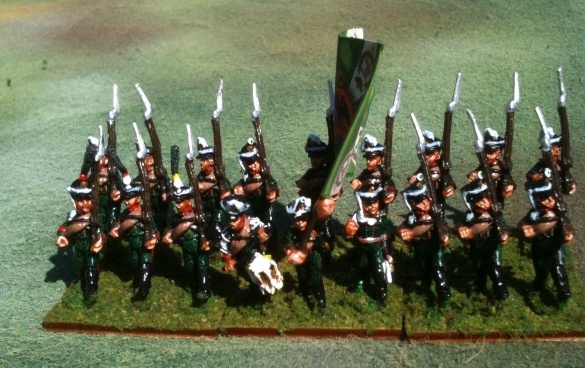
Here is our first unit; the white pom-poms with green centers indicate that this is a 1st battalion. Note that NCO's had quartered pom-poms.


The blue shoulder straps indicate this unit is the 2nd of its brigade.


The Jagers had black leather belts, unlike the line which had white.


The second unit's jagers have green pom-poms with white centers identifying it as a 2nd battalion.


This unit's shoulder straps are yellow, designating it as the first regiment of its brigade.


The Jager regiments have dark green collars, cuffs, and turnbacks, all piped in red, as was the outside seam of the dark green pants.


The third unit; all four units are Sash and Saber 28mm figures. The standard is incorrect; when I was painting these units I couldn't find a reference to standards for the Jagers; it turns out that's because they didn't carry any. One way for the Czar to save a few roubles, I imagine! I have fifer figures to replace the standards now.


The GMB standards are lovely, though... Note the white lace on the drummer's uniform; were he of a Carabinier company, he would have a tall red plume on his shako as well.


Rear view of the third unit; all of these pictures were shot outdoors, the first set on an overcast summer day in late afternoon, the second set near midday on a late autumn day (accounting for the shadows).

The fourth regiment defending a wall; the officer has shako cords and sash in mixed silver, black, and orange.


The goose step that these Sash and Saber figures are modeled in would have made the somewhat mad Czar Paul I proud; at one point he allegedly ordered the soldiers equipped with steel plates over the knees to encourage them to keep the leg straight when marching; no wonder he was murdered in his bed, leading to the ascension of Alexander I in 1801!


Another view of the 4th Jager unit; it really will be a shame to give up those nice GMB flags! I suppose I'll just have to raise some more Line units to use them...


A final view of the 4th Russian Jager unit; note the metal canteens strapped to the packs.


Till next time,

Peter

Thursday, August 11, 2011

The Russian are coming! The Russians are coming!

Sorry, not the punch line of a bad joke about a bunch Ruskis visiting a bordello, but rather announcing the onset of the home stretch painting for our Borodino project for Historicon, 2012. Czar Barry will be detailing some of the planning process for this massive undertaking on his blog, along with pictures of the units he is doing. I'll also be posting pictures of many of my own Russian Napoleonic units, both old and new. Hey, the Russians fought (if you can call it that) in the 1809 campaign too, allegedly on the side of Napoleon. Have no fear, I'll continue to post about French, Austrian, and Rhine Confederation units as well!  Hopefully there will be some playtest battle reports also.

In preparation for the onslaught of the forces of Alexander I on this blog,  I'm going to attempt to use the static pages feature of Blogger to post a roster of my Napoleonic armies, both existing and planned; this will doubtless further reveal the seriousness of my own megalomania, LOL! If it works, I'll do the same for my other forces (Ancients, Late Medieval/Renaissance, English Civil War, 15mm Renaissance Galleys w/ crews, 1:1200 Napoleonic sailing ships, and Superior Starfleet Wars spaceships) as well as my publications (stealing an idea from Eric Burgess there).

Anyway, there should now be a sort of toolbar across the bottom of the blog's header, with a tab for Napoleonic Troops; if you click on it, it should give a rather more detailed listing than you might want of my painted troops, which number just a few shy of 5,000 figures as of today.  The other tabs are just place holders for future information for the time being.

Meanwhile, back to painting Russian Cavalry!

Peter

Tuesday, August 2, 2011

French Napoleonic Line Horse Artillery

Horse Artillery, where the crew are mounted and/or ride upon the limbers, etc., date back to Frederick the Great, but saw wide use starting with the French Revolutionary and Napoleonic Wars. Mounting the gunners made them more mobile, so as to either accompany Cavalry formations, and/or be used as a mobile reserve, more easily repositioned than their foot slogging brethren. The first French Horse Artillery was formally organized in 1792, initially wearing uniforms similar to the foot units; within a few years they adopted uniforms reminiscent of the chasseurs and hussars in style, if not coloration. They certainly considered themselves the elite of the Line artillery; horse artillery was certainly expensive to maintain!

In 1804 there were six regiments of six companies; some regiments later added a 7th company with the absorption of the Dutch Horse artillery (1810) and other expedients (1813), rising to possibly 8 companies by 1814. Each company crewed a battery, usually composed of six of 6 or 8 pounder guns, but sometimes 4 pounders were used; howitzers could be substituted for two of the guns. the composition of a company, even  theoretically, varied somewhat over time, but generally included roughly: 4 officers (1-2 Captains and 2-3 Lieutenants), 10 NCOs (1 Sergeant Major, 4 sergeants, 1 Corporal, 1 Fourrier), 24 Gunners 1st Class, 35 Gunners 2nd Class, four metal workers, four carpenters, and 2 trumpeters.

When I first planned my "new" French Napoleonic Army, I had only two units of these superb troops. Dating back to my original Scruby armies of the 1970's, I've used 2 mounted gunners and one of foot to really make it clear that these are HORSE batteries; indeed, I believe this may even have been Jack's suggestion in his catalogue! For most nations, if there are no specific mounted horse artillerists, their Light Horse and/or Dragoon figures will be suitable.


This is my First Horse Artillery Company (The term Battery didn't come into general use until well after the Napoleonic Wars); Foundy figures and Minifigs guns. They wear the flamboyant Hussar style uniform (sans pelisse, although Horse Artillery Officers often wore them in place of or with the dolman). Being the first battery, it of course includes a mounted trumpeter!


Here we get a good view of the trumpeter, wearing reversed colors on his dolman, i.e, a red jacket with dark blue braid, collar, cuffs and turnbacks, the later with red grenade emblems. Like the cavalry, he is mounted on a grey, and his sheepskin is black with red "wolf's teeth" edging.


If this was post 1811, he would presumably wear that boring Imperial livery - green jacket with dark blue collar, red cuffs and turnbacks, and the special red/yellow/green lace liberally applied.


This is my second Horse Battery, again Foundy figures with Minifigs guns. The gunners wear dark blue dolmans and pants, with dark blue (or sometimes red) collars, and red cuffs, red turnbacks (with dark blue grenade ornaments), red lace on the dolman, red stripes down the outside of the pants and red knot or spearhead decorations of the thighs,  as well as red plume, shako cords, and light cavalry edging and tassels on the boots. The trooper s have white sheepskins with red wolves teeth edging.


Another view of my second Horse Artillery company; to show a limbered battery, the gun model is reversed and placed behind the stand, muzzle pointing backwards. For all, the buttons and shako plates are brass. Barrell sashes are dark blue and red alternating. The sabretache should have the regimental number in gold, often over crossed cannons, and a green laurel wreath design, details not painted on here,


A final view of the 2nd company, note the buckets! Evidently, there was an official pattern to the color of the horses assigned to each gun of the battery. In 1812 the official colors of horses for the 8 pieces in every battery were: for the 1st cannon - whites, 2nd cannon - pales, 3rd cannon - red bays, 4th cannon - chestnuts, 5th cannon - bays, 6th cannon - blacks, 1st howitzer - brown piebald, 2nd howitzer - black piebald.  Doubtless this would have been difficult to maintain in peace time, and in war time... surely impossible!


As I started expanding my French Infantry (and running bigger scenarios, starting with Austerlitz in 2005), it became clear that I needed to add another Horse Artillery company. Just as the Empire became increasingly strapped for cash, having four mounted figures per unit was getting to be expensive. Here I used the four left over figures from the 20 man Sash and Saber Chasseur a Cheval Regimental pack to depict the less flamboyant uniform of the later Napoleonic wars. The gunners on foot in this unit are Minifigs.


Gone are the cords, plumes, and most of the lace - at least from the mounted figures. The Captain does wear a Colpack, and has gold epaulets and other ornamentation. He might even at this late date still sport a dark blue pelisse with gold braid and black or grey fur. If he had the shabraque on his horse, it would be dark blue with gold edging. Barrell sash, if worn, would be gold and dark blue. Senior officers (colonel) had white plumes, when worn at all.


A final view of my 3rd company, showing the gold edging on the bag of the officer's colpack, as well as the gilt buttons and red stripe down the outside seem of the pants. Note also the improved horse painting compared to the original two units!


Well, then came Czar Barry's Borodino


My 4th, 5th, and 6th Horse Artillery companies in a firing line; Old Glory figures with Sash and Saber Cannons.

Final view of the last three companies from behind. In real life six guns would form just one battery, and the guns would be spaced out much more, with the ammunition wagons stationed well behind the gun line. BTW, Marmont was colonel of one of these regiments (the Second) from 1796 - 1799, until he was promoted to Brigadier general, and of course ultimately Marshal of France.


Until next time - Good Gaming!

Peter

Tuesday, July 26, 2011

Renaissance Trilogy (Historicon pt 5)

Thankfully, having gotten to bed at about 2AM, I had scheduled my Saturday game(s) for the civilised hour of 11AM; as this was really 3 games in one, made possible only by having Dave M. and others assist me with the GM chores, I still planned to get started setting it up around 8:30 AM. As luck would have it, Tim and I ran into Bob Jones on the way into breakfast, and he sat down with us and had coffee while we discussed his latest rules projects, Zouave II and Die Marching! Having succeeded in both entertaining us and making us late for setting up the game, he then vanished until later, LOL! 

This event was a kind of three ring circus, using a 6 foot by 20 foot table to run three events simultaneously, using the Band of Brothers 2nd edition rules by Piquet, covering the Late Medieval/Renaissance era, 1200 - 1600. These are, of course, the most perfect wargames rules in existence, having been written by yours truly, with considerable help form many others, most notably, my co-author, Ken Baggaley. In all seriousness, I think the Piquet card deck mechanisms work fantastically for this era, making it easy to model Uncontrolled charges and Undisciplined Advances by impetuous troops (like Swiss Pikes and French Gendarmes), as well as a host of other unique situations and tactics. Classic Piquet based rules really work best with 1-2 players a side, although I have used mechanisms allowing up to 6 players a side for very large games. That is part of the reason for doing the simultaneous games - it displays the system at its best (and the way most people will probably play it back home).  We used Eric B's Charlotte "Rule of 1/3" for impetus for these games, and I have to say that I think it is the perfect compromise. Once again, the better pictures are by Gabriel F, denoted by (GF).


Sudomer,  March 15, 1420:    Hussites vs. German Crusaders

The Hussite rebellion, having both both a Czech nationalist and especially religious elements, was triggered by the condemnation of Bohemian theologian Jan Hus as heretic by the ecclesiastical Council of Constance in 1414, followed rapidly by a several months long trial, resulting in his being burned at the stake in 1515. He had been given guarantee of safe passage by Sigusmund, Holy Roman Emperor, but this was held to be non binding on ecclesiastic authorities, as well as invalid because the recipient was a heretic. As one might imagine, this didn't play well back in Prague, and ignited a series of events that became the Hussite rebellion. Jan Ziska became the Military leader of the movement. As most (but not all) of his troops were essentially peasants, he utilized a system of War Wagons to create mobile fortresses to nullify the advantages of the enemy's knights. He was also an early adopter of both light field guns, often mounted on wagons themselves, and hand firearms. Sudomer was the first test of this system, when a Hussite force was intercepted on its way to Tabor by a group of Royalists. Ziska used fishponds to anchor the flanks of his Wagon fortress, obliging the Royalists ("Crusaders" against the Hussite heresy, which included the insistence that the laity receive Communion in both kinds, i.e., the bread and the wine both, according to their reading of the scriptures).


Michelle moves up her wing of the Crusaders, as the other Catholic player does the same on his side of the table. They (wisely) decide to send the infantry in first, and hold the Cavalry back for later.


The two forces engage along the length of the Wagon Fortress, the Hussites trying to make maximum use of their crossbows, handguns, and light artillery. The beer bottle is appropriate, given the fame of the products of the Czech brewmeisters!    (GF)


Close up of the War Wagons; a stylized chalice was a chief emblem of the Hussites, symbolizing their demand that the Cup not be reserved solely for the clergy.     (GF)


Hussite players Steve K and Gabriel F check the combat tables!    (GF)


Overview of the engagement along the line of wagons...    (GF)


Closer view of the action; note the Hussite sequence deck and Impetus clock.    (GF)


The Hussite defenders have repulsed the first attack; my Hussites are all by Old Glory, and are very nice figures; most of the "Crusaders" are my 30+ year old Minifigs Teutonic Knights from their Alexander Nevsky range; a bit anachronistic, but not too badly so!    (GF)


The Hussite Cavalry stands in reserve, prepared to seal off any break throughs by the Crusaders; unlike some other times I've run this action, they were never needed, the Royalists eventually giving up and withdrawing. The Hussites would be undefeated for the next 14 years, until internal squabbling culminated in defeat of the radical faction by the moderates at the battle of Lipany in1434. Many of the same issues raised by the Hussite movement would surface again in the next century, this time gaining permanence under Martin Luther.    (GF)


The Battle of Ceresole, April 14, 1544:   France vs. Hapsburgs/Imperialists

This was one of the last battles of the Great Italian Wars between the House of Valois in France and the Hapsburgs of the Holy Roman Empire and Spain. The Swiss are now merely good infantry, not the almost unbeatable supermen of 100 years prior. I served as GM for this action, a more or less open filed encounter that took place in Piedmont.

Overview of the table after the initial French advance; as I commented, if you play the French in the Italian Wars, they are pretty much going to attack whether you want them to or not, so you might just as well make it work for you instead of struggling against it!    (GF)


Imperialists Cuirassiers use their pistols Caracole fashion to wear down the French lancers, while a unit of  allied Italian foot comes perhaps a bit to close to an elite Spanish Tercio.


On the Imperialist right, a series of maneuvers and counter maneuvers has resulted in the destruction of their cavalry on this flank, but on the bright side, the Imperial Landsknechts on the ridge made short work of the rather poor Gascon pikes, seen routing in the distance.


I help the Imperial player work out the combat between Swiss pikes and his own Italian allies.     (GF)

Can you say "Push of Pike"?    (GF)


The Swiss have pushed back the Imperialists; honors of the day went to the French, the Imperialists reaching zero morale points after the cavalry on their left flank was also defeated.


The Battle of Cerignola, April 28th, 1503:    Spain vs. France

Usually cited as thew first battle won primarily by infantry equipped with firearms, this battle resulted when the French army under the Duke of Nemours, came upon the Spanish under Gonsalvo de Cordoba, "El Gran Capitan" of Spain. The French had been chasing Gonsalvo across SOuthern Italy, trying to bring him to battle, but he awaited his own terms. The French army had spent a long, hot day marching, and Nemours proposed that they should rest and attack min the morning; his subordinates would have none of it, and insisted on an immediate attack. After some debate, this was placed into motion without any effort being made to scout the Spanish position. As it turned out, Gonsalvo had good reason to stand and offer battle here, having prepared a position on a low ridge behind a stream, backed up by hasty earthworks.


The initial French advance; both Cavalry wings have advanced to the stream, whilst the three pike blocks fall behind somewhat, screened by skirmishing crossbowmen.


The Spanish players take comfort in the strength of their position; on the other hand, these are still the Swiss of legend, with fire in their bellies; even should they rout, they will rally again at the first  opportunity! 


Dave M acted ably as GM on this battlefield; French player Greg K is to his left. The Spanish Cavalry on both flanks have been defeated, and the Swiss are assaulting the ridge position!


Tim C., reprising his role as Grima Wormtongue, gives French player Rob B some tactical advice.


It looks like Tim's advice worked out for Rob... or did it?!


This was an incredibly hard fought battle, with the Spanish repulsing several pike attacks; ultimately, though, their Morale Chips ran out and the French were victorious. This is the 5th time I've run this scenario, and the first time the French have managed to win it!


We finally wrapped up Cerignola around 4PM, and packed up all the troops, terrain, etc. once again. As always, my deep thanks to all the players who who helped with the cleanup, and my assistant GM's; only that kind of assistance makes it even possible to pull off something like this!


Once everything was packed up, Tim and I retired to our room to rest for a short while. We then met Bob Jones, Jim Getz, Ian Black, John Holly and Sam Mustafa at the Radisson bar for drinks, and then proceeded to dinner at a fantastic bistro about 20 minutes from the convention center that Bob had scouted out - the exceptional quality of the food and drink was exceeded only by the liveliness of the conversation! Unfortunately, planned attendee Adolfo Laurenti from Chicago had to cancel at the last minute due to problems back home, and was sorely missed. Returning to the Radisson with blood alcohol levels well over any state's legal limits, both Tim and I chilled in our room for a few hours before retiring. 

Sunday morning saw a pre-arranged breakfast meeting at Ruby's Diner, located at the King of Prussia mall; this tradition was started last year when John Mumby and Terry Schockey from Colorado had treated Tim and I to breakfast on  Sunday morning; this time there were 10 or so of us from the Piquet/FoB crowd including myself, Tim, John, Eric, Gabriel, Michelle, Brian, Dave, Greg and Steve, if my memory is correct; Terry didn't make it to Historicon this year, so Tim and I only had to pick up John's tab. Terry of course is liable for the whole group's tab next year!  :-)

After farewells and returning to the Convention center, Tim split up to go with John to the Airport in Philly (as well as diverse detours, I'm told). I decided to forgo my traditional final sweep of the Dealer's Area in favor of an earlier return home. Barry once again helped take excess troops off my hands so that we could get it all back to Connecticut. This time I made the trip in about 3 hours and 40 minutes, absent any detours and with much lighter traffic; as I neared home the radio was playing the Marseillaise, as arranged by Hector Berlioz and featuring Placido Domingo as the tenor, in honor of the upcoming Bastile Day; a very suitable and inspiring sound track for the final leg of my Historicon Journey. We're already thinking about what games we want to run next year, and hope to encourage still more of our friends to run games at Historicon 2012; Barry will be doing Borodino for sure, with troops contributed by many of the HAHGS members.

Hope to see you next year at Historicon... exact date and location to still TBD!

Peter

Saturday, July 23, 2011

Neverenufkski, circa 1813 (Historicon pt 4)

This game was played Saturday night using Field of Battle, 2nd edition (more or less). It was a fictional action set in Central Europe, circa 1813. The OOB was  a subset of that planned for our big Borodino game next year, with an emphasis on some of our Napoleonic troops that seldom see action on the tabletop. That explains the relatively large number of Guard and Elite units that will appear. Some of the figures used date back many decades (such as my Minifigs Austrian Cavalry), and others were just painted in the past few months and seeing their first action (such as my Grand Duchy of Warsaw Cavalry and Barry's Russian Combined Grenadiers and Cossack Battery, the miniatures for the later by Steve Barber Miniatures, IIRC).

The name of the battle is sort of a joke that there are "Never enough" troops; at Waterloo, Marshal Ney asked Napoleon to send him more troops. Napoleon remarked to his aides "More Troops? And where does he expect me to get them from?  Does he expect me to make them?!"   Of course, being wargamers, *we* can always buy/paint more, subject only to time (and the oversight of the Empress on the Imperial budget, of course!) In the event, there were actually probably a bit too many troops on this field, even using a 16 foot long by 5 foot wide table, something that will likely modify our plans for Borodino somewhat to include a bit less infantry (by changing the scaling factor) and a bit larger table!


Overview of the 16 x 5 foot table as players make last minute adjustments to their deployment, French to the left, and Allies to the right. Seen clockwise are Dan B. (Marshal Davout), Eric B. (Napoleon), GM Czar Barry (minus head), Brian C., Herman, Greg K., and the back of Tim C's head (to complement the anencephalic Czar, it would seem!)


Looking from the other ends of the tale, clockwise are Dave M (Russian Line Corps)., Rob B.  (Russian Left Wing cavalry), the now intact Tim C, ?, Philip K (French Right Wing cavalry), Michelle F (Italians, Badeners, Bavarians and Poles) (obscured is Gabriel F - French, more Poles, and Hessians), and Eric B (as Napoleon, commanding the Infantry, Cavalry, and Artillery of the Imperial Guard).


Part of the large Russian Corps commanded by Dave M. Speaking of headless gamers, Dave managed to have both one of his Divisional generals and later his Corp commander as well die on D20 Leader survival checks - anything but a "1"! Maybe he had the Hurricane Dice, eh? Anyway, don't Barry's Front Rank troops look impressive - especially the solid wall of Russian ordnance?


Another long view of the table set up; the slips of paper have the composition and ratings for the various player Commands on them.


Close up of Michelle's command - Italian Footguards in the forefront, with Grand Duchy of Warsaw infantry behind them, then Badeners, then Bavarians. The French have their own artillery park to the fore as well.


Russian Left Flank cavalry, featuring Barry's beautiful Front Rank Russian Dragoons. In their first two outings, these Dragoons have established a record of under performance so impressive that the Czar has threatened them with Ebay if they don't improve their performance this time!


Barry's Front Rank Russian Uhlans. The Czar was seen whispering to them  "C'mon, guys - you're so much *bigger* than those puny French cavalry!"   (which are mostly Old Glory and Foundry)


French Legere and Ligne in overcoats, supported by more Polish infantry, and some Hessians in the distance, part of Gabriel's command. 


Italian Footguards wisely form square as the Russian Dragoons surge forwards, eager to avoid the ignominy of the threatened auction!


French Infantry advance in the Center.


French Line, backed up by Imperial Guard Infantry. Beyond them is a Grand battery of 3 Imperial Guard Artillery units. These made very effective use of 3 Artillery Firepower cards (plus Eric's hot dice rolling) at the outset of the battle to decimate the Russian Imperial Guard infantry opposite them!


French Infantry continue to advance in the center.


Russian Cossacks charge boldly into French Infantry in line, supported by a light Cossack battery - the sheep and pig denote units that are Out of Command.


Not surprisingly, the Cossacks appetite for Glory is diminished somewhat by close range musketry.
"Igor, dey has very tough Caviar hereaboutski, nyet?"


Michelle's Poles (more of Barry's Front Rank figures), supported by Kingdom of Italy troops (my Minifigs), as seen from the player's perspective.


Dave M's Russian Infantry Corps, supported by Rob's Russian Cavalry.


Another picture of the action on the French Right/Russian Left.


A nice view of Dave's Russian Corps from the side.


Just a few troops going at it in their sector!


Badeners and Bavarians advancing in support of the Poles


The Cossack charge was repulsed, but it seems that part it was a clever ploy to draw off French fire, and allow the cavalry of the Russian Imperial Guard to charge across the table in attempt to silence the (now unloaded) French Imperial Guard Artillery. "Into the Valley of Death rode the Several Hundreds!"


The Russian Guard Cavalry succeed in eliminating the Guard artillery to a man... but the Middle and Old Guard are up for blood now, as they hit the Empress Cuirassiers in the flank!


Frenchies maneuvering in the center.


Furious hand to hand combat over the village in the middle of the table!


On the Russian Right/French Left flank, the action has taken a while to develop as both sides had cavalry Divisions without infantry support, and a large woods to circumvent.


French (etc) Light Cavalry take the initiative; the French Hussars have fallen back after taking canister from an Austrian Cavalry battery, but the Chevau-Leger Lanciers, GD Warsaw UhlansCuirassiers.


On the opposite flank, in what seems like the twinkling of an eye, Philip's French, Saxon, Wurttemburg and GD Warsaw cavalry have overwhelmed the Russians, the hapless Russian Dragoons dissolving in combat once again! Barry, I'd change their facing colors to Pink, Fuscia, and Diarrhea Tan! 


In the Center, French, Bavarians, and Badeners press Dave's Russians.


View from behind Michelle's troops - Dave's Russki infantry has thinned out considerably, as I (blue shirt - headless is the style for this evening, I guess) finally have a seat to watch the evolution of the combat!


Napoleon (Eric B) *finally* gets the Old Guard Infantry and the Imperial Guard Cavalry to advance, having rolled "ones" for the Leadership dice of their Commanders several times in a row. "Monsieur Aide de Camp, who are *you* to issue orders to the Guard? We engage only upon hearing the word from His Majesty's very lips!" 


Dave's Russians continue to thin out, so Allied C-in-C Greg K. decides to call for the Austrian Grenadier Reserves to retake the central village!


Napoleon to Davout - "Get your Divisions moving, Monsieur le Marechal, and draw the fire of the enemy; I shall follow behind you with the Old Guard and mop up what remains!"


Russian Artillery and Infantry fire have convinced these Boys from Baden to head for the rear!


Davout's men advance, and are met by the remnants of the Russian Foot Guards.


Austrian Grenadiers, and yes.... pike armed Moscow Militia can be seen approaching in the distance.


Long view of the table at about this point; all of the Russian Cavalry on their left have been dispersed or routed, leaving half a dozen units of French cavalry on the flank of Dave's Russians. "I have a Baaaa-d feeling about this!"


The infantry combat in the center grinds on, by musket ball and bayonet, each in its turn.


The now unopposed French cavalry are causing many Russian Musketeer regiments to form square for protection!


Davout's attack grinds down Herman and Greg's Russians.


Forced into square by the French Cavalry, the Russian infantry suffers heavily from Italian close range musketry!


Having ridden down the Austrian Cavalry battery, the French Left Flank cavalry engages the Russian and Austrian horse, with neither side able to gain a decisive advantage.


At this point, the Allies reach zero Morale points (and below). The French have at least 20 left, and the Allies are paying them still more. The Allied position is untenable - their left flank cavalry have been eliminated, while Dave's Russians have taken heavy losses and are outflanked. The French hold the central village, and Davout's attack (with plodding support form the Cavalry and Infantry of the Guard) is poised to  break through the Allied right center; only the swirling cavalry combat on the far Allied right has been completely indecisive. The Czar orders a withdrawal, leaving the field and a hard-fought, Major (but not decisive) victory to Napoleon.  


Editor's Note:  the table was more crowded than desirable, especially in the French Left center, something that we'll adjust for in refining Czar Barry's massive Borodino scenario for Historicon next year (wherever and whenever that will be; hopefully the details will be settled shortly). With all of the players being experienced in the Field of Battle rules, the game moved on a quite a brisk pace; still, having started a little after 8 PM, it wrapped up well after Midnight. Eric and I kept going with Painkillers (although I'm licensed to prescribe the real things, here we're talking about the British Virgin Islands version$$), and most of the other guys wit beer and other spirits. The LA Piquet Kult, courtesy of Steve K, provided a very welcome midnight pizza to fuel the hungry players as well - a class gesture!  Even more welcome, at least to Barry and I, was the generous help of the players in packing it all up and carting it all away; having started setting up the first game of the day before 8 AM, it was still not until 2 AM that my head hit the pillow; needless to say, sleep followed *very* shortly thereafter!


"We never, ever, ever give up!"   (Motto of the LA Piquet/FoB group)

Peter

$$ - BVI Painkiller:  1 oz cream of coconut, 2 - 4 oz Dark Rum, 2 oz orange juice, 4 oz
pineapple juice; blend and serve over ice cubes, dash of grated nutmeg on the top (it really makes the drink!). Slips right down, especially beach side, and MUCH stronger than it tastes!

I made one mistake: freezing the mixture for the trip down, which made the wonderfully saturated fat in the cream of coconut partially congeal; I could have fixed that with a blender, but unfortunately, I didn't bring one... this time!   :-)