Friday, October 4, 2013

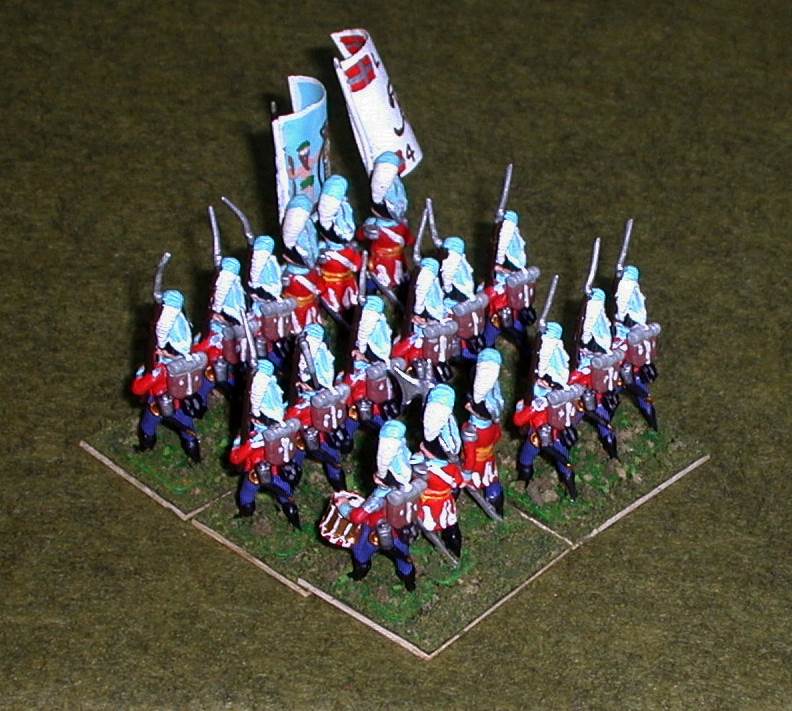
NKE Archers

These are some shots of the units of New kingdom Egyptians I painted up rather rapidly this winter in preparation for the game I ran at HAVOC this past March.using the gridded /Charlie-David Sweet Ancient rules  I had prepared the game on short notice, so with Historicon behind me, I finally had the time to terrain the bases with a mixture of sand and talus, plus some Silflor clumps. Originally I had planned to use the rather tan/yellowish "winter" tufts, figuring that would be best to represent vegetation in an arid environment, but it turned to be too close to the color of the sand and talus, and thus nearly invisible; the Summer tufts were thus called into service instead. I loathe basing, and spend as little time as possible on it. Considering that, I'm pretty happy with how these stands came out!


A "unit" of Light Infantry Archers.


The red stripes on the headress identifies them as belonging to "Division Amun", at least in my scheme!


egyptiangods_god_amon_hiddenone.gif 
(172 x 414 x 128) (13884 bytes)
Amun, one of the chief gods of Egypt


Mostly 25mm Old Glory figures, with a few odds and ends of Garrison models as fill-ins. 


More OG Archers; you can see that the "Magic Wash" worked very well to pick out the folds of their "kilts".


Once again, the high percentage of Command figures in the 30 figure Old Glory sets (great value!) meant I had to work to use them all.


The yellow stripes, etc identify this unit as being from "Division Re" in my scheme. 


egyptiangods_god_ra_profile.gif 
(78 x 170 x 64) (3207 bytes)
Ra: at one time king of the gods of Egypt; and god of the sun; rode "the boat of millions of years" across the sky in the day,  and a different boat across the underworld at night.


Another unit of archers. These guys look well fed, and like they put in some serious gym time, LOL!  Maybe they saw "The Five Hundred" and felt they needed to bulk up to compete!  :-)


The blue stripes and other accessories identify these guys as belonging to "Division Seti"


egyptiangods_god_set_chaos.gif 
(120 x 180 x 256) (8056 bytes)
Seti (or Set); Egyptian god of Chaos.


The greenish "leather" armor is supposed to represent crocodile skin; probably dark brown would be more accurate, but then it would hardly show, now wood it?


Another archer unit, this time incorporating a "standard bearer" and a hornist.


I have some spare figures and will probably add another stand of 2 figures to each of these units; as I was in a rush, I painted no more figures than absolutely necessary!


Green is the distinctive color of "Division Ptah" in my scheme. 

Ptah standing.svg
Ptah was the Egyptian god of Creation, and of craftsmen.


Her's a 5th unit with dark red as a distinctive color.

Could be a 2nd archer unit in Division Amun... but that might make the other gods jealous if his Division has more troops than theirs!


With the other units, that makes a total of 30 archers. I'll need to add some close order archers as well eventually...


Peter

Sunday, September 29, 2013

Danish Army of the Napoleonic Wars, Part 6: Light Cavalry

In contrast to Norway and Sweden, Denmark is rather flat and actually quite suitable to the operation of cavalry. Thus, the Danish Army included a fairly good proportion of it.

Organization of the Danish Light Cavalry

There were three regiments of Light Dragoons in 1801, each of four squadrons. Book strength for the squadrons was 160 men, but they averaged closer to 120 men in the field. A fourth regiment was added in 1808. There was also a Hussar regiment of 4 squadrons, later increased to 6 squadrons. The regiment also included an additional single squadron of Lancers, the Bosniaks.

Uniforms of the Danish Light Cavalry

Light Dragoons

The Light Dragoons (Lette Dragoner) wore a short red jacket, similar to that worn by the infantry. All regiments had buff colored frontal turn backs (long jackets and conventional turnbacks for officers, once again) and white metal buttons. A "Tarleton" type helmet was worn. The turban on this varied in color by the regiment, as did the facing color which appeared on the collar, cuffs, lapels, and shoulder straps.  A white plume tipped with red was worn on the left side of the helmet until it was abolished in 1813. Pants were dark blue with a broad red stripe down the outside seams, with white metal buttons. The shabraque (saddle blanket) was red with white  (silver for officers) borders and ornamentation (see drawing). Officers wore silver epaulets and the crimson and yellow striped sash until 1812, when both were officially discontinued and replaced by rank markings on the sleeves similar to those used by the Infantry (see Part 3 of this series). Boots and cartridge boxes were black, white belts. Trumpeters had wings in the facing color with piping and tassels in the piping color, and may have had red crests on their helmets.


Regiment
Facing Color
Piping
Turban
Liv Regiment
Black
Lt Yellow
Red
Jutland
Dark Green
Lt Yellow
Dark Green
Funen
Light Blue
Lt Yellow
Light Blue
Prince Frederick *
Black
White
Red

*Raised as the Zealand Regiment in October 1807; renamed in December 1807

Hussars

The Danish Hussars wore a fairly standard Hussar pattern uniform, with a light blue dolman with carmine (red) collar and cuffs, with white lace piping. The Pelisse was carmine red with black fur, buttons and cording were white. A red and white barrel sash was worn. Belts were brown leather. Fawn coored pants, dark grey with a red stripe and buttons down the outer seam for undress wear. Shabraque was carmine red with a light blue "vandyking" pattern to the border, piped in white . Sabretche was light blue with white royal monogram in the center, red "vandyking" border piped in white. It was suspended by red slings with white metal fittings.Harnesses were black with whiite cockle shell ornamentation.

Headwear was a black "Tarleston" type helmet with a red turban and a white plume tipped in red on the left hand side from 1801 - 1807;. In 1808, a tall black cylindrical shako was adopted, with white tape ornamenting the top and bottom, and in a diagonal across the front. A silver badge with a red center was worn on the front of the shako. Thin red cords were worn on the shako (red mixed with gold for officers). Evidently a black fur Colpack in the French style was another authorized option for head wear.

Officer's dress was similar to that of the men, except with silver substituted for white. I have no information about the dress of the trumpeters.

The Bosniaks

This squadron of Lancers attached to the Hussras had a uniform in similar colors. From 1801 - 1807 they wore a rather exotic uniform, with a light blue cossack style jacket, with red facings. An Arab style red Fez with a white turban and white ostrich plum feathers was worn on the head. The pants were light blue. There is an image of this unusual costume, which differs in some details from the above, in the NYPL collection, here.

From 1808 -  1815, the uniform changed to a more standard Uhlan style, with a light blue jacket and red facings, light blue pants, and a cazpska with a red top and white plume. Shabraque was probably the same as for the Hussars. Lance pennons ?? red over white. No information is available to me about the dress of the officers or trumpeters. The only picture I could find of this later style uniform is this one, again from the NYPL collection; I have doubts as to it's accuracy.


Now, on to some pictures!


This is the Funen Light Dragoon Regiment (Fynske Regiment Lette Dragoner)
\

Light blue facings with light yellow piping, light blue turban with thin white diagonal stripes on the cloth turban.


Once again, the pairing of the red jackets with the dark blue trousers is very attractive!


The Danish Hussars (Hussarregiment). I can't recall if these Minifigs were specifically designed to be Danes or not.


A somewhat blurry side image. At the time when I painted these troops, I didn't have the detail about the saw toothed edge to the shabraque available to me. 


Likewise the sabretache was painted without some of the details I posses now. Still, quite a handsome unit!


The Bosniaks - a single squadron of Danish lancers! 


These are Minifigs Grand Duchy of Warsaw Line Uhlan figures, IIRC. Some of the details of how I have painted them are necessarily somewhat speculative, given the limited information available.


I think you could drive your local Grognard crazy asking him to identify *this* unit on the tabletop, eh?


Next time - the Danish Heavy Cavalry

Peter

Friday, September 27, 2013

Spacing Out?

** We interrupt your regularly scheduled Danish for some coffee... Nah, rather a digression into Wargames - in - Space! **

I have been doing a lot of thinking about Sci Fi Naval gaming recently. Unfortunately, that is all I have been doing!  I really need to put some ships on the table and roll some dice!. Anyway, my thought shave variously involved Star Navy 5150, Galactic Knights, and Piquet.


First, I want to try out the Star Navy rules; I got the PDF six plus months ago, and read through it once. I finally printed it out last week and read through it again. I suspect I'll find it a bit too generic for my tastes, but maybe not. In any event, the part I was really after was the scenario generation and campaign system, which looks quite brilliant. I can't really relate that well to the factions in the rules, though. As I use the Superior Starfleet Wars (SFW) ships (now Galactic Knights), I thought I'd start by doing a cross walk between the Star Navy factions and ships, and those of the GK setting.  So, here's what I came up with:

Star Navy Ship Classes and SFW/GK Ship Types:


Class 3  (4 Hull Points, Max thrust 4, 2 x 45 deg turns max): SD and SDL

Class 4 (8 Hull Points, Max Thrust 3, 2 x 45 deg turns max): SC

Class 5  (12 Hull Points, Max Thrust 2, 1 x 45 deg turns max:  GB and GD

Class 6  (18 Hull Points, Max thrust 1, 1 x 45 deg turns max) SGD


Star Navy Factions and SFW equivalents (for my purposes, at least)


Free Company - Aquarians

Star Navy  and Planetary Defense Forces - Avarians

Hishen - Carnivorans

Xeog - Entomalians

Zhu - Zhu - Terrans


As my largest fleets are the Carnivorans and Avarains, my first games (and maybe campaign) will involve them (aka Star Navy vs. Hishen). I also want to play some more games with Galactic Knights as well, exploring the concepts and various weapons systems further, and perhaps adapting the Star Navy 5150 campaign system for use with those rules.


Piquet in Space?

Finally, I still find myself tempted to Piquetize combat in Space. My thoughts would be to use the opposed variable die size system from Piquet for combat, and may be the line listing style of ship sheets as used in the old Starfire games to keep things fairly simple. For basic weapons and defense systems, the die types would be something like this:


Shields: used by the ship to oppose the Weapons die roll for all energy type weapons
None - D4
Level 1 D6
Level 2 D8
Level 3  D10

Armor: determines the number of "pips" difference between the opposed die
None:  2 pips per "hit"
Level 1: 3 pips per "hit"
Level 2: 4 pips per "hit"
Level 3: 5 pips per "hit"

Crew Quality: used for "Morale" rolls, repairs, and by comparison with the enemy, as a modifier to weapons and or defensive dice.
Green  - D4
Trained - D6
Veteran - D8
Elite - D10

Weapons (Kinetic, Beam Rail Gun, Missile,...)  Modified by range and size/speed of target
Level1 - D6
Level 2 - D8
Level 3 D10
Level 4 D12
Level 5 D12 +1

AA (anti missile/anti-aircraft defensive fire)  _this is probably a number of shots, maybe using Level 1 Beams as in GK?

Another decision would be whether to use Jump Points a la Starfire/Weber's books; an advantage of this is the strategic importance of Jump points as well as their locations. Downside is the necessary record keeping. Thus it is probably simpler to stick with an unrestricted Jump Drive, except on a scenario basis.

Some weapons might have special effects , including Piquet style "at least one system lost" and Double, Triple etc the defender's roll.  This could also determine Critical Hits, and/or ship Morale checks?

Ship/squadron/Fleet Morale and some for of Piquet style Morale points to force battles to a decision before every last ship is venting plasma.

Initiative:  Charlotte Rule of 1/3 vs FoB style -.Movement by squadrons?

I think this one would work well using the Hand of cards - # dependent upon Admiral Quality? Obviously,  MOVE cards would have to allow movement by both sides, but with some advantage(s) to the side playing the card.

Lots to think about, but first I should more thoroughly Explore what I have already, eh?!

Peter


Tuesday, September 24, 2013

Danish Army of the Napoleonic wars, Part 5: Liv and Guard Infantry

    The Norwegian and Danish Liv (Life) Regiments were among the oldest in the army, and considered a step above the rest. Other than their straw yellow facing color, their uniforms were identical to the rest of the Line regiments. The organization of the Liv regiments was essentially identical as well.

The Kings Lifeguard of Foot

Den Kongelige Livgard til Fods consisted of a single battalion of 4 companies, 120 - 160 men each. They were stationed in Copenhagen and saw action only against the British invasions of 1801 and 1807.

Their uniform consisted of a red coat with long conventional tails (unlike most Danish troops of the era).  The  conventional turnbacks were white, and the collar cuffs were light blue, piped with silver lace. There were 4 wide bands of silver lace across the front of the coat. Buttons were silver, as were the shoulder straps. Cross belts were white with a silver plate where the belts crossed. Cartridge boxes were black with a small silver grenade in each corner, and a silver plaque with the royal cipher in the center. Pants were dark blue in winter, white in summer.

A black bearskin was worn, with white cords and a white plume with a light blue tip. The front was decorated with a silver plate bearing a gold coat of arms. The bearskin had a peak. The bag on the back was light blue with white piping and tassel.

Officers dressed the same as the men, except that they had gold cords on their bearskins, silver epaulets, and the usual red and yellow striped sash.  When dark blue pants were worn, they were decorated with a silver stripe down the outside seams, as welll as silver "Hungarian knots" on the front.


Norwegian Liv Regiment (Norske Livregiment til Fods)


Yellow facings piped white, white metal buttons


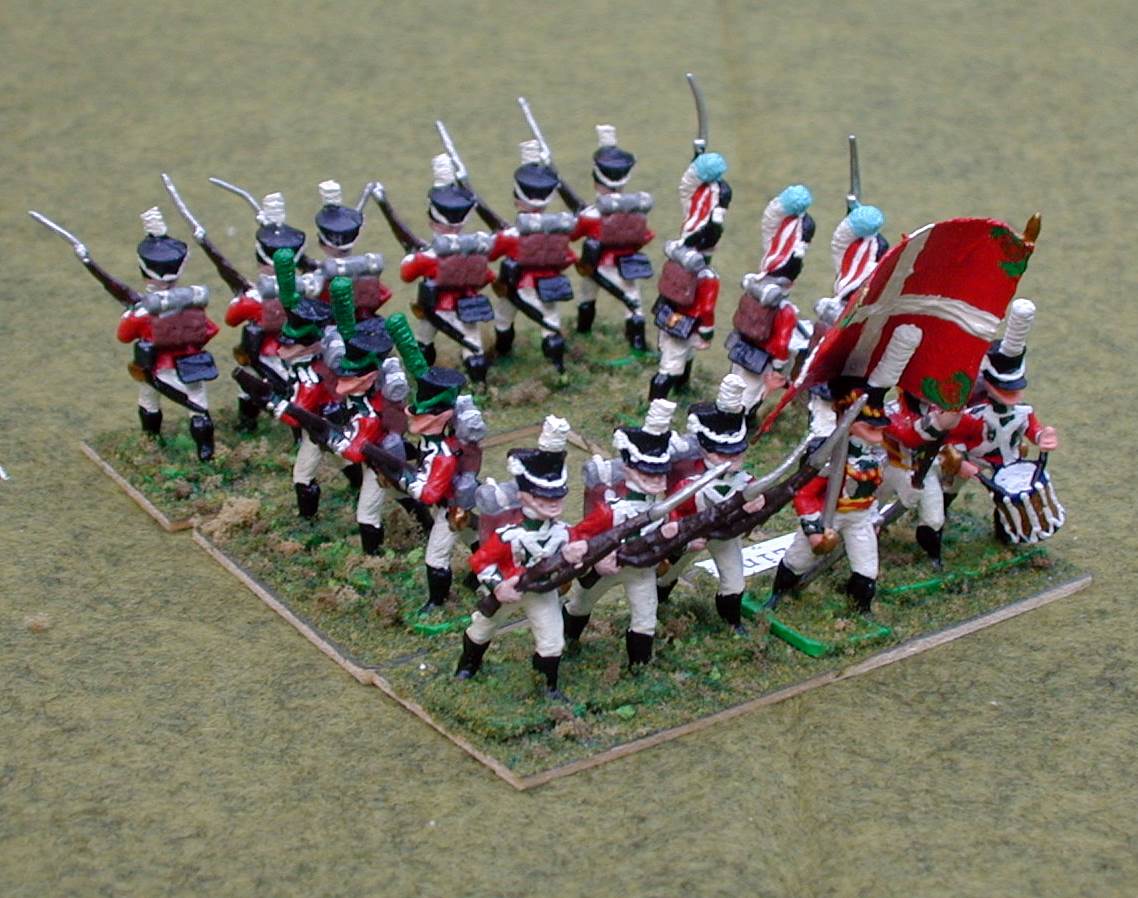
This regiment's grenadiers have abandoned the bearskin, as ordered in 1813, wearing instead the tall, white plume with a light blue tip on their shakos.


The King's Livgard of Foot (Den Kongelige Livgarde til Fods). The more ornate standard has the Royal Arms of the Kingdom of Denmark.


Note the ornamentation on the cartridge boxes.


The dark blue pants look very sharp with the red coats and the light blue facings and bags on the bearskins, I think!  Fit for a King, as it were...


Next time - The Danish light cavalry

Peter

Friday, September 20, 2013

Danish Army of the Napoleonic Wars, Part 4: Light Infantry

Organization of the Danish Light Infantry

    The Danish regular  light infantry consisted of Jager Corps (Jaegerkorps), in which half the men were armed with rifles and the others with sharpshooter muskets, and Sharpshooter Corps (Skarpskyttekorps), in which all the men were armed with sharpshooter muskets. I have conflicting information as to the composition of these units. One source says 80 men per company, with 4 companies of Jagers or sharpshooters, and one of Jager-Grenadiers. Another implies that only certain units had Jager Grenadiers, and gives a battalion strength of roughly 576 men for Jager battalions and 548 for Sharpshooters (and doesn't list the Jutland Jager Corps at all). In any event, second ("reinforcement") battalions were added to all of the units in 1808.

Uniforms of the Danish Light Infantry

    In general, these were of the same overall pattern as the Line infantry, previously covered, with different colors substituted. The short jackets were dark green, with black facings on the collars, cuffs, and lapels. all piped in white. White turnbacks at the front of the jackets. Shoulder straps and button col,or varied by the unit, as detailed below.  Pants were either white or grey. All belts were of blackened leather. Hansen shows some light infantry officers wearing dark green pelisses with grey fur, and silver grey lace, and green pants in 1813 - quite classy!  Like the Line infantry, officers wore sashes of crimson striped with yellow.

Headgear was also similar to the Line Infantry. Hats with turned up brims were worn through 1807, with short dark green plumes and dark green cords, white hat bands for most. Officer are shown with bicones with green plumes, or hats similar to the men, again with green plumes and gold cords. Jager Grenadiers wore a headdress again similar to the Line infantry Grenadiers, with a black metal front with a brass banmd on the bottom, a black peak, a green transverse caterpillar crest running from ear to ear, a green plume with a red tip on the left side, and a dark green cloth flamme at the back, with white piping and tassel (the NYPL site has a good picture of this uniform, #27 in the Danish Napoleonic section). 

In 1808, officers and men adopted the shako. This again had dark green cords and plumes for the men, dark green plumes and red mixed with yellow cords for the officers. The Jager-Grenadiers now wore a black bearskin with a green plum tipped in red on the left side, and a dark green bag on the back, piped white. 

Danish Light Infantry Distinctions, 1801 - 1814


Unit Name
Facing Color
Sh. straps
Buttons
Zealand Jager Corps
Black piped white
Lt Green
Pewter
Jutland Jager Corps
Black piped white
Lt Green?
Pewter?
Schleswig Jager Cp
Black piped white
Dk Green
Brass
Zealand Sharps Corp
Black piped white
Lt Green
Pewter
Jutland Sharps Corp
Black piped white
Lt Green
Pewter
Holstein Sharps  Cp
Black piped white
Dk Green
Brass


The Kings Livjager Corps

The Kongens Livjaeger Corps was a volunteer light infantry unit raised from upper middle class citizens of Copenhagen in 1801. Initially, only 2 companies of 80 men were raised, but it was increased to 4 companies due to the threat of attack by the British. The companies were increased to 100 men each in 1806. The unit fought with distinction in the defense of Copenhagen in 1807. In 1815, it was the only volunteer unit not disbanded, and was ranked just below the Guards and ahead of the Line troops. The men were armed with rifles, supplied by the King.

The uniform of the Corps was short dark green coat with black collar, cuffs, lapels, and small black frontal turnbacks. Dark grey trousers were worn (dark green for full dress). There was black lace on the jacket and also the pants. Belts were black, and black boots with black tassels were worn. The headdress was rather unique six sided czapska with a dark green wide band around the bottom, green cords, green cockade surmounted by a large green pop-pom on the left side.

The six sided "czapska" of the Livjagers


Top view of "Czapska"

Officers had gold epaulets, and in full dress, gold piping on on the facings, turbacks, and lace. Yellow sashes with red stripes were also worn by the unit's officers, a mark of special distinction for a volunteer unit. Initially the officers wore a sort of Tarleton style helmet with a green fore and aft caterpillar crest and a leopard skin hat band, but in 1806 they switched to a six-sided czapska like the men.A dark green pelisse with black fur, black lace, and brass buttons was also worn as an option.


And now, on to some pictures:


The Zealand Jager Corps (Sjællandske Jægerkorps)


Black facings piped white, silver buttons, white pants. I used the Minifig models for the Livjagers for these units, but strictly speaking the castings for the Line infantry in shako would be correct, just painted in the colors of the Jager uniforms.


The Jager-Grenadier company is seen on the far right of the line.


The Jutland Sharpshooter Corps (Jyske Skarpskyttekorps)


Black facings piped white, yellow metal buttons, grey pants


Note the wings on the jacket of the  hornist, and the bag of the Jager-Grenadier's bearskin.


The King's Livjager Corps (Kongens Livjægerkorps)


A good view of the unique six-sided "czapska" in this picture. 


Hornists wear the same uniform as the men, with the addition of black wings with yellow lace and tassel ornamentation. The Livjagers suffered over 25% casualties at the battle of Copenhagen in 1807.


Incidentally, this post marks the 200th post since I began the blog on January 2, 2011. That seems like a lot, at least to me... and then I see Bob Cordery has just passed two THOUSAND posts in about 6 years. Good grief!  :-)

Next time:  The King's Livguard of Foot and the Liv Infantry Regiments.

Skål!

Peter

Monday, September 16, 2013

Danish Army of the Napoleonic Wars, Part 3: Line Infantry Part 2

Before continuing on, I thought a few simple line drawings might be helpful:

A sketch of  the 1801 - 1807 Infantry hat, viewed from the left side. It is sometimes shown considerably taller, and with the brim rolled up all around instead of just on the left side. 


A sketch of the pattern for the short Danish jackets, showing the frontal turnbacks unique to them.


From the Text to the Hansen plate on the 3rd Infantry Regiment Jutland (see below). This sketch illustrates the system of cuff based rank distinctions using lace bands and rosettes introduced in January, 1812 (in part to save money on the expensive epaulets).  1- "Vice Corporal", 2- Corporal, 3- Sergeant; 4- Second Lieutenant, 5- First lieutenant, 6- Captain, 7- Major, 8- Lieutenant Colonel, 9- Colonel


Continuing on with more examples of Danish Line infantry in the post 1808 uniforms, we have the following:


Schleswig  Infantry Regiment (Slesvigske Infanteriregiment)


Light blue facings, white piping, yellow metal buttons. Note the black belts on the Jager company.


The officers should actually have mixed yellow and crimson cords on their shakos/bearskins.


Queen's Infantry Regiment (Dronningens Ingfanterieregiment)


Light blue facings, no piping, yellow metal buttons


Each of the regiments had a unique combination of facing color, button color, and piping (or not). See the table in my earlier post for the details by regiment.


3rd Jutland Infantry Regiment (3. Jyske Infanteriregiment)

Black facings piped white, white metal; buttons. Overall, a striking unit, and a popular one with military artists. Hansen's excellent plate of this unit is shown on the Chakoten site, here. Click on the plate for a really good, up close view!


Zealand Infantry Regiment (Sjællandske Infanteriregiment)

Dark green facings piped white, silver buttons


Properly, it seems that this unit was disbanded prior to the adoption of this later style of uniform, the men being in part used to expand the Marines, before those troops were in turn used to form the new Copenhagen regiment. As Zealand is the name of the island on which Copenhagen is located, in retrospect it seems to have been somewhat like a Danish shell game!


Next time:  The Danish Light Infantry.

Peter