My Republican Roman Army is from the time of the Punic Wars, 264 - 146 BC, especially the 2nd Punic War, 218 -101 BC, when Rome barely survived the challenge posed by Hannibal's genius. It contains 2 distinct components - the original army, all Minifigs, painted back in the mid 1970's, and the much later additions, all Old Glory, painted about 7 years ago.




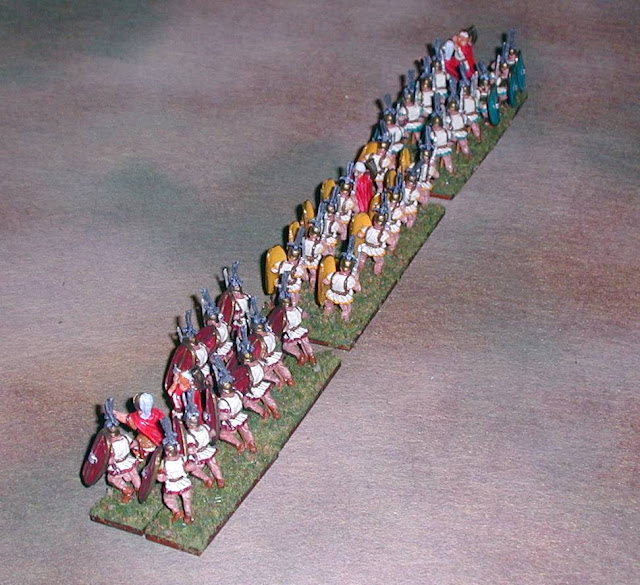


Here's the whole army, deployed for battle - skirmishing Velites to the front, screening the Triplex Ascies (triple line) composed of the more lightly armed Hastati, then the well armored Principes, and finally the veteran Triarii in reserve. The Roman cavalry are deployed to one flank, and the allied cavalry to the other.

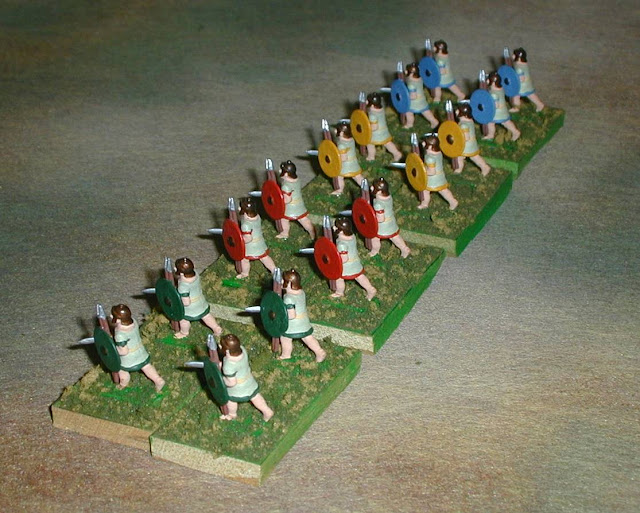
The newest of all the troops in myu Roman army are these Velites.

The Velites were composed of young and/or poor men, and functioned as Javelin armed skirmishers, although were not afraid to use their swords when needed.

These Old Glory 28mm figures are dressed in Wolf skin cloaks.

Doubtless the wolf skins were intended to reflect the Roman foundation myth of Remus and Romulus, the newborn twins who were abandoned and then nurtured by a she-wolf.

For variety, I've done the wolf skins of each unit in a different color.

If indeed all or most of the men worse such skins, it seems likely that more than a few dog skins were substituted!

The defensive equipment of the Velites was composed of only a helmet

and of course their shields!

These much older Minifigs Velites are more simply equipped, the dubious wolf skins being omitted!

They look much ,ore like the Greek Peltasts/Psiloi that they were doubtless modeled upon.

For game identification purposes, each unit has their own distinctive color.

There is little evidence this would have been the case in actual fact, however.

These are some Old Glory Hastati.

Hastati had a large shield (scutum) and might wear a bronze chest plate (a square of metal, really) for armor.

Their chief weapon was he gladius (stabbing sword),

They were also armed with a pair of heavy throwing javelins, the famous pilum.

Next up are some Old Glory Principes.

The Principes generally worse full, torso armor, typically of mail.

Otherwise, their armament was similar to the Hastati.

Originally, Roman soldiers had to provide their own equipment, thus the Principes typically were older and better off economically.

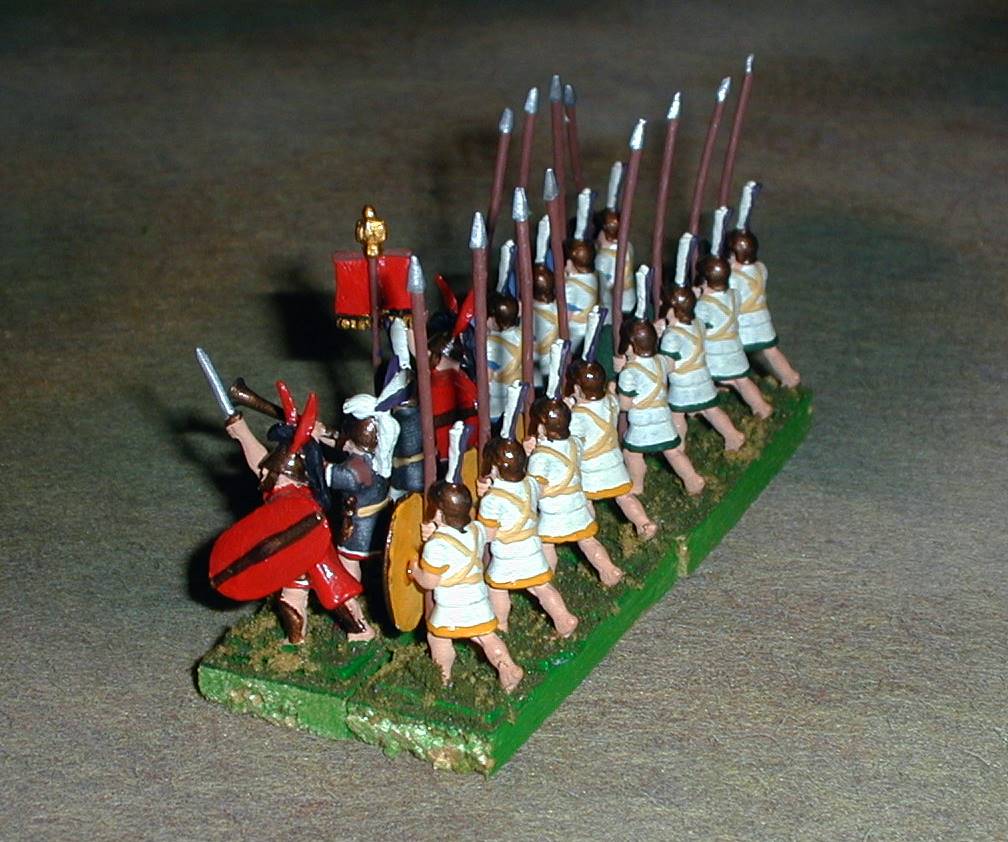
Now on to the Minifigs portion of the Roman Heavy infantry. Some readings of Polybius and Livy have the Hastati equipped Hoplite style, with long spears. The Minifigs version are so equipped here.

One suspects the transition from long spear to Pilum was gradual over a century or more.

These Minifigs Hastati have leather torso armor and bronze pectoral plates.

The vexilum type standard (signum) bears the inscription, SPQR", the initial of the Latin phrase meaning "Senate and People of Rome".

The Minifigs version of the Principes.

Mail coats, greaves, and large shields again form their defensive equipment.

Armed with the Pilum and gladius, they were formidable warriors.

Plumes in black and/or purple were worn on their helmets to make them look taller and more imposing.

Finally, we have some Minifigs Triarii.

These men were older combat veterans, not a social class, and constituted the last reserve of a Roman Army of the middle Republic (sometimes called the Manipular or Polybian army).

They are described as having purple and white plumes on their helmets, as seen here.
SPQR!

Roman "Knights", drawn from the most prosperous elements of Roman society./

They were well armored and armed with stabbing spears and/or Javelins.

The chief weakness of the Roman heavy cavalry was their small numbers... and the Romans experienced difficulty providing even the small required cavalry establishment that formed part of each Legion.

Italian Allied cavalry.

To partially compensate for the small numbers of Roman cavalry, each allied Ala (the equivalent of a Legion) had twice as many cavalry in its official establishment.

These troops were often more lightly equipped than their Roman counterparts.

Both had significant problems facing the opposing Carthagenian mounted troops. during the 2nd Punic War.

A few Roman odds and ends...

The Roman army placed little emphasis on missile fire,bit did employ small numbers of specialist archers (typically recruited from Crete) and slingers (often recruited from Rhodes).

War engines were usually limited to siege warfare.

Roman superior officers might include Consuls, Praetors, Quaestors, Proconsuls, and Tribunes. A consular army typically consisted of 2 Roman Legions and 2 allied Alae, totaling nearly 20,000 men.

The usual size of a Legion in this period was 4,200 infantry, of which 3,000 was heavily armed and 1,200 velites, plus 200-300 cavalry.

There were 10 maniples (the smallest tactical sub unit of a Roman army of this era) in each of the three main battle lines that a legion was drawn up in for battle: Hastati, Principes and Triarii, for a total of 30 maniples in each legion. The maniples of the Hastati and Principes each had 120 men, while those of the Triarii were half that size at 60 men each.
My Romans are slated to face off against my Carthagenians tomorrow, as Barry and I play our first game or two of To the Strongest! If we like these rules, I am going to need a lot more Commander figures!


