Monday, September 8, 2014

Saxon Napoleonic Line Infantry

During the Seven Year's War, the electorate of Saxony was invaded by Prussia , with Frederick II taking Dresden. Heavy financial contributions were levied on the populace, and the Saxon army was trapped in the camp at Pirna. The troops were taken prisoner, with many of the soldiers being incorporated into the Prussian army. Saxon territory was devastated during the 7 years war, and by a famine following the war. In 1806, the Prussian army again invaded Saxony as a prelude to its declaration of war with France. Some say the Saxon Army was dragooned into fighting with the Prussians, and others say it voluntarily joined them. With the defeat of the Prussian Army and its Saxon  "allies", Elector Frederick August III of Saxony joined the Confederation of the Rhine, and was elevated to King of Saxony, with the title Friedrich August I.

Like most German states of the time, Saxon Territories were somewhat disjointed, but totaled 1,994 square leagues, including the great cities of Dresden and Leipzig. As a league was about 3 miles, that translates to an area of roughly 18,000 square miles. For comparison, this corresponds to roughly the same area as the US states of Connecticut, Massachusetts, and Rhode Island combined (i.e., Southern New England). The Population of Saxony was 1,680,908 in 1750, dropping to 1,6333,000 following the 7 Year's War, and losing another 65,844 in the famine that followed. By 1785 then population was up to 1,941,806, and grew further to approximately 2,300,000 by 1808.

Elector Frederick Augustus II of Saxony (r. 1734 - 1763) also became King of Poland in 1750. Saxon rule didn't benefit Poland particularly, and after his death in 1763, the Polish crown (an elected position ) passed to Stanislaw August Poniatowski. Internal and external intrigues lead to the First Partition of Poland in 1772 between Prussia, Russia, and Austria, to be followed by a Second Partition in 1793, and a Third Partition took place following the defeat of Kosciuszko's rebellion in 1794. Poland and Saxony would become re-associated following the creation of the Grand Duchy of Warsaw by the Treaty of Tilsit in 1807.

The reputation of the Saxon infantry was mixed. I suspect that may be at least as much due to political issues as anything else. In 1806, despite being at least partially press-ganged, the Saxons performed no worse if not better than their Prussian counterparts. Of course, Napoleon was eager to have Saxony join the budding Confederation of the Rhine, so playing up the Saxon martial  abilities would also be shrewd politics on many levels. In any event, he was so successful in converting Saxony to the French cause that the King of Saxony was his next to last supporter (after Denmark), and suffered almost  as much as a consequence at the Congress of Vienna, losing about 40% of its territory and population (to Prussia, of course). The collapse of the Saxon infantry under Bernadotte at Wagram certainly wasn't one of the finest moments in Saxon military history, but the fact that Bernadotte had made himself thoroughly persona non grata with Napoleon, and subsequent events involving him meant that much of the abuse heaped upon him rubbed off on his Saxon troops as well.

Organization of the Saxon Line Infantry

Just as the history of Saxony extends back before 1500, the Saxon army had been in place for quite some time. The basic composition of the army at the start of the Revolutionary and Napoleonic Wars dated back to that established in 1763. There were ten regiments of Line Infantry, plus the Leib-Grenadier-Garde. There were reorganizations in 1778, 1797, and 1810. In 1797, each Regiment had a staff of 14, comprising 1 Chef (Chief), 1 Oberst (Colonel), 1 Oberstleutnant, 2 Majors, 1 Regimental Quartermaster, 2 Adjutants, 1 Regimental Judge, 1 Regimental Field Surgeon, 1 Staff Field Surgeon, 2 Cadets (Faehnjunker), and 1 Provost. Each regiment had 2 battalions, each of 1 Grenadier and 4 Musketeer companies; in practice the Grenadier companies were commonly brigaded together into Grenadier battalions. Each company had: 1 Captain, 1 First Lt., 1 Second Lt., 1 Cadet (not in Grenadiers), 3 Sergeants, 1 Quartermaster, 1 Field Surgeon, 8 Corporals, 3 Drummers, 2 Fifers, 2 Sappers, and 150 privates.  Thus a company had 174 men total, and a full regiment had a paper strength of 1,784 men. The 1810 reorganization resulted in disbanding 4 of the Infantry regiments and redistributing the men to the remaining outfits. This resulted in an increased company strength, each having 180 privates. This brought the paper strength of a 10 company regiment with staff up to 2,043. Once again, the Grenadiers were usually brigaded together into separate 4 company battalions.

Uniforms of the Saxon line Infantry

The Saxon Infantry changed the color of their jackets from Dark Blue to White in 1765 (probably a reaction against being press-ganged to fight for Prussia during the 7 Years War!). The regimental distinctive colors appeared on the collars, cuffs, and lapels. The turnbacks were left white. Pants were white, as were belts. A small black bicorn was worn until 1810, when a French style shako was finally adopted. The bicorn had a white pom pom with the center in the facing color, and a white cockade. NCO's had gold or silver lace on the hat according to the button color of the regiment, and the hair was worn powdered and in a queue until 1808.  Grenadiers wore a black Austrian Style bearskin with a brass plate bearing the arms of Saxony; the fabric on the back was in white and the facing color. The regimental Schuetzen had green plumes on the bicorn and carried rifles. The 1810 shako had a brass plate on the front with the crowned royal Cipher, "FA", and was completed with white cords and cockade, and a white plume tipped with the regimental facing color. Grenadiers had red cords and plumes on their shakos, as well as red epaulets and sword knots.

* Knoetel says the 1810 uniform had facing colored piping on the shoulder straps and on the white turnbacks as well. 


Chronology of Saxon Infantry Regiments 1793-1815
IR #
Regiment Name
Raised
Later Names/Dates
-
Leib-Grenadier Garde
1729
N/A
1
Kurfurst
1670
Koenig  1806
Garde Regt 1815
2
aus dem Winkel
1741
von Sanger 1798
von Cerrini 1808
disbanded 1813
3
Prinz Anton
1701

4
Prinx Clemens
1704
von Steindel 1812
disbanded 1813
5
Prinz Maximillian
1701
von Oebschelwitz 1806, disbanded 1810
6
von Nostitz
1742
von Thummel 1802
von Burgsdorff 1808
disbanded 1810
7
Prinz Freidrich August
1711

8
von Low
1682
disbanded 1813
9
Prinz Xaver
1723
von Oebscelwitz 1806
Disbanded 1810
10
von der Hyde
1748
von Ryssel 1800
von Bunau 1805
von Bevilaqua 1806
von Dyherrn 1808
disbanded 1810
11
von Niesemeudchel
1673
vacant 1810-1813
12
von Lindt
1730
von Rechten 1801
Disdfamnded 1813


Saxon Line Infantry Facing colors, 1765 - 1815
Regiment
Facing Color
Buttons
1
Red
Yellow
2
Red
White
3
Dark Blue
White
4
Dark Blue
Yellow
5
Yellow
Yellow
6
Yellow
White
7
Light Green
Yellow
8
Light Green
White
9
Light Blue
Yellow
10
Light Blue
White
11
Purple-Red
White
12
Purple-Red
Yellow
Garrison
Black
White


IR Prinz Maximillian  wearing its yellow facings on the collar, cuffs and lapels. I have also painted the turnbacks in the facing color. Although completely logical, this is incorrect; they should be plain white (or perhaps white piped in the facing color - see above). Odd, but that's the way the uniform was! Note the red plume and cords for the drummer, even though he is not a member of a grenadier company. 


The standards of the Saxon units were of a unique design, the most distinctive feature being the regimental border patterns. All of their flags bore the crowned and wreathed royal cipher "FAR" on one side, and the arms of Saxony on a mantle on the reverse. This regiment's border pattern has red, yellow and green


This is IR Prinz Friedrich August on the advance. The entire style of their 1810 pattern uniforms and rank distinctions are now along French lines.


IR  Prinz Friedrich August with its light green facings (once again, the turnbacks should have been left white). Note the completely different border pattern on the standard from the earlier regiment


Lie all of my Saxons, these are 25mm Minifigs,"French" figures with just a paint conversion to make them into 1810 Saxons! They were painted well over 25 years ago.


IR Prinz Xaver with its light blue facings. Note yet another distinctly different border pattern on the standard. This regiment was actually disbanded in 1810, but I especially liked this border pattern. 


As usual for the Saxons, he drummer has shoulder "wings" in white piped with the facing color, and the drum rims are in the facing color as well. 


The Arms of Saxony are seen well here - Barry, Sable and Or, a Bend of Common Rue. Rue is a bitter  herb cultivated in the past as a condiment and medicine, now largely found only in flower gardens, having blue-green leaves and yellow flowers. 


IR Koenig in attack column, showing off its bright red/scarlet facings. 


Note yet another distinct border pattern on their flag; the unique designs really make Saxon flags stand out on the tabletop. All of the flags were hand painted, so I was very pleased with how they look.


Another view of Saxon IR Koenig.


Sources for this and forthcoming posts on the Saxons:

Poles and Saxons of the Napoleonic Wars, George Nafziger, Tom Devoe, Mariusz T. Weslowski. Emperor's Press, Chicago IL, 1981.

Napoleon's German Allies (3): Saxony 1806 - 1815., Otto von Pivka and Richard Hook. Osprey Publishing, London, 1979

L'Amrmes et les Uniformes des Soildats du Premier Empire, Volume 3, Liliane and Fred Funken

Flags and Standards of the Napoleonic Wars, Keith Over.

Hanbuch der Uniformkunde, Richard Knoetel. Leipzig, 1896.


And online:

Grosser General Staff site - nice plates on many of the German states, including the Saxons:
http://www.grosser-generalstab.de/sturm/sturm220.html

Histofig plates and text on Saxon Army:
http://empire.histofig.com/-Royaume-de-Saxe-.html

Brefreiungskreige site - awesome collection of the plates of Knoetel, Saurweid, Leinhart and Hummel, and more!
http://befreiungskriege.wordpress.com/saxon-army-resources/

Plates of the Saxon Army 1805-1806
http://www.napoleon-series.org/military/organization/c_saxon1805.html

Histunif site Saxon pages - includes detailed sketches of the Heavy cavalry lace and shabraque edging patterns, and reduced images of all of the fantastic Peter Bunde plates (used with his permission, the full, detailed plates and text are all available commercially from Peter)
http://www.histunif.com/confederation/Saxe/saxe.htm

Friday, September 5, 2014

Post Historicon Planning

Although I certainly play other games, most years my planning and painting focuses on my convention game plans.  Last year I had to miss all but Historicon, which may account for why I wound up running 5 games there this year!  :-)

The first convention coming up is Ellis Con, a small local convention run by the Simulations Club at at Ellis Technical High School in far eastern Connecticut (Danielson)... almost in Rhode Island, so the opposite end of the state from me. This year it will be held on Saturday November 15, 2014.
I haven't made the final decision yet, but I am leaning towards running a pair of games using my old gridded Ancients rules Legio Quaternarius. These rules are pretty tried and true, and are very easy to learn and play... and they include the shooting catapults! In that case I will probably use my Alexandrian Macedonian Army against my Mauryan Indians for one game. Both those armies could use some relatively minor touch up and updating, and neither has previously appeared here on the blog.  The second battle will likely feature my Republican Romans vs. my Carthagenians, although other possible match ups could involve my Palmyrans, Sassanid Persians, Byzantines, or Teutonic knights. It looks like Joe will run Quatre Bras and Greg perhaps Bolt Action or IHMN.


The next convention on my tentative schedule is HAVOC, run by Battle Group Boston in Shrewsbury, MA, usually the last weekend in March. For this one, I am inclined to run a pair of Renaissance/Great Italian Wars games using Pikette Squared. This convention has very set table sizes and fixed 4 hr time slots, with very short allowances for set up and take down, and is also quite a drive for me (about 2.5 hrs each way), so games that set up and take down quickly and fit their smallish 8 x 5 feet tables are wise. Likely combatants are France, Spain,  Italian States and Imperialists.

Historicon, July16 - 19 in Fredericksburg, Virginia is the big one. My plan is to run Waterloo there (using FoB2), probably twice back to back (Night/following AM), although Ligny is a tempting and slightly less predictable choice (and I have plenty of Prussians already). Hopefully Joe will attend and run Quatre Bras. I also plan to run Maginano 1515 with BoB2, and/or Hostile Realms, and hopefully Ken B and I will click this year to run the NKE vs. Canaanite game with Pulse of Battle that we had planned on for 2014. If all goes well, Tim should run another WW1 East Afrika game, Gabriel some War of the Roses action, and maybe a game from Eric, Jared, and/or Dave - could be the biggest Piquet/FoB2 game contingent ever!

Thoughts for some local games include play tests of  Waterloo and/or Ligny, Marginano. Other games might include Klagenfurt 1809, a Snappy Nappy 1815 "Campaign in a Day" at some point, a Russian Civil War game with Jared the end of this month, and who knows what else?

Peter

Sunday, August 31, 2014

La Bricole Returns

Sometime last year I finally joined the informal Napoleonic Wargaming forum, "La Bricole". Not long afterwards they had a sudden and involuntary migration to a new host, resulting in loss of many of the members (but not the files). I finally reconnected with the forum myself a month or so ago, and it is starting to pick up steam again.


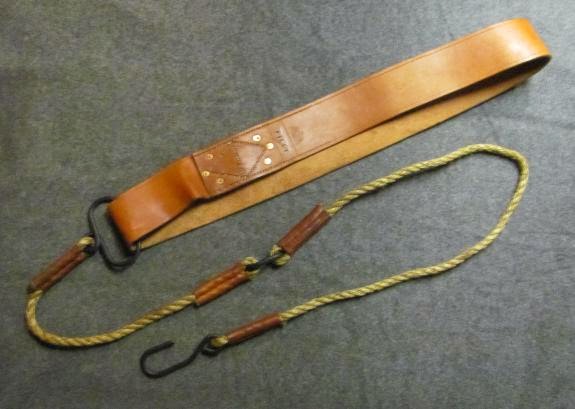
The name of the forum is a tongue in cheek reference to an obscure bit of Napoleonic trivia (a "bricole" is a hand rope used by black powder artillerymen to maneuver their guns). From that you might think the group is composed of a bunch of nit pickers and button counters. Nothing could be further from the truth, however. The members are Napoleonic wargaming enthusiasts who are helpful and supportive, and enjoy sharing their projects. Bad behavior is neither expected not tolerated! 

If you'd enjoy sharing your enthusiasm for the period with similarly minded gentlemen wargamers (ladies welcome as well of course), then consider joining (or rejoining) La Bricole. It is now hosted by Forumer, and can be found here: LINK.  Hope to see some of you there!


Modern reproduction of a bricole for use by re-enactors and the like

Wednesday, August 27, 2014

More French Napoleonic Artillery

My recent orders of Essex and Connoisseur figures needed for my Historicon games were rather small, so I added few extras to make the shipping charges seem more worthwhile. That resulted in some figures lingering on my painting desk, which I have no finished off. Here they are for your viewing pleasure!


This battery is made using the Connoisseur figures. State of the art in their day, they aren't quite up to modern standards, but still have a charm of their own. They are also the only artillery figures I have that are wearing covered shakos. 


So, uh, what's with the medium green pants, lapels, collars and cuffs, Peter? A moment of hitherto unrecognized red-green color blindness perhaps?


No, this unit is based upon an illustration in Fred and Liliane Funken's Arms and Uniforms of Soldiers of the First Empire. It depicts an artillerist of the Coastal Artillery in 1809. Presumably, these were the men that manned the guns of the many fortresses and batteries protecting French harbors from the scourge of the Royal Navy. I've found the wonderfully eccentric colors fascinating since I first acquired the books (French language versions) back circa 1970. I have no idea of the accuracy, and the illustration doesn't really show the turnbacks well, so I went with red (they look like they might just be white in the picture, which would be odd as well). The cuffs are also shown to be dark blue with medium green piping and cuff flaps, but I just went with solid green. In for a penny, in for a pound!  Anyway, I figure it is plausible some of these guys may have been pressed into service opposing the British invasion Walcheren in 1809, or in the later phases of the 1813 to 1814 campaigns. Unfortunately, the same plate shows another coastal artilleryman from 1812, wearing a dark blue uniform with red piping etc like pretty much every other French Napoleonic artillery uniform! In any even, with their unusual uniform, they will serve as conscript/militia artillery, as well as a unit to baffle wargaming grognards with!  :-)


These are some excellent Essex artillerymen purchased with the clear-out discount at Wargames, Inc. They were piggybacked onto an order of some additional New Kingdom Egyptians for Ramses' army.


They are the Artillerie a Pied de la Garde Imperiale. The Foot Artillery of the Guard was a relatively late addition, six companies being formed by a decree in April, 1808, and belonging to the Old Guard. Three companies of Young Guard Artillery (or Concrit Artillerie) were added in June 1809. By 1813, the Young Guard component had increased to 16 companies!


The shako was worn until the introduction of the better known bearskin headdress (Old Guard companies only) in 1810, so these troops are wearing the earlier uniform. Guard insignia include the brass eagle plates on the shakos and cartridge boxes. Both are nicely sculpted on these figures. The guns of both batteries are Sash and Saber 12 lbers. 


Canine Corps - Annie scores bonus points for height with her jump to get the "shark" in the pool.


Whilst Zoe score points for distance and accuracy! "You're going DOWN Sharkie!"
(Piper, 10 years old, looks on from a distance, seemingly unimpressed. She's OK with some swimming, but doesn't jump into the water, which was her late half sister, Cricket's,  obsession!)


"I got it first.... No, I got it first!"
They aren't called Golden Retrievers for nothing!

Saturday, August 23, 2014

Six PDF Rules sets available from Piquet, Inc.

Brent Oman at Piquet, Inc is gradually making a number of titles available in PDF form. While I personally still prefer printed rules in most cases, the lower price of PDF's makes it easy and economical to explore rules you're uncertain about, there are no postage charges (especially good for overseas customers), and there is (nearly) instant gratification. Finally, they don't take up space on the bookshelf or in the basement, etc!  All can be purchased by sending Brent PayPal payment: brentoman@q.com.  Brent will send off the pdf when payment has been received. I've dealt with Brent on multiple levels for many years now, and he is very reliable!  As of today, these include the following, in order of PDF release:

1) PKowboys (Western Gunfight Rules)

 PKowboys is available for $12. The rules include all the needed play and card sheets. Author: Jeff Grossman.

From the rules -
"Pkowboys is intended to represent skirmish combat between rival gangs (outlaws, lawmen, gunslingers, and townsfolk) in the American West between 1860 and 1900. Players represent the leaders of different gangs, or in large battles a player may act as the leader of multiple gangs."

Designer Notes

I suspect most miniatures rules sets start out the same way – the author is frustrated with the some aspect of his current rules and sets out to fix things. I’m an exception to this rule. I had a perfectly decent set of “gunslinger” rules that had served my gaming group well for many years. Instead of trying to “fix” this rules set, I decided to bring some of the concepts from the Piquet rules sets to the Wild West.

Almost immediately I was beset with the impossibility of using the Piquet initiative system with a fast and lethal combat system. If the opposing gangs were in combat range, one side could be completely destroyed in one single initiative run. One of the early solutions was a variable card value system where players would play cards until they had reached their points limit. Someone joked that if the limit was set at 21, we’d be playing Blackjack! From this moment, our series of confused gaming sessions quickly gelled into the set of rules you’re now holding.

Here are the principles behind the design of Pkowboys. If you find a gap in the rules, use your best judgment and follow these guidelines to resolve the dispute.

Western combat was quick and decisive. Gun battles lasted minutes or seconds.
Any shot has the chance of being lethal.
Many gunfighters lost their nerve and fled when under fire.
Leadership was as important with gangs of outlaws or lawmen as it was in large battles.
The Jesse James/Wild Bill Hickock Theory: being unlucky is a bad thing no matter how good you are.
Gunfight tactics in a nutshell: move into a good position and shoot like mad.


Peter's note: I own a copy, but haven't played them, as I'm not a big skirmish games fan; my tendencies run more towards megalomania! Here's a post from another blog from a few years back about the rules: LINK

2) Blunders on the Danube (1809 Scenarios)

Blunders on the Danube is available as a PDF for $15 This one ought to be familiar to most of you!  :-) 

This book contains more than 20 scenarios for use with Brent Oman’s excellent rules for Wargaming in Miniature, Field of Battle published by Piquet in 2006. The scenarios range from quite small (Klagenfurt) to enormous (Wagram). Many of these scenarios would be almost as useful for Les Grognards, 2nd edition, the Napoleonic module for the Piquet Master Rules for wargaming. With some effort, they shouldn't be hard to adapt for use with other rules systems as well. For more information including the list of scenarios, see the 1809 Scenarios tab on this blog.

Peter's note: I think this is one case where the PDF may even be better (as well as cheaper) than the printed book, as you can easily print off the just the scenario you want, when you want to use it, along with the associated OOB's/Rosters. I designed the book to make it easy to photocopy the necessary pages in that fashion, but printing them is even easier!

3) Theatre of War (Campaign System).

Theatre of War, the Piquet campaign system, is available in PDF format for $15. Author: Brent Oman.

Theatre of War was written to allow miniature-based campaigns that provide linked, tactical tabletop games with a larger meaning. In itself, this is not a unique goal for a campaign system. However, Theatre of War is designed to be used with miniature collections of existing, fixed sizes (no more collecting and painting forces for the next game just in order to meet the order of battle requirements!) and provide an entertaining background for a campaign with a definite result. Quite often, miniature campaigns end up as an exercise in map movement, followed by a couple of large games as all available forces concentrate in a clump at one map location. Inevitably, the resulting tabletop games turn out to be games with every figure each campaign participant owns, lined up on opposite sides and marching forward into a meeting engagement! A fatal
flaw in many campaign systems is the transition from the large campaign map to the smaller tabletop tactical map. Theatre of War provides a system of  determining the tactical scenario, based on decisions made by the campaign players.

Peter's note:  I think ToW is a brilliant concept. It will usually generate 3-5 battles per campaign, so that you really can play a campaign to a conclusion! It is designed for use with traditional Piquet supplements. It would be fairly easy top adapt to Field of battle/Pulse of Battle, and Hostile Realms. It would be harder but not at all impossible to adapt for use with non Piquet family systems. My friend Dave, out in LA, did a marvelous series on his blog detailing the adaptation and use of ToW for a campaign using (my) Hostile Realms rules. Well worth reading if you're at all interested in either! LINK (last to first, scroll down to start at the beginning.

4) Les Gronards, 2nd Edition (Classic Piquet - Napoleonic Supplement)

Les Grognards, 2nd Edition is available as a PDF for $15. Author: Brent Oman.

Les Grognards is a "classic Piquet" supplement, covering the Napoleonic wars. LG2 includes rules for 3 different game scales: Company scale (basic infantry unit is a company), Battalion scale (the infantry unit is a battalion), and Grand Tactical scale (infantry unit is a brigade/regiment). LG2 also includes Horizon Moveent rules for the Battalion and Grand Tactical scale games. Horizon Movement eliminates virtually all measuring for movement, with movement instead based on terrain and enemy unit positions. The rules include lists for 37 armies as well as rating recommendations. Ownership of the Master rules is required.

Peter's note: I helped play test and used LG2 extensively until Field of Battle came out, and I think it's still a great rules set for 1-2 players a side. I used it for Dennewitz, 1813 at Historicon 2005, and was handed a GM award by Pete Panzeri there for same. There are a lot of different options/variants in LG2, including the Horizon  Movement option, an idea originally championed by another wargames friend, Jim Getz. I used a Domino impetus variant proposed by Bob Jones for that game and it worked well. The "hand of cards" is another fun variant for LG2 and other "classic" Piquet games. The Piquet Master Rules (only $5 in print form) are definitely needed to play or understand LG2!

5) Field of Battle, WW1

For the 100th anniversary year of the start of WW1, Pat Wingfield's new rule set "Field of Battle WW1" was released in PDF format. It is available for $19.

The rules cover 1914-1918. More details from Pat:
These rules are written to allow the players to recreate Corps and higher level battles of WWI. They use battalions as the combat element, brigades or regiments as the maneuver element and divisions as the command level. While designed with 6mm figures in mind the rules will work well with any size of figure. The ground scale is 1” to 100yds.
This set of rules started life as an attempt to simply modify the Field of Battle WWII rules to reflect conditions some 25 years earlier. However, the troop density and the change in technology, military thought and tactics during WWI means these rules have many differences to the WWII set, while retaining the overall concept.
Innovations in these rules include the use of battalions as the combat element in open field operations but company level units within trenches. There are also simple but effective pre-offensive bombardment rules that may make all the difference to the success or failure of an assault.
Organization Tables, that are segregated by nationality and year of operation, are supplied for the main protagonists.
There are also a large number of examples and designers notes to help the players pick up the rule mechanics.
The rules are supplied as a pdf and the contents page and internal references are all hyperlinked allowing easy rule reference finding. While the rules have been produced so that they are convenient to use on a tablet computer they can also be printed as a hard copy.


Peter's note: While World War 1 isn't my thing ordinarily (see my famed "anti-khaki rule"), I enjoyed playing in Tim's Latema Nek game at Historicon (not sure if Tim used these relatively recently released rules, IIRC), and now Jared and I have a date to play a Russian Civil War game using his 15mm figures next month!

6) Grand Piquet

Grand Piquet 2nd Edition is available for $12 US as a PDF file.  Author: Jim Mauro

Grand Piquet is Jim Mauro's take on grand tactical Napoleonic gaming with the Piquet fog of war view of the battlefield. A fairly simple game that enables very large games to be played.


From the back cover:

Many changes were made for this new edition of Grand Piquet. The Army commander now plays a more pivotal role in the command and control of a Corps. These formations no longer move whenver or wherever they wish. A D12 is now the basis for all initiative rolls, which effectively eliminates the need for phases, as well as mitigates the wild swings in initiative. The Sequence decks have been radically altered. Now there are Action cards, by type of unit (e.g. Infantry Action card), whereby there is much greater flexibility in actions taken by units. Also, the basic Sequence deck is now made up of 20 cards, instead of 28. The combat system is based primarily on Target type, so there are fewer modifiers to calculate. The basic concept of "chipping" within the morale system is intact, yet there is no need to keep track of morale chips. Unit/sub unit designations are determined by numbers of men and not by regiment. Players determine the size and make up of a unit, thereby effectively tailoring each Command Group to a particular situation or task. These are but a few of the changes that have been made.

Grand Piquet has never received the attention that it has deserved - give it a try; I think you'll be rewarded with a unique and fun game experience.


Peter's note: Jim ran a great game based upon Aspern-Essling using the first edition of these rules and his 6mm figures back in ? 2001. IIRC I played one command of the outnumbered French, and not very successfully. That damned bridge kept getting smashed by the flotsam and jetsam floating down from Vienna courtesy of the Kaiserlicks! I used GPK2 (with Jim's help) for a huge Dresden battle at Historicon 2003. GPK is quite unlike any other Piquet family game, and the unique mechanics really make you feel like you're fighting a battle, personally! It is a game best used for fighting the major battles of the Napoleonic wars, with 15mm or smaller figures, and at least 3 players a side - the more players, the greater the chaos of war! A player commands a Corps. I have pdf files of full color cards for these that I made for the Dresden game for anyone who's interested. The new  pdf version  is an ideal way to check out this unique rules set. There is a handful of erata and optional rules/suggestions from Jim in the files section of the Piquet Yahoo group which should also be downloaded (you have to join the group, even if you quit right after you download them): 
LINK. Scroll all the way to the bottom for the Grand Piquet Word document (rules updates - clarifications). Also there  in a folder called Grand Piquet are a set of card files with detailed descriptions of the possible actions for each card - not as pretty as the ones I designed for my own use, but perhaps more functional!


** Disclaimer: Note that with the obvious exception of Blunders, I have no financial stake in any of these, and regardless, anyone who thinks that 98% of miniature wargames rules (etc) authors make any meaningful profit from their efforts has never written or published a set themselves! Regardless, I consider all of these gentlemen to be friends of mine.

Peter