Showing posts with label Ral Partha. Show all posts

Tuesday, October 27, 2015

Carthago renatus est! Part 2 - Cavalry, etc


When you think of Carthage, who doesn't think of Elephants?  I sure do! These are Minifigs, as is the bulk of my Carthaginian army. 


In reality they were a fairly minor aspect of the Carthaginian military, but I still built a large Elephant Corps for them, as seen above. Certainly Hannibal's greatest use of them, at the Battle of Zama, was also his biggest defeat. 


We now believe that the elephants used by Carthage were largely or exclusively the smaller, now extinct African Forrest Elephant, and that howdahs were not used. At the same time, countless images over the centuries have depicted them this way, so who am I to argue?


Portly posteriors of the ponderous pachyderms!


On the other hand, these rather plain looking troops are the famous Numidian (light) cavalry.


They were central to many of Hannibal's victories, and when the bulk of them switched sides, again at the Battle of Zama, the results were anything but good for Carthage

I made a crude "Leopardskin" cape for the Leader from paper. I got the idea from one of Charlie Sweet's Numidian units! I actually need more of these guys; surprisingly, many 25/28mm manufacturers don't seem to make them, plain as they are!


"Spanish" (Celtiberian) Light Cavalry.


Once again wearing white tunics with purple borders, and red-brown leather boots. 


The finely cast, slender  javelins have taken some wear over the past 30 years. I actually have 2 more figures of these troops who were AWOL during the photo session!


Cisalpine Gallic cavalry.


Their yellow tunics were evidently typical.


... as were the striped and checked cloaks. I had more patience painting these patterns back when, it seems!


"Spanish" (Celtiberian) Medium Cavalry. The dress of these fellows is rather similar to that of the Scutarius with their long black cloaks. 


Once again the purple and white tunics and leather boots. 


These Minifigs are cast with short lances more than spears; it's debatable if they were actually used in that fashion, though. 


Liby-Phoenician Heavy Cavalry.


These nice figures are by Ral Partha.


Yes, there actually is fairly heavy shading on their red cloaks. 


Carthaginian Noble Heavy Cavalry. 


Probably few in number, along with the Numidians, these were the creme de la creme of the Carthaginian cavalry arm!


"And their squadrons were gleaming in Purple and Gold..."


Finally, a Potpourri of Minifigs Balistae, Hannibal himself, and some Eureka Gallic leader figures.


 I definitely need more leaders and heroes for To the Strongest!


The Eureka figures are full of action, aren't they? 


Here's the entire army on the table, deployed for battle. 


Attempting more of a Cannae, it seems, despite having the Elephants out in front a la Zama!


A view from the rear.


Carthago renatus est! (Carthage is restored). 
Of course, using the language of the victors might be a clue as to who really won the 1st, 2nd,  and 3rd Punic Wars!

Saturday, October 10, 2015

Carthago renatus est! Part 1 - Infantry

    My Carthaginian army is both the largest of all my ancient armies, and the one that I started painting first. Who can resist the romance of the story of Hannibal Barca, arguably the greatest general of ancient times, and the epic struggles of 2nd Punic War? Obviously, not I! The collection is so large and varied, in part because it was almost entirely a polyglot army of mercenaries... which makes the achievement of Carthage and Hannibal all the more remarkable, despite their ultimate defeat by equally amazing determination and resiliency of the Romans.


Much of the economic and military strength of Carthage during the Second Punic War came from her extensive possessions and trade with Iberia (Modern day Spain/Portugal). Pictured above are some Spanish (Celtiberian) Caetrati.


They wear typical Celtiberian attire - a white tunic with purplish borders, and red lather boots. 


The Caetratus was a skirmisher, armed with javelins, small shield , and swords. 25mm Minifigs. 


Next up is a horde of Libyan Javelinmen.


These troops were recruited form North Africa, in the territories not distant from the city of Carthage itself. 


Their armament and battlefield function were similar to the Caetrati. Ral Partha 25mm figures. 


Here are some more light infantry found in the ranks of Carthaginian forces. in this case some Numidians. 

I have followed the (likely incorrect) wargamer's convention of depicting them as being quite dark skinned. 

Once again, they were equipped with Javelins, a small shield, and sword. 25mm Minifigs.


Although longer range missile fire was not a big feature of the battles of the second Punic Wars, Carthage did employ some slingers in her forces.

These men were trained specialists and generally recruited from the Balearic islands off the coast of Spain. 

One suspects these Balearic Slingers might have seen greater use in sieges. 25mm Ral Partha figures. 


Libyan spearmen. These men were again recruited from North Africa, and were initially equipped in a fashion similar to the Greek Hoplites. 


Their equipment consisted of a large shield and a long thrusting spear.


Over time, many of them probably acquired captured Roman armor. 


A second unit of Libyan spearmen. 


These men often formed the seasoned, sell drained core of Hannibal's infantry. 


25mm Minifigs.

Some more Libyan spearmen. this time form Ral Partha. I love the big  spears provided with them!


At the Battle of Cannae (216 BC), the Spearmen were placed at either end of the infantry line, as Hannibal trusted them to hold their own against the Romans, who would probably push back his other, less reliable infantry
.

Of course, Hannibal's stratagem worked perfectly, leading the to the double envelopment and destruction of the Romans, who lost 8 Legions, and probably 40,000 - 50,000 men that day.


Carthaginian Sacred Band infantry (or, less glamorously, Militia spearmen raised from the City for emergency defense purposes)

I usually treat them as Elite, as they stand out from the Libyans, but the reality was probably the opposite!

The back rank at least look the part of Elite troops! Once again, 25mm Minifigs.


The "circle with streamers" motif is one educated guess as to possible Carthaginian standards. 


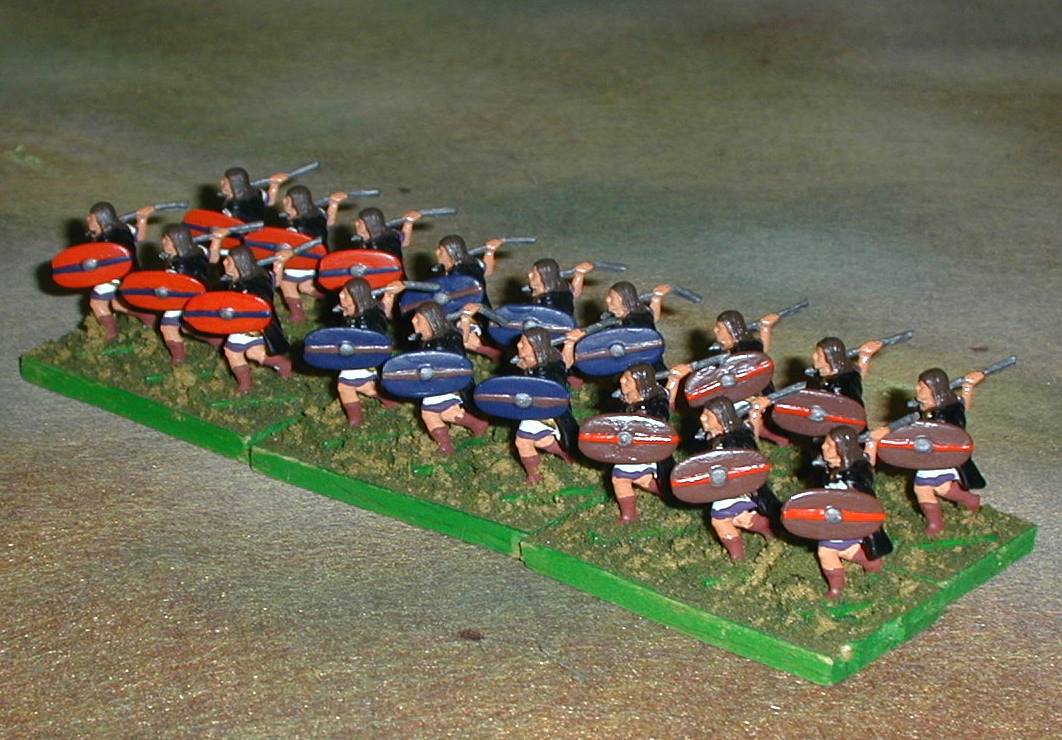
These next are Celtiberian Scutarii.


A scutarius was equipped with a large shield or scutum, hence the name.


They carried heavy throwing spears of soft iron, the effect of which is felt to be similar to that of the Roman pilum. Ral Partha 25mm figures./


This is the Minifigs take on the Spanish Scutarii. 


They wear the white tunic with purple borders characteristic of the Celtiberians. 


The long black cloaks were also typical of the dress of a Scutarius. 


Finally we have the Ral Partha take on the Scutarii.


Once again the white tunics with magenta borders, but no black cloaks.


These Ral Partha designs stress the Celtic appearance of the troops.


Now for some "real" Celts - from Northern Italy (Cisalpine Gaul)!


The Romans seem to have referred to them all collectively as "Gauls", and had been trying to push them out of Piedmont and the rest of Northern Italy.


I  spent a lot of time doing the designs on the cloaks of these 25mm Minifigs, which came out quite well, I think. 


The nuisance factor of doing those cloaks, though, meant that I wasn't eager to paint more of them, though. Eventually, I realized I really did need more Guys form Gaul!


These perhaps overly colorful fellows were the result, and joined the ranks less than 10 years ago. 


The plan originally was to overlay the bolder colors with stripes or checks in shades of dull reds, greens, yellows, and blacks.


Ultimately, I just couldn't face doing it, so they just got some Magic Wash, LOL!


The figures are Old Glory 25/28mm with some Eureka command figures thrown in a few places.


The Gauls were armed with large shields, javelins, and long cutting swords made of relatively soft iron. 


Just like those of the miniatures themselves, their swords were prone to bending!


These figures have the "white washed hair" (using Lime) that some tribes used before battle to make them appear fore fearsome. 


Among the many Gallic tribes that supported Hannibal were the Boii, the Insubres, and Ligones. After the Roman defeat at Cannae, many Southern Italian allies joined Hannibal, notably the Samnites and the city of Capua, the second largest in Italy. 


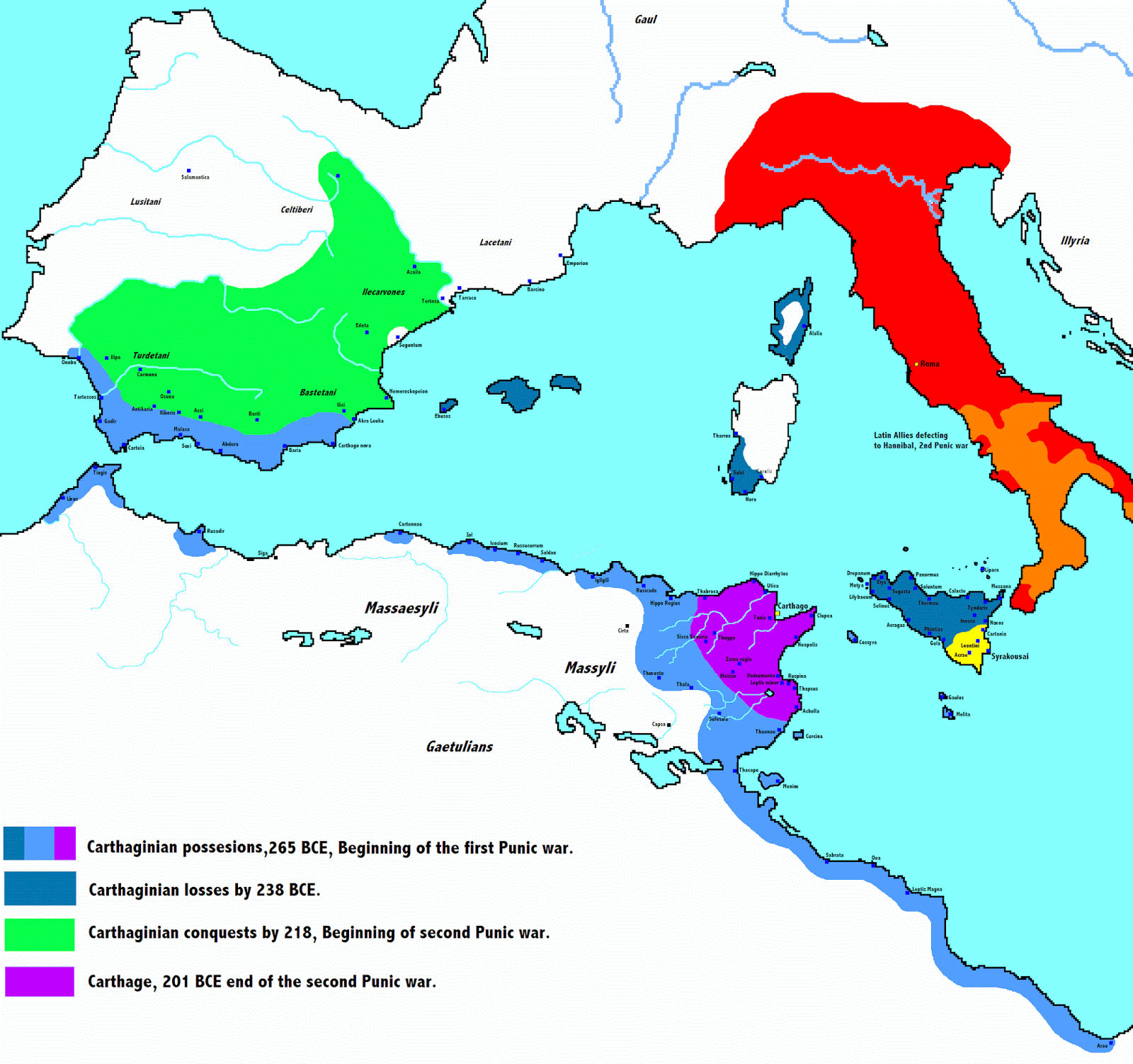
Map of Roman and Carthaginian teerritories (from Wikipedia)