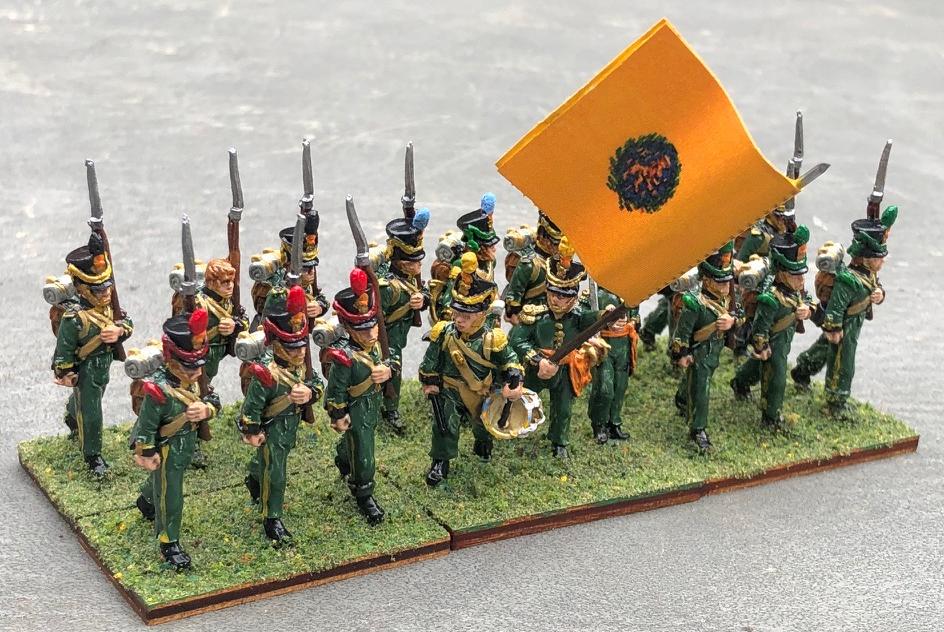
The twin Duchies of Nassau (much reorganized after losing territory to France and the new Grand Duchy of Berg) joined the confederation of the Rhine in 1806.
The Nassau troops were (less than happily) stationed in Spain during most of the Peninsular War.
Nassau left the Confederation of the Rhine in November 1813.
The regiment is equipped here as it was during the Hundred Days in 1815. These are Perry Miniatures. I see that I forgot to trim and paint the top of the flagstaff; that will be corrected momentarily!
Technically the Grenadiers should wear Colpacks, but I have given them shakos like the Flanker company. Note the colored shoulder rolls in red and green for the elite companies, replacing the epaulettes of the French allied years.
Then twin duchies of Nassau-Usingen and Nassau-Weilburg joined the Confederation of the Rhine on July 12, 1806 as the united Duchy of Nassau. They were ultimately required to supply 2 Infantry regiments, each of 2 battalions, and a small cavalry unit of 2 squadrons of Jagers zu Pferde.
In 1807, the Nassau contingent served at the siege of Colberg, and also participated in the assault on Stralsund.
The 2nd Nassau regiment and the mounted Jagers were both sent to serve in Spain in 1808, while the 1st Regiment participated in the Danube campaign in 1809, and then later joined their colleagues in Spain. The 2nd regiment participated in the Battle of Talavera. Nassau went over the the Allies in November 1813; the 1st regiment defected to the British and the 2nd regiment was disarmed in Spain at that time.
During the hundred Days campaign in 1815, the 2nd Nassau regiment was famously present from the beginning of the fighting at Quatre Bras on June 16, and Nassau troops were involved in the fighting at Hougoumont, Papelotte, and La Haye Sainte at Waterloo on the 18th.
These excellent Front Rank sculpts wear the uniform of the 100 Days campaign. The only significant change from the uniforms worn from 1808 were the introduction of the Colpack headdress for the Grenadiers by 1810 (some say fur should be more brown in color), and the change from epaulets (red for Grenadiers, bright green for Voltigeurs) to shoulder rolls or Achselwuelste (red for Grenadiers, yellow for voltigeurs). For details of this uniform one can hardly do better than the Cent Jours site.
The pom-poms on the shakos of the four Fusilier companies were: 1st yellow, 2nd white, 3rd light blue, 4th black. Uniquely, all of the leather work foer the Nassau regiments was buff.
As for the Mounted Jagers, they wore an all dark green uniform of Hussar style (no pelisse) with silver lace, and a black helmet resembling that of the Bavarian dragoons with a green side plume and a black "sausage roll". Belts were silver, later black. They later (post 1810) adopted a dark green pelisse with silver lace and brown fur, and a brown colpack with a green bag, and white tassle (silver for officers).
I had long planned on adding a unit of versatile Nassauers to my collection, but realizing they fought during the Talavera campaign and battle, and needing to place an order to Front Rank for some additional Generals made me pull the trigger on these fellows. They are now ready to march on Lancaster (and Talavera) in just a few more days!
The Grand Duchy of Würzburg was formed in December, 1805. Archduke Ferdinand III, born in 1769 and brother of Holy Roman Emperor Francis II (who was later Emperor Francis I of Austria) was also Grand Duke of Tuscany. When this territory was ceded to France by the Treaty of Luneville in 1801, Ferdinand was compensated by being given the Electorate of Salzburg, By the same treaty, the Bishopric of Würzburg was secularized, and granted to Bavaria in 1803. When Salzburg, along with the rest of the Tyrol, was ceded to Bavaria in the aftermath of the battle of Austerlitz, Ferdinand received the newly created Electorate of Würzburg from Bavaria in compensation. With the dissolution of the Holy Roman Empire in August 1806, Würzburg was elevated to a Grand Duchy, and joined the Confederation of the Rhine (Rheinbund) in September, 1806. This placed Ferdinand in the odd position of being allied to Napoleon, and in potential conflict with his own brother, the Austrian Emperor! The Grand Duchy was located in Northern Franconia, along the river Main, and included the Duchy of Coburg, the Abbey of Fulda, the Archdiocese of Mainz, the Marquisate of Ansbach, the Bisopric of Bamberg, and the County of Vertheim; its capital was in Wurtzburg (an alternate spelling of the city's name). The town of Schweinfurt was acquired from Bavaria in 1810. The estimated population of the Grand Duchy during the Napoleonic Wars was 260,000 people. Würzburg left the Confederation after the Battle of Leipzig in 1813. At the Congress of Vienna in 1814, the Grand Duchy of Würzburg was returned to Bavaria, and Tuscany was returned to Ferdinand! Würzburg was obligated to provide a contingent of 2,000 men to the Reinbund. This consisted of an Infantry regiment of 2 battalions (later increased to three, and then 4 by 1812), 2 squadrons of Dragoons (later three, and changed to Chevaulegers), and a battery of 4 guns. The numbering of the regiments of the small states of the Rheinbund is confusing; I have chosen to use the listing in John Gill's excellent "With Eagles to Glory" as of 1809. Gill places the Würzburgers as the 3rd regiment of the Confederation of the Rhine. The regiment had already been sent to Spain prior to the commencement of the 1809 campaign against Austria, and remained there until the survivors were recalled to Germany in 1812.
The Würzburg Infantry Regiment - these are wonderful Perry figures! The Grenadier and Light companies are distinguished only by sword knots and the plumes on the helmets.
Now that we know who the Grand Duke was, the fact that everything about the unit scream "Austria" makes sense, eh? Probably why it was sent to Spain instead of being stationed in Europe! I have given the unit dark brown "Spanish" pants, which I think looks very sharp. Nothing original, but rather inspired by the pictures of the same unit on the Perry website. The officer, of course, has stubbornly clung to the regulation white trousers!
I used a darker version of my Magic Wash on these figures - aside from having to go back to touch up all the white, I like the results better.
The Perry Command set comes with 2 standard bearers, even though there was only one flag per battalion. Who am I to argue? :-) The cravats were included cast on to the figures. I couldn't find a description for them, so I went with red and white striped; the flagpoles have a red and white spiral design - more Austrian influence! Subtle, eh?
I wasn't sure about touching up the edges of the flag (printed from Warflag/Napflag), but it looks like I will have to do so - with the red-blue-white border, it will be a pain in the neck! :-)
OK , so I took some more pictures after doing the flames and edges with red and dark blue paint.
I do think the improvement is noticeable, if not dramatic. The lighting and background are a bit different as well.
This shot also gives a better look at the elite companies as well.
The modern day city of Wurzburg; "Dom R1" by Guliyev at the German language Wikipedia.
Most Americans are aware of the Hessian states of Germany, if at all, chiefly due to the employment of Hessian troops under contract to the British during the American Revolutionary war. It was troops of the Hessian contingent that Washington surprised in 1776 with his Christmas night crossing of the Delaware near Trenton, NJ. Hessian lands had been split into two separate, small states in 1567: Hessen-Darmstadt and Hessen-Kasel. While both states fought against Revolutionary France, their fates during the Napoleonic Wars were quite different. Both states were initially augmented in 1803, receiving territories from former Imperial free towns and small church states. In 1806, however, the newly elevated Kurfurst of Hessen-Kasel, Wilhelm I, displeased Napoleon when he partially mobilized his army as the war between France and Prussia began. Under the terms of the Treaty of Tilsit in 1807, Hessen Kasel was dissolved and its territories, along with additional; lands seceded by Prussia, were used to form the nucleus of the new Kingdom of Westfalia, which was given to Napoleon's brother, Jerome. Wilhelm returned to his lands in November, 1813, after the French were expelled from Germany following the battle of Leipzig.
Landgraf Ludwig X of Hessen-Darmstadt wisely allied himself with France in 1806, joining the newly formed Confederation if the Rhine as a founding member in July of that year. As a reward, Ludwig was elevated to the rank of Grossherzog (Grand Duke), and Hessen-Darmstadt was further enlarged by receiving all remaining former Imperial possessions found within its (fragmented) boundaries. Its population at this time was probably about 600,000 persons. Hessian troops fought with the French in 1806 and 1807, generally earning a good reputation. Hessian reputations didn't fare as well when their contingent fought in Spain, but the men lived up to their reputation in the Danube campaign of 1809, being engaged in heavy fighting at Aspern as part of Cara St. Cyr's Division of Marshal Massena's IV Corps; Hessian troops also fought at Pressburg, Wagram (being involved in heavy fighting around Aderklaa), and Znaim. Troops from the Grand Duchy continued to fight along side the French is Spain, and also participated in the invasion of Russia in 1812, and the 1813 campaign in Germany, before passing into the Allied camp for the remainder of the Napoleonic Wars.
Map of Hessen-Darmstadt territories over time; the territories in green were added following the Congress of Vienna in 1815; other territories were lost to Prussia at that time.
Hessen-Darmstadt Infantry
In 1806, the army of the Grand Duchy had three Infantry "brigades", essentially the same as regiments in most armies, each composed of 2 battalions of line infantry , wearing dark blue coats, and one battalion of Fusiliers (light infantry), wearing dark green coats. All battalions had four companies of about 120 men, which was increased to 170 men per company for the Danube campaign in 1809. In late 1808, the Gross und Erbprinz brigade, which fought in Spain, was reorganized along French lines into two 6 company battalions with one each of Grenadiers and Voltigeurs, and four center companies per battalion, all (eventually) wearing dark blue coats. It is unclear if or when the other brigades made the transition. The bicorne hat was worn until 1809; thereafter it appears the shako was adopted, bearing a silver heart shaped plaque upon which the heraldic striped Lion of Hesse was embossed. Gill states that the transition to shakos was made late in the 1809 campaign, but notes that the transition "was still incomplete when the contingent returned to Darmstatdt in January 1810". Breeches and crossbelts were white; later, blue pants may have been worn on campaign. All units had red turnbacks on the jackets, with the collar, cuffs, and lapels in the facing color. The Leib Garde and Leib regiments had white button hole lace on the cuffs and lapels; the other units may have had the lace as well.
Hessian Infantry Brigades, 1806 - 1815
Brigade
Facing Color
Button Color
Leib Garde
Bright Red
White
Leib
Light Blue
White
Gross und Erbprinz
Lemon Yellow
White
Prinz Emil (raised 1814)
Pink
White
I am not aware of any 25/28mm manufacturer who makes troops specifically for the Hessians of the Napoleonic wars. For the uniforms up to 1809, I suppose 1806 era Prussians would be the closest fit. Of course, those two are in fairly short supply. As a result, I chose to do my small Hessian contingent in the late 1809 and beyond uniforms with the shako, using Sash and Saber French line infantry figures.
This is the Leib Garde brigade, with its red facings. Note the wings on the drummer, trimmed in white, and the red and white striped rims of the drum. On reviewing my sources, the officer's plume should probably be black with a red base instead of white; I will probably change this.
I have chosen to assume, perhaps without justification, that the Hessian units remaining in Germany ultimately transitioned to the French organization as well - six companies with one each of Grenadiers (red plumes and epaulettes) and Voltigeurs (green plumes and epaulettes). This is implied in Von Pivka's Osprey Men at Arms #122 (see below).
A somewhat blurry photo, but a clear image of the flag of the Leib Garde brigade. Each infantry battalion (but not the Fusiliers) carried two flags. In the case of the Leib-Garde, all four flags were the same as shown above, with an all white field. Flag is downloaded from Napflag.
A rear view of the Hessen-Darmstadt Leib-Garde brigade; the red turnbacks are common to all units. This unit had silver scales on the chinstraps.
Next is the Leib brigade. This unit has light blue facings, which are a bit hard to see well in the photo. Black chinstraps edged with the facing color were worn by this and the remaining infantry units.
Rear view of the Leib brigade. The company pom poms for the first four companies were white, black, blue and red respectively, as seen here.
This view best shows the light blue facings of the Leib brigade, which contrast much more cleanly on the actual figures; quite an attractive combination, I think. I originally painted two 12 figure Hessian units in December 2008, in preparation for our 1809 project at Historicon, using left over Sash and Saber figures. I finally had the time this month to flesh both units out to a full 18 figures (and add one of the glorious Hesse-Darmstadt standards to the Leib brigade, as seen above).
Unlike the Leib-Garde, the other Hessian brigades had two different styles of flags; one Avancirfahne with a white ground, and three Retirirfahnen, with a black ground. The first battalion of each brigade carried one of each, the second two Retirirfahnen. Later, this was reduced to one flag per battalion, with the 1st battalion carrying the Avancirfahne. The corner rays on the Avancirfahne were half black, half colored (red for the Leib brigade, yellow for the Gross und Erbprinz), while the corner rays on the Retirirfahnen were solid in the same colors as listed. The central design was the same for all flags.The flag carried above is the Retirirfahne of the Leib brigade. I have deepened the colors of the red corner rays and black cross somewhat with paint. New flags were issued in 1814; these are shown (and available) on the Napflags site.
SOURCES:
With Eagles to Glory, John H. Gill, 1992. Great book with a fine chapter on Hesse-Darmstatdt.
Napoleon's German Allies (5): Hessen-Darmstadt and Hessen-Kasel, Otto von Pivka, 1982.
Uniformenkunde, plates and text by Richard Knoetel, 1890. Available online here.
I hope you've found this survey useful. I hope to eventually add a Hessian artillery battery and their small Chevauxleger regiment to complete the force. As a closing note, Marshal Davout, not as man inclined to compliments, said of the Hessian performance in 1809, France "could not be better served than by these troops."
ADDENUM October 30th: A few errors were brought to my attention, including the closed lapels worn by Hessian units plus I wanted to fix the chin strap/scales, officer plume color, and I realized I left off the white button hole lace on the Leib Brigade. "Merciful Heavens, your highness, how can we possible go to battle without our Lace in place?"
So, here's the Leib Brigade with those changes made:
ADDENUM December 18, 2022:
Lucas Luber of Piano Wargames in Germany has done a superb range of Hessians in 28 mm metal (and also files for 3D printing), including the infantry, Cavalry, Artillery and High Command. They are being painted, with the first unit already posted now...
I don't know about the rest of you, but when it comes to the armies of the minor states involved in the Napoleonic wars. the Bavarians always come first to my mind. They fought in many of the battles, and their "cornflower" (medium) blue coats and raupenhelms (dating from 1799) are particularly distinctive. They were the first allies I added to my French Napoleonic army way back in the 1970's, and it was the Foundry figures depicted below that finally made me take the plunge and replace my veteran Scruby figures wholesale in the mid 1990's.
Maximillian Joseph, Elector (Kurfurst) of Bavaria from 1799, allied himself with France and Napoleon in 1805, and as a reward became King in late 1805. The Bavarians contributed the single largest contingent to the newly formed (1806) Confederation of the Rhine. They played a particularly large role in the the 1809 campaign in Germany, fighting at Abensburg, Eggmuhl, Regensburg (Ratisbon), Neumarkt, Aspern-Essling, Wagram, and Znaim, as well as extensive (and unpopular) duty against the rebels in the Tyrol and the Voralberg.
Bavarian Line Infantry
In 1809, there were thirteen regiments of Line Infantry in the Bavarian army, numbered 1-14 (with #12 being vacant):
Bavarian Line Infantry Regiments, 1809
No.
Title
Collar
Lapels/cuffs
Piping
Buttons
1
Leib Regiment*
Red
Red
None
white
2
Kronprinz*
Red
Red
None
yellow
3
Prinz Karl
Red
Red
White#
yellow
4
Salern
Yellow
Yellow
Red
white
5
von Preysing
Pink
Pink
Red
white
6
Herzog Wilhelm
Red
Red
White
white
7
Lowenstein
Pink
Pink
None
yellow
8
Herzog Pius
Yellow
Yellow
Red
yellow
9
Graf von Ysenberg
Red
Yellow
Red
yellow
10
Junker
Red
Yellow
Red
white
11
Von Kinkel
Red
Green
Red
yellow
12
vacant
13
Red
Black
Red
white
14
Red
Black
Red
yellow
ALL regiments had red turnbacks, and blue shoulder straps, piped red.
* The first (later renamed “Konig” in 1811) and second regiments had wide button hole tape in the button color as well, 7 bands on each lapel, 4 on each cuff, and 2 at the rear waist of the jacket.
# ? on the collar only
The 11th regiment was disbanded in 1811, and the 13th was renumbered as the 11th, while the 14th was renumbered as the 13th. In 1814, all regiments changed to red facings with yellow buttons, and the button hole lace of the 1st and 2nd regiments was abolished.
First up is IR #8, "Herzog Pius". this regiment has "sulfur yellow" collar, lapels and cuffs, all piped in red. Its buttons were yellow metal, so the lace chevrons on the drummer's coat are yellow,, and the wings are in the facing color, here also yellow, which also bore the crest of Bavaria embroidered upon them (and no, I haven't even tried to paint THAT on the figures!).
I am using my standard six stands per unit organization, and thus the Grenadier company has red plumes, and the Schutzen company green plumes on their raupenhelms.
Although hard to see here, like all the line regiments, the turnbacks on the jackets are red.
The next unit is I.R. #5, "von Preysing". This regiment has pink collars, cuffs, and lapels piped in red, with white metal buttons.
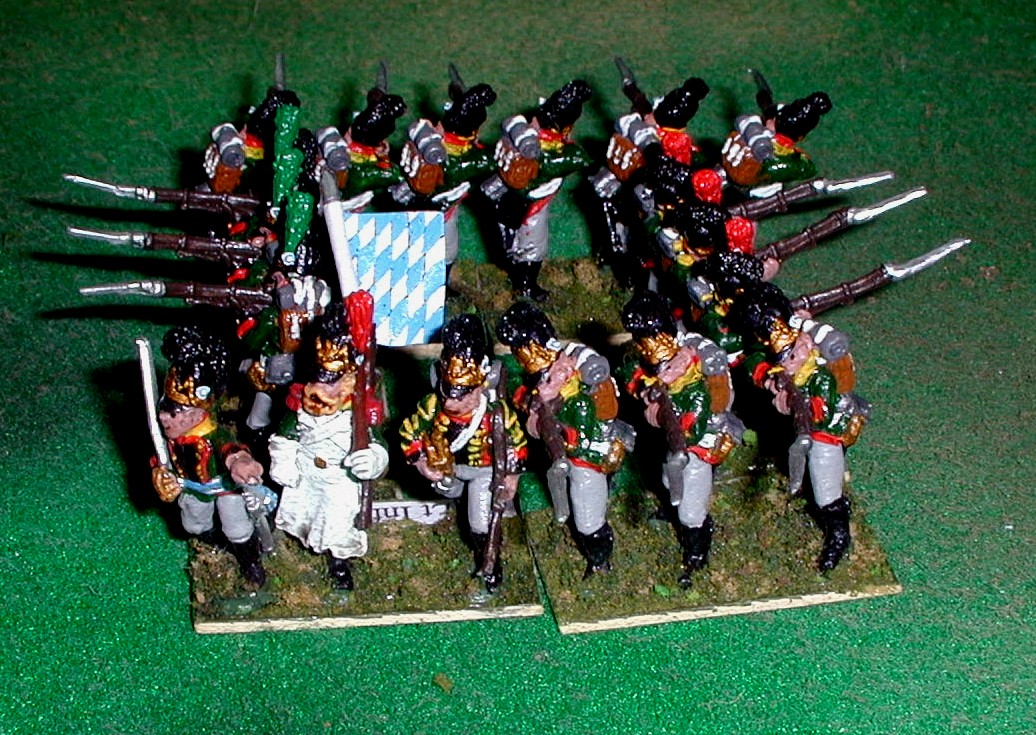
This picture shows the 1803 pattern of the Ordinarfahnen, namely an overall pattern of white and light blue diamonds (rhombi), already associated with Bavaria in heraldry for centuries. It was re-issued again in 1813.
This picture shows the Bavarian cockade, light blue with a white center and rim.
Company distinctions were worn on the raupenhelm above the cockade (not shown on my troops) in the form of wool tufts; 1st company white, 2nd white and yellow, 3rd company green, and 4th company green and yellow. To make things confusing, in the 2nd battalion, the plumes of the elite companies had white lower halves. When third battalions were raised in 1814, the company tufts were changed to solid colors for the first battalion: 1st company white, 2nd yellow, third blue, 4th green; the tufts of the second battalion had white lower halves, and for the 3rd battalions, the lower halves of the tufts as well as the plumes of the elite companies were black.
Here is IR #1, the Leib or later "Konig" (King's) regiment. It has the white lace tabs on the buttonholes. As this unit has white metal buttons, the lace chevrons and edging to the wings of the drummer's coat are all in white as well.
The design of the Leibfanhnen changed numerous times in the early years of the Revolutionary and Napoleonic wars, as territories were added and subtracted, necessitating changes to the central coat of arms. When the realm added Protestant districts in 1803, the Virgin Mary disappeared from the Leibfahnen as well. The elevation of Maximillian Joseph to King from Elector in 1806 required the electoral cap to be changed to a crown. In 1808, the central crest was simplified to just light blue and white rhombi, as seen here.
The central device of the 1808 pattern is seen better in this photo.
Here seen deployed in line is IR #11 "von Kinkel". They probably did seem a bit "kinky", as only this regiment had dark green facings for the lapels and cuffs (piped in red). White metal buttons. Note the blue and white striped patterns on the rims of the brass drum.
The rear view shows the light blue and silver sash of the officer better. This unit's flag has the central crest on a light blue field instead of a white one, a known variant.
Bavarian Light Infantry
Also in 1799, the Light Infantry adopted the Raupenhelm and the more traditional uniform cut from the earlier Rumford styles. The coats of the Light Infantry were initially light green, but changed to dark green in 1809. Unlike the Line infantry Regiments, which were named for their proprietor or "Inhaber", the Light Infantry battalions were named for their commander, which lead to very frequent name changes. All battalions had red turnbacks, white belts (Gill says black, probably an error as Funken, Knoetel, Hourtoulle, and von Pivka all say or show white belts), and grey breeches. The 5th and 6th battalions were added in 1803, and the 7th in 1808. The elite (Schutzen) companies had green plumes, with the Karabinier companies (added in 1811 according to Otto von Pivka in Osprey Men at Arms #106 dealing with Bavaria) wearing red plumes.
Bavarian Light Battalions, 1809
No.
Collar
Collar Piping
Buttons
1
Red
None
Yellow
2
Red
None
White
3
Black
Red
White
4
Black
Red
Yellow
5
Lemon Yellow
Red
White
6
Lemon Yellow
Red
Yellow
7
Light Blue
Red
White
For my Light Infantry battalion, I chose #6, in 1809 titled "La Roche". This unit had "lemon yellow" collars, while the lapels and collarss were black piped in red; red turnbacks.
This view shows the officer's sash well. The hornist has yellow lace chevrons and edging to the wings, similar to that of the line drummers. I have given the sapper figure here a sort of unofficial Bavarian fanion to carry; the light infantry battalions did not have standards.
Late in the Napoleonic Wars (late 1813 to 1814), a number of new infantry formations were raised, including volunteer Jagers, a Grenadier Guard regiment, Garrison regiment, and Landwehr. The above cited Osprey has details of their uniforms for those interested in pitting their Bavarians against the French, instead of being allied with them. Roger, of our gaming group, has every unit in the entire Bavarian army in his collection!
Although it was way back in May 1974, while on tour with the University of Connecticut Marching Band, I was fortunate enough to visit Bavaria. Our trip started in Ingolstadt on the Danube. Unfortunately, our plane had been delayed in Boston by more than 12 hours, so by the time we arrived in Germany, we were all very jet lagged. Therefore, it wasn't until our last few hours there that I realized this city was the home of the Bavarian Army Museum! I made a mad dash there and had a whirlwind tour that lasted a little over an hour, where I could easily have spent a half a day or more there. Oh well! I did get to visit Regensburg (Ratisbon) and see the famous bridge there. When seen in person it is obvious why it could not be easily or completely demolished in 1809, a fact which allowed the Austrians to escape after the battle of Eckmuhl. After visiting Wurrtemburg (Freiberg), Switzerland (Lucern, Geneva, and Zurich), France (Lyon, Nice), Leichtenstein, and Austria (Feldkirch), we returned to Bavaria and spent our last 2 days in Munich. This of course entailed mandatory trips to the Marienplatz and the famous Hofbrau House.
As of this writing, it is pretty much right in the middle of Oktoberfest in Germany, which lasts 2 weeks. It starts in September and ends the first Sunday in October. The best known and most often heard of all German drinking songs, "Ein Prosit", is below. It is usually played by a brass (oompah) band every 15 minutes or so during the Festival.
Roughly translated, the lyrics mean:
"A toast, a toast, to the the warm spirit of comradeship" (and of being pleasantly buzzed, LOL!). So, a toast to all of my fellow wargamers and military history enthusiasts... although, sacrilege that it is, I'll make mine a nice dry Reisling, thanks. Ein, zwei, drei - Gusuffa!
 The twin Duchies of Nassau (much reorganized after losing territory to France and the new Grand Duchy of Berg) joined the confederation of the Rhine in 1806.