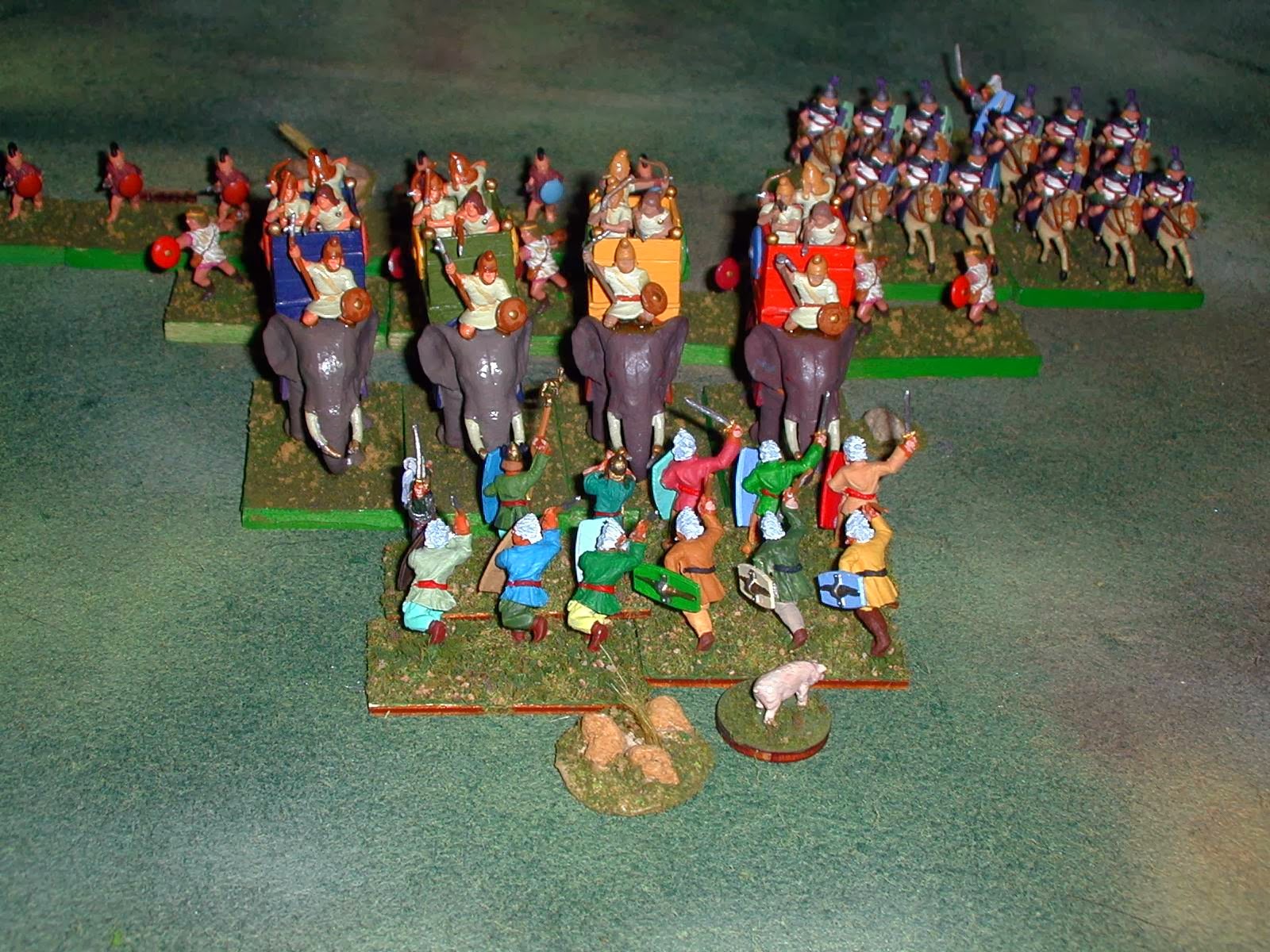
Thursday, February 6, 2014

Portuguese Napoleonic Line Infantry

The Portuguese army underwent major reforms in 1806, in an attempt to modernist the force and make it more effective, Unfortunately for them, there was insufficient time and funds to fully enact these reform before the joint Franco-Spanish invasion of Portugal, led by French General Junot, in November of 1807. By the 27th of that month, the Prince Regent, Joao (John) VI, along with most of his court and some 15,000 people, had departed in a vast fleet for Brazil, to continue the government of Portugal from exile. Junot entered Lisbon on the 30th of November. The Portuguese army was largely disbanded, and its best elements swept up for service in the newly formed French "Portuguese Legion"; it ultimately was composed of three regiments of Infantry and one of Dragoons. They were of course soon dispatched for service outside of the Iberian Peninsula, and participated in the 1809 campaign against Austria, as well as the 1812 invasion of Russia.

Junot's occupation of Portugal would be short lived. The French occupiers displayed little tact or restraint, and by May 1808, the country was rising in revolt against French rule. British troops arrived under the command of Sir Arthur Wellesely at the beginning of August, 1808, and with Portuguese assistance, defeated the French at Rlica and Vimiero, leading to the evacuation of all French troops from Portugal by the terms of the Convention of Cintra. Command of the British forces passed to Sir John Moore, who was then pursued across Spain my a large French army under Napoleon himself. The army was evacuated form Spain in January, 1809, Sir John perishing in the battle of Corunna. At the request of the Portuguese Government, in march, 1809, a British officer, William Beresford, who had accompanied Sir John Moore to Corunna, was named Marshal of Portugal and assigned to reorganize and modernize the army, which he did very successfully, with assistance of large infusions of cash, uniforms, and weapons from Great Britain.

In 1808, there were 24 single battalion regiments of Line Infantry in the Portuguese army. Each battalion had one company of grenadiers, one of light infantry and eight of fusiliers, with a nominal strength of just over 1500 men. A dark blue single breasted jacket was worn For recruitment purposes, each regiment belonged to one of three divisions; the division a regiment came from determined the color of its turnbacks, and the piping in its (dark blue) shoulder straps, collars and cuffs. These colors were yellow for the Northern division, white for the Center division, and scarlet for the Southern division. The following table lists the regiments with their individual facing colors.

Portuguese Line Infantry Facing Colors, 1806 - 1815

Regt.
Name
Collar
Cuffs
Turnbacks/Piping
1
Lippe
Blue
White
White
2
Lagos
Blue
White
Scarlet
3
1st Olivenza
Blue
White
Yellow
4
Freire
Blue
Scarlet
White
5
1st Elvas
Blue
Scarlet
Scarlet
6
1st Porto
Blue
Scarlet
Yellow
7
Sebutal
Blue
Yellow
White
8
Evora
Blue
Yellow
Scarlet
9
Viana
Blue
Yellow
Yellow
10
Lisbopn
Blue
Sky Blue
White
11
1st Almeida
Blue
Sky Blue
Scarlet
12
Chaves
Blue
Sky Blue
Yellow
13
Peniche
White
White
White
14
Tavira
White
White
Scarlet
15
2nd Plivenza
White
White
Yellow
16
Viera Telles
Scarlet
Scarlet
White
17
2nd E/vas
Scarlet
Scarlet
Scarlet
18
2nd Porto
Scarlet
Scarlet
Yellow
19
Cascaes
Yellow
Yellow
White
20
Campo Major
Yellow
Yellow
Scarlet
21
Valenza
Yellow
Yellow
Yellow
22
Serpa
Sky Blue
Sky Blue
White
23
2nd Almeida
Sky Blue
Sky Blue
Scarlet
24
Braganza
Sky Blue
Sky Blue
Yellow


The 21st (Valenza) Portuguese Line Regiment. From the table above, this regiment has yellow  collars, cuffs, and piping. As is often the case, the blue of these uniforms is much darker than it appears in the photos. 


The front stand is a Grenadier company, and has fringes on the shoulder straps - these were blue mixed with the piping (divisional) color, in this case, yellow. 


The cords on the "Barentina" shako, which clearly influenced the later British "Belgic" shako which started appearing after 1812, were blue mixed with the piping (divisional) color, in this case once again yellow. 


This unit was known to have carried this variant pattern of standard, possibly issued prior to 1806.


The next unit is the 14th  (Tavira) Line. This picture clearly shows the usual pattern of the King's color. Each regiment had a second, regimental standard, with the field in the color of the division (piping color), the arms of Portugal in the center, a blue scroll bearing the regimental title beneath the arms, and the royal monogram "JPR" in the corners. Although I hand painted all of these flags, you can download them from Warflag, which also gives the details of the minor variations, cravat colors, etc. Several commercial versions of Portuguese flags are also available. 


Once again, from the table above, the 14th Liner had white collars and cuffs, with red turnbacks and piping.


The piping color (red) once again appears mixed with blue on the shako cords, and the fringes of the Grenadier's shoulder straps. It seems that the Light companies may have had green fringes to their shoulder straps (not shown). 


The Portuguese cockade should be blue and red, in a quartered, bow-tie sort of fashion. 


This unit is the 16th (Viera Telles) Line. I do love those Portuguese flags with their "gyronny" background pattern in blue and red! 


The drums were painted blue with the Portuguese arms on the front, with red rims. Colorful! Drummers wore the same uniforms as the men, with the addition of a special lace to the collar, cuffs, turnbacks and seams. This lace was blue, edged on both sides with the divisional (piping) color, and with small crosses in the same color down the center. 


The 16h, per the table above, has red collars and cuffs piped white, white turnbacks, and white mixed with blue shako cords (and shoulder strap fringes for the grenadiers). 


The last unit is the 24th (Braganza)  Line; light blue collars and cuffs piped yellow, yellow turnbacks, yellow mixed with blue shako cords and grenadier fringes. 


The Barentina shako has an oval brass plate on the front with the arms of Portugal stamped upon it, a brass band beneath it at the bottom with the regimental number engraved upon it, and in between, a hunting horn or grenade badge for the light and grenadier companies  respectively. The plumes on the left side of the shako were white for the Grenadiers and center companies; green for the Light companies.


All of these troops are 25mm Minifigs, painted by me over 20 years ago. Sadly, they have never sen action on the tabletop as yet, a drought which my growing British forces (and eventual Spanish ones as well) ensure will not last too much longer! By the later part of the Peninsular War, the Portuguese troops were considered fully the equal of their British allies. Indeed, Wellington famously referred to his Portuguese allies as "the fighting cocks of the army". 


File:Coat of arms of Portugal (1640).svg

Royal Arms of Portugal


Sources:
North, Rene Soldiers of the Peninsular War. Almark Publications, London, April 1972
 Chartrand, Rene and Younghusband, Bill,  The Portuguese Army of the Napoleonic Wars. Vol 1,2, and 3, Men at Arms #s 343, 346, and 358. Osprey Publishing, London, 2000. 
Over, Keith Flags and Standards of the Napoleonic Wars. Sky Books, 1976.  (I see this can be obtained as a free pdf download from several sites now).

I will cover the Cacadores (Cazadores), Dragoons, and Artillery in a future post. 

Peter

Saturday, February 1, 2014

Battle of the Trebia - AAR part 2

I picked up the action as a solo game on Thursday night, and fought out another hour of the battle. It started out with the Romans actually winning the first  roll with three impetus. They of course opted to act first...

And promptly turned a LULL card; they lost the toss so the Carthagenians played a card - another LULL, which the Romans actually won, and thus Sempronius turned a new card... WARBANDS CHARGE!
Note the really nice custom cards for Pulse of Battle (these don't come with the basic game, but have to be ordered separately - well worth it!)


Now, there was only one Warband of renegade Gauls in the Roman army, and here they are - Disordered, and with 3 UI lost; in other words, as bad as it can get without being removed! 


"OK, Boss, we'll charge those Elephants that have already beaten us twice - good plan!" This is an involuntary action, so the card can be good or bad depending. With the Elephants rolling a D12 and the Gauls a D4, the outcome was as expected; the Gauls were eliminated. 1 Roman Morale Point lost.


The Romans turn a TACTICAL ADVANTAGE ("save it and try to remember to use it!") card, followed by a MOVE ONE COMMAND GROUP. Sempronius opts to apply it (with the TA) to the badly exposed Roman Knights, but rolls only a single segment without "Fancy business"; the best he can do is to withdraw them 1/2 move, which is enough to get both Numdian units no longer positioned for Flank charges. 


With that, the initiative passes to Hannibal. He turns a MELEE card! First, a fresh unit of Spanish Scutarius boldly charges (up to 1/2 move distance straight ahead) into the untouched "Green" II Legion. 


The opposing Velites throw their Javelins and miss, deciding against an attempt to evade, which would likely fail, and as they are already Disordered (note the not so sacred chicken marker - damned Hyopothermia!), that would cost them a unit Integrity (UI). The Scutari decide to hold onto their Pila for a tougher combat, and roll a D12 vs the Velites D6, with the results as above; that results in the Velites being thrown back 6", losing 2 UI, and the Scutarius following up in good order. 2 more Roman Morale Points lost!


The other Carthagenian unit within 1/2 move of the enemy is a unit of hairy Gauls. They are better charging than being charged, so, they do; right into a unit of Roman Hastati of the III (Red) Legion.


The fates smile upon Hannibal's men once again, and the Hastati are forced back, losing 1 UI in the process; another lost Roman Morale Point. The scowl that Hannibal has been wearing since the Roman Knights ran down Mago's Javelinemen  starts to brighten!  


Hannibal draws a MOVE ONE COMMAND GROUP card, and applies it to his left central command, moving the Elephants forward and also adjusting his other Gallic Warband unit so that it has an open path for advancing, along with other minor adjustments. 


The next Carthagenian card is a MOVE card! Mago's Numidian cavalry only roll a single segment with no "fancy pants" (for the LA guys); they move so as to get on the flank of the Roman Knights, and also get them in the field of fire for their Javelins, but opt to hold their shooting for now. The Libyan veteran infantry adjust their lines and move forwards...


as do the right flank Elephants, the Carthagenian Noble cavalry, and the other unit of  Numidian Light Horse. The Roman Knights are starting to feel decidedly queasy - perhaps the Bratwurst they stole from the last Gallic village they burned to the ground in retribution for the inhabitants supporting the Punic cause was tainted?


On the Carthagenian left flank, the Elephants stomp ahead, and the Numidian Light Horse maneuver to get on the flanks of the Italian Allied cavalry and the Roman IV Legion. All cards have been now played from both sides 1st initiative. 


Hannibal; wins the toss handily for 4 impetus, and of course opts to go first - gotta keep the pressure on! He turns... WARBANDS CHARGE! Both units of Gauls surge forward, screaming with battle lust (while Hanno and Agbal, admiring the Gaul's nearly nekkid bodies, just watch with ordinary lust!)


"Barbarians!  Can't live with them, can't have triumphs without them" mutters Titus Hostilius. The first Gaul mauls the opposing Hastati of the II (Red) Legion, and they withdraw in Disorder, losing a UI and *another* Roman Morale Point in the process; the Gauls pursue, losing a UI (but no Morale Points) as a result. The Velites of the IV (Minifigs) Legion wisely opt to evade the charge,  which came from over 8" away, so it was automatically successful. 


Hannibal turns his next card - MOVE ONE COMMAND GROUP! He selects the right center command of  Gisgo, who rolls a Double Magic Move. The Spanish Scutari charge forwards again, this time striking the armored Princeps, who are still suffering from Hypothermia. Both sides throw their pila in the opening round, but the impetus of the Spaniards carries them forwards, and the Princeps are thrown back with the loss of two UI, and yet another Roman two Morale Points!


Meanwhile the Velites evade the Elephants (their javelins going wide of the mark in the process),  which content themselves with crushing the chests of a few Hastati, enraged by the Pila  they hurled at them. Another lost UI and Roman Morale Point, but the melee will continue on at the next opportunity. 


Hannibal turns a much needed LEADERSHIP card, and moves to his left flank to rally the many damaged units there, along with the efforts of his local commanders, Jabnit and Bromoseltzer, son of Bomilcar. This was followed by a second LEADERSHIP card, and the removal of many Disorder and  lost UI markers. Note that Leaders that are attached to their units can only attempt to rally that unit (at an additional Up 1) - not any others in their command. Of course, they can detach from the unit on this card as well. prior to making the rally attempts, or vice versa, as well as moving up to 12". Army Commanders can rally troops as well, but they are limited to only ONE unit per card, and doing so makes them susceptible to loss on the Army Morale Card - Hannibal has taken a calculated risk.  The Carthagenian Left is still somewhat battered, but their spirits have risen greatly!


With that, the initiative passes to Sempronius Longus and the Romans. He draws the LEADERSHIP card, but the Roman commanders have little success in steadying their own wavering troops. This is followed by a TACTICAL ADVANTAGE card, which is saved, and a MANEUVER card. Consul Sempronius uses that to wheel the Roman Knights around to face the previously Ambushing Numidians of Mago; however, as they begin the wheel, the Numidians seize the Opportunity to hurl their Javelins into the flank of the Knights, and this time missile fire finally manage to hit something; the Roman Equites lose a UI (and another Roman Morale Point), and are forced back, almost onto the second unit of Numidians! Maybe it isn't a good day to be a Patrician, after all?


On the Roman Northern flank, the Velites of the IV Legion wheel to protect the flanks of the rest of their Legion. Sempronius turns his final card - MISSILE COMBAT. This allows the Velites to remove their Arrow (Javelin)  markers, thus enabling them to shoot again. As none of the Velites have targets (and all but those of the IV Legion are out of position and battered), the card has little impact. "By the voluptuous vulva of Venus!" swears Longus. "Four cards and nothing to show for them at all! Amazingly, 

Carthage has won every single melee in the second turn so far, and the proud Romans are down to  just two Morale Points. It is time to dice for a new Initiative, and the wily Hannibal will once again roll his D12+1 against Sempronius" D10. He has only lost one Initiative roll so far, the first of this turn, which wound up helping the Carthagenians at least as much as the Romans!


SPQRSPQRSPQRSPQRSPQRSPQRSPQRSPQRSPQRSPQR


An overview of the Battle as it stood following the "intermission", I picked up the battle Friday night from this point. Rome won the toss for Initiative, beating Carthage by 1 pip, and opted to go first, naturally! They turned a MELEE card. 


Up against the ropes, Semproniuis opts to charge with all the units that can engage (within 1/2 move of  an enemy directly to their front) in melee. Romans win battles in manly fashion, by straight up fights, not clever tactics, after all!  Five melees result. On the Roman left, the Roman Knights charge the flank of Mago's Numidian Light cavalry. Ambush, shambush! The Hastai of the I Legion (Yellow) resolve another round of Melee against the Elephants they are already in contact with. 


The Hastati of the II Legion (Green) charge the opposing Scutari.  Given that the Romans are Disordered and down a UI, his was perhaps not the most clever move. However, as can be seen my the markers, the rest of that Legion is in even worse shape.


Finally, the Hastai of the III (red) Legion charge a Gallic Warband and the Princeps of the IV Legion charge the other enemy Warband!


Results of the melees on the Roman Left:; the Roman Knights, unsurprisingly, hammer the Numidians, causing 2 UI loss to them, but but become Disordered in the process, and fail to push the enemy back. Hannibal surrenders 2 Morale :Points with bad grace. The Elephants, however, stomp the ravioli out of the opposing Hastatri, although they fail to drive them off. The Hastati lose 2 UI and, more importantly, two Morale Points; Rome is down to Zero MP! This is critical, because if the ARMY MORALE card is turned while they have no Morale Points, , there is a strong chance that the game will end immediately, and the Romans will have to retreat in defeat!


In the center, both melees have no discernible results (in both cases, each side rolled Odd, which ends the melee for now, and the difference was too small to cause any UI loss).


On the Roman right, the fresh Princeps make the most of their better quality (higher Defense Die Type), heavy armor, and also cast their Pila for good measure; the opposing Gauls are pushed back 3" with the loss of a UI and another Carthagenian Morale Point.

Hannibal now has only 2 Morale :Points left himself, and he calls out a prayer to Tannit to give her aid to his warriors. He then turns his card - MISSILE COMBAT. This allows him to remove the Arrow markers from the many units that have the. Useful, but no Carthagenian missile troops have targets at present, and the ineffective nature of missile fire has already been amply demonstrated. It is time to roll for initiative again. HJannkobal rolls a "2" on his D12, adding one to bring it up to three. Sempronius rolls an "8" on his D10; there will be 5 Impetus in the next initiative. Having won the toss, he is ecstatic, of course chooses to go first; if he can bring Hannibal below zero Morale :points, not only  with the hated Carthaginians be subject to the Army Morale Card themselves, but they will have to start paying the Romans 1 point from the kitty for every one they don't have to surrender (this is the only way that an army can increase it's Morale Points during a game, other than scenario specific rules).  It looks like the great Punic general will be on his own today! 


Sempronius turns his first card - a LULL.  Oh no! Hannibal's Leadership die roll beats his, and the wily African seizes the initiative. Carthage turns a card: MANEUVER. This is of marginal usefulness to him at present. He uses it to make minor adjustments in the facing of a few troops near the flanks. Sempronius turns his second card... another LULL! Hannibal seizes the initiative once again and turns a card - LEADERSHIP. Once again, useful, but a Move or Melee Card would be much more helpful at this point. Mago tries to rally his  Numidian LC and fails, and on his own attempt to rally some of his cavalry, Hannibal rolls a "1" on his D12+1, meaning he fails and can make no further attempts on this card. Curses!


Sempronius is relieved that the LULLs in the action have not cost him dearly. He turns his third card, and intermediately turns very pale - ARMY MORALE! The Roman consul consults his oracles. The sacred chickens refuse to eat, and the liver of the sacrificed calf is severely diseased! Disheartened, Sempronius rolls a "2" on his D10.  He must beat the opposing D12 roll, which comes  up a "6". The Romans have failed Army Morale, and must retreat. The Battle of the Trebia is over! Although his ambush failed to have the desired result, Hannibal has just barely managed to wrest a Marginal Victory from the jaws of defeat. 


Postscript: Note the spread of lost Roman Morale Points (gold coins) at the bottom right of the last photo! A check of the next two Roman cards shows that they would have been "Weather Worsens" (which would mean that it starts to sleet, adding a Hypothermia card to both decks), followed by another Army Morale card. A check of the Carthagenian cards showed that their next card was... Army Morale as well! Perhaps Hannibal's prayer to Tannit was answered, after all?