Cacadores
The Cacdores (or more properly, Cazadores in both Portuguese and Spanish - the word has the same "hunter" origin as chasseur and jager do French and German respectively) were created in the aftermath of the disestablishment of the Portuguese army following the Franco-Spanish invasion of 1807, and its subsequent revival after the French left Portugal following the convention of Cintra in 1808. Initially, six battalions were raised, many of the men coming from the mountainous territories of the Kingdom. They were trained by British officers in the "new" light infantry tactics. The Cazadores became the elite of the Portuguese army. Each battalion had four companies of regular Cazadores, and one of sharpshooter called Tiradores (or Atiradores). Each company had just over 120 men and officers, and thus the paper strength of a battalion was a little over 620 men. They were dressed in uniforms made of dark brown cloth of local manufacture - a good choice for light infantry! Although it was planned to furnish all of the men with rifles, that goal was never achieved. Probably no more than 25 - 50% of the men were so equipped.The initial uniform had the collars and cuffs on the brown jackets varying by battalion, as listed below, with green piping on the collars, cuffs, as well as the brown turnbacks and shoulder straps; the Tiradores had green fringes on the ends of the shoulder straps. The front of the jacket had yellow buttons and cords The "Barentina" shako was worn, bearing a brass bugle horn on the front, as well as a brass band below it bearing the number of the battalion. The shako had green cords, and a plume on the left side. The plume was green for Cazadores, black for Tiradores. Officers were to wear gold cords, and sergeants yellow, although there is some doubt to what extent this was actually observed. Pants were brown or white depending upon the season.... or more likely, availability! Belts were black, usually with a brass plate on the chest where they crossed.
Portuguese Cazadores, 1808 -1811: Uniform distinctions
Battalion
|
Province
|
Collar
|
Cuffs
|
1st
|
Estramadura
|
Dark Brown
|
Sky Blue
|
2nd
|
Algarve
|
Dark Brown
|
Scarlet
|
3rd
|
Beira
|
Dark Brown
|
Yellow
|
4th
|
Estramadura
|
Sky Blue
|
Sky Blue
|
5th
|
Alentejo
|
Scarlet
|
Scarlet
|
6th
|
Minho
|
Yellow
|
Yellow
|
The Cazaores having been so successful, and need for additional Light Infantry great, an additional six battalions were raised in 1811, three of them with cadres from the former green coated Loyal Lusitanian Legion, itself raised from Portuguese nationals living in Great Britain back in 1808. Prior to this, some adjustments were made to the general pattern of the uniform. The yellow buttons and cords in the jacket gave way to black starting in July 1809, as did the piping on the collars, cuffs, turnbacks, and shoulder straps; the fringes on the straps of the Tiradores became black as well. The transition to the British style "stovepipe" shako also began in 1809 - 1810.
Portuguese Cazadores, Uniform Distinctions 1811-1815
Battalion
|
Province
|
Collar
|
Cuffs
|
1st
|
Estramadura
|
Black
|
Sky Blue
|
2nd
|
Algarve
|
Black
|
Scarlet
|
3rd
|
Beira
|
Black
|
Black
|
4th
|
Estramadura
|
Sky Blue
|
Sky Blue
|
5th
|
Alentejo
|
Scarlet
|
Scarlet
|
6th
|
Minho
|
Yellow
|
Yellow
|
7th
|
Estramadura
|
Black
|
Yellow
|
8th
|
Beira
|
Sky Blue
|
Black
|
9th
|
Minho
|
Scarlet
|
Black
|
10th
|
Porto
|
Yellow
|
Black
|
11th
|
Beira
|
Sky Blue
|
Scarlet
|
12th
|
Tras os Montes
|
Scarlet
|
Sky Blue
|

4th Cazadores, wearing the earlier and more colorful pre-1810 uniform. The shade of green is probably too bright here.

Note the black plumes on the Tirador company (adjacent to the windmill on the hill.

Drummers and Buglers (not shown) had brown drums bearing the Royal monogram painted upon them, with black rims. Drummers had white and green scalloped lace on the edges of their collars and cuffs; the lace was yellow and green for Buglers. The Cazadores did not carry standards, except that the 7th and 11th battalions were awarded honorary colors in recognition of outstanding service, starting in 1813. These lacked the yellow diagonal cross of the Line colors. and below the central arms there was a green palm sheath bound by a white ribbon bearing an inscription in Portuguese.
Cavalry
Portugal was not a very suitable country for cavalry, and although the twelve regiments of Portuguese cavalry (sometimes referred to as "Dragoons") dated back to the 1760's, they were chronically under strength especially in horses, even before the French invasion of 1807. The French disbanded the regiments, but they were reformed following the Convention of Cintra in 1808. The re-organized regiments had a nominal establishment of just under 600 men in eight companies.
From 1806 on, the Portuguese cavalry wore dark blue, single breasted jackets with collars and cuffs colored as in the table below. The collars and cuffs, as well as the front seam of the jacket were piped in the color of the military division which they belonged to ; white for the Center, Red for the South, and Yellow for the North. The turnbacks on the jacket were in the same color as the piping. A crested helmet like the British "Tarleton" style, with a red plume on the left side was worn from at least 1806, transitioning to a bell-topped shako similar to that adopted by the British Light Dragoons circa 1811. The shako was also worn with a red plume. Pants could be white, grey, or blue. A black sabretache with a brass plate bearing the arms of Portugal was worn. Belts were white.
Portuguese Cavalry Regiments, 1806 - 1815
Regt
|
Name
|
Collar/Cuffs
|
Piping/Turnbacks
|
1st
|
Alcantara
|
White
|
White
|
2nd
|
Moura
|
White
|
Scarlet
|
3rd
|
Olivenza
|
White
|
Yellow
|
4th
|
Mecklemburg
|
Scarlet
|
White
|
5th
|
Evora
|
Scarlet
|
Scarlet
|
6th
|
Braganza
|
Scarlet
|
Yellow
|
7th
|
Lisbon
|
Yellow
|
White
|
8th
|
Elvas
|
Yellow
|
Scarlet
|
9th
|
Chaves
|
Yellow
|
Yellow
|
10th
|
Santarem
|
Sky Blue
|
White
|
11th
|
Almeida
|
Sky Blue
|
Scarlet
|
12th
|
Miranda
|
Sky Blue
|
Yellow
|

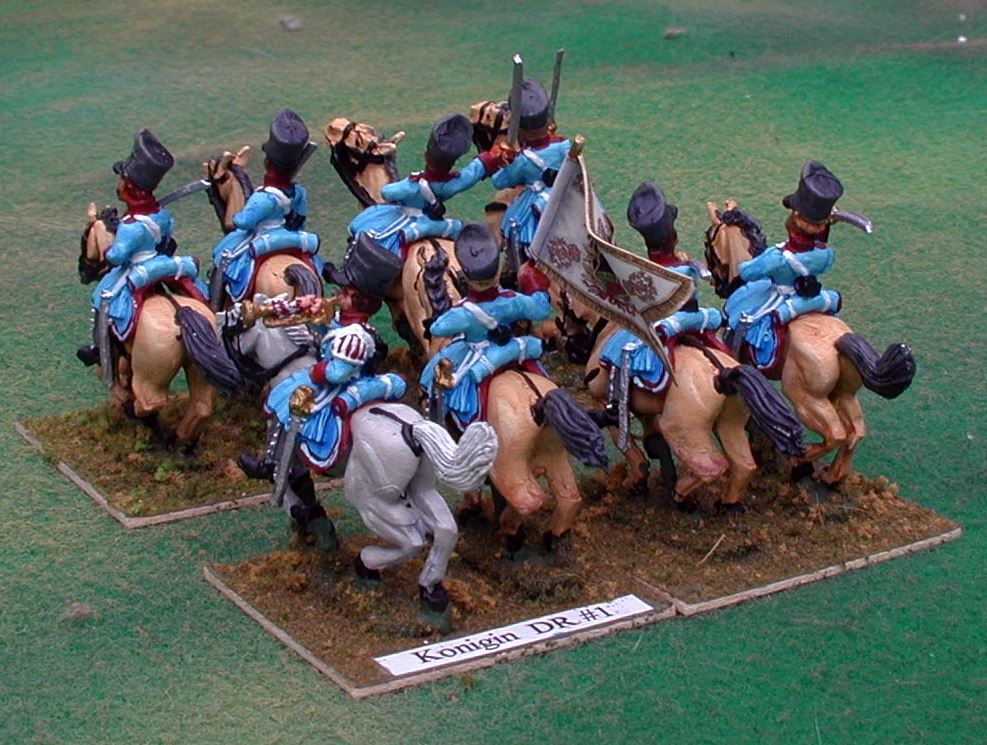
Portuguese 8th "Elvas"Cavalry Regiment, wearing the pre 1811 "Tarleton" style helmet. As per the table above, the collars and cuffs are yellow, edged with the Divisional color, in this case, scarlet. The saddle blankets are blue, edged in the divisional color - once again, scarlet in this case.

Each squadron had a standard bearing the arms of Portugal in the center, and the Royal monogram in the corners; the field of the standard was according to the squadron - white for the first, scarlet for the second, yellow for the third, and blue for the 4th. A blue scroll with yellow lettering lies beneath the Arms, reading "Regimiento 8, e 3", the e representing "esquadra", so 8th Regt, 3rd Squadron.
 \
The trumpeters had broad yellow lace added to their collars, cuffs, and the seams of the jacket. At least one source (below) indicates the trumpeters may have had red crests on their helmets with red over black plumes, so I have of course gone with this more colorful option on these Minifigs!
Artillery
The Portuguese artillery establishment had traditionally been devoted chiefly to manning the guns of the various coastal and frontier fortresses of the country. It was organized into 4 regiments by 1806, each regiment having one company each of miner, pontooniers, and bombadiers, and seven of artillery. They were equipped chiefly with 3 and 6 pounder cannons, organized into batteries ("battalions") of 12 guns. Gun Carriages were painted grey, similar to the British. Aside from some limited experimentation in the early 1800's, there was no Portuguese horse artillery.The Artillery wore dark blue, single breasted jackets with brass buttons. The color and cuffs varied by regiment. The turnbacks as well as the piping on the front seams, shoulder straps, collar, and cuffs were all red. Belts were white. Breeches could be white or dark blue. The "Barentina" shako was worn, with a black plume, red cords, and brass plate, transitioning to the Stovepipe shako starting circa 1810.
Portuguese Artillery Distinctions, 1806 - 1815
Regt
|
Name
|
Collar
|
Cuffs
|
1st
|
Lisbon
|
Dark Blue
|
Dark Blue
|
2nd
|
Algarve
|
Black
|
Black
|
3rd
|
Estremoz
|
Black
|
Dark Blue
|
4th
|
Porto
|
Dark Blue
|
Black
|

A Portuguese Battery; like all figures in this post, these are vintage 25mm Minifigs.

The yellow cords and blue plumes on the shakos are according to an alternate source (below).

Artillery drummers (not shown) had broad yellow lace to their collars, cuffs, and jacket seams. Portuguese Artillery regiments actually had colors, which were similar to those carried by the infantry. We can safely assume that it is highly improbable that such flags were carried in the field.
Sources: same as for the earlier post on the Portuguese Line Infantry, plus:
Lachouque, Henry, Tranie, Jean, and Carmigniani, J.C., Napoleon's War in Spain: The French Peninsular Campaigns, 1807 - 1814. Arms and Armour Press, London, 1982.