Wednesday, July 18, 2012

Convention Transport Logistics

    "Amateurs study tactics; Professionals study Logistics"; so goes a failry well known military aphorism. Now that I'm all packed and ready to depart for Historicon early Wednesday morning, I thought I'd post a bit about the preparatory work. Let me just say that it certainly makes you appreciate the challenges of staff officers, especially in the pre-industrial era!

    For the past 40 (!) years, I've used the same hard, clear plastic shoeboxes to store and transport my troops. Once commonplace items, these have been unavailable for at least the past 25 years. The clear plastic is great for display, and I use the lids as trays that hold the figures, and the lids are color coded - blue for French, white for Austrian, Green for Russian, Dark brown for Prussian, Yellow for Saxony, and so on.
 

Pictured above are my Austrian and Russian Napoleonic armies on the shelves in their boxes; each will hold about 90 28mm infantry, 40 cavaly or 30-40 artillery crew with guns.


These are part of my French and assorted minor state troops - about 20 boxes of each. the Prussians and a smattering of British are above; other shelves hold my Ancient Armies, Late Medieval and Renaissance armies, ECW armies, space ships, 1:1200 sailing ships, 15mm Galleys, etc!

     As a transport mechanism, though, the boxes don't lock that well, and the rigid plastic is somewhat brittle, especially after so many years. A few years ago I placed strips of anti-skid tape (like you might use on stairs) in the lids which helped somewhat with the tendency for the troops to shift around during transport. Still, with my collection now exceeding the available boxes and  more secure transport desired, I decided this was the year to make a serious investment in a new approach.

"Really Useful Boxes" is a company that makes a vast line of, well, really useful boxes!  They can sometimes be found at Staples and other retailers; on one such trip I discovered the 8.1L Really Useful Box (intended to store full size envelopes) seemed to be exactly what I was looking for; the company makes literallly dozens of other sizes, shapes and types. One such 8.1 Liter box holds 60 stands/180 figures of Infantry, OR 30 stands/60 figures of cavalry, OR 20 stands of Artillery (60+ figures), mounted the way I do them. The boxes interlock very snugly with one another, and when the handles are snapped up, they lock the lids in place. Perfect!  So, with a few samples in hand, I made some calculations:


The back of my (hatchback) car will hold one row of 4 boxes, followed by three rows of three boxes, which can be stacked at least 4 high - that means maximum practical capacity is 52 of the 8.1 L VUB's.

My French Army thus would require the following minimum numbers of boxes to transport:

912 Infantry /180 per box = 6 boxes
202 Cavalry/60 per box = 4 Boxes
110 Artillery/60 per box = 2 Boxes
51 Generals/60 per box = 1 box

Total required = 13 boxes; I will be bringing almost all of this to Historicon, plus some allied troops (Italians, Poles, Wurttemburgers, and a few other odds and ends), which certainly shouldn't occupy more than 2 boxes at most. I'll also be bringing my Russians, a bit smaller in number than my French; thus 30 VUB's should certainly be more than enough, and at that rate I wouldn't need the last row, which is good as it will leave space for some scenery and luggage, as well as possibly other troops from Joe, Greg, and possbibly Roger..

"RUB"s of this size are US $9.67 each, so 31 would come to $299.77 plus $45 shipping, so almost $350. Yikes!

    Those old hard plastic shoe boxes will hold up to 90 infantry, 32-40 Cavalry, or 30 Artillery. I can fit up to four rows of six boxes across, stacked up to five high, for a maximum of 120; form a practical standpoint, I need at least the space that would be taken by the 4th row for terrain, etc, so that reduces it a maximum of 90 boxes. Believe it or not, last year I needed to bring more than 90 boxes, but that was due to bringing almost all of my French, Austrians AND Russians, plus six Renaisssance armies and two ancient ones (much smaller).

   So, after obtaining the OK from the Empress (and promising to hold my Historicon purchasing down), I placed the order, and less than a week later three BIG boxes appeared in my driveway...


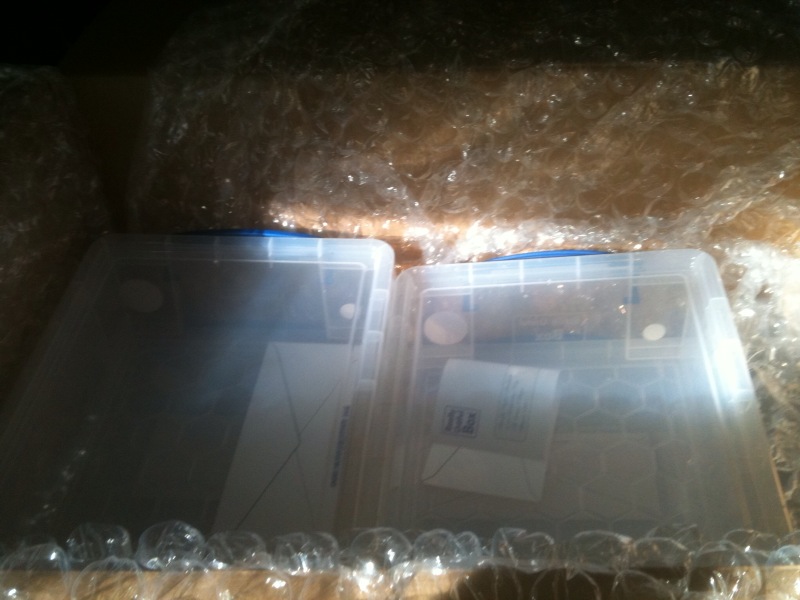
I opened them to be sure they had the correct items and the correct quantity:


Yep, them's the goods, alright!


So they sat in my garage until 10 days ago when I started the Historicon packing process in earnest. This is a picture of a rare sight - my 20 x 6 foot wargames table with NOTHING on it! It is painted blue for naval battles and for sue as the base level for all Geo-Hex tabletops, which I rarely do any more.


The 31 Really Useful Boxes were unpacked and moved downstairs, ready to be loaded up with trooops:


After packing all the French and Allies (left side) and Russians (right side), carefully organized by commands for Borodsino, this is what the table looked like:


Yiikes; looks like a disaster struck my collection - at least as far as all the empty boxes and troops to be left behind. However, here's what the box holding the Imperial Guard infantry and Artillery looks like:


Once every thing was organized (which took about 8 hours) they loaded up really easily into my car, along with the big Grapefruit boxes I use for Terrain, groundcloths, dice, accessories etc.


Maybe this winter I'll tackle adding flex steel to the bottoms of the boxes and magnets to the bottoms of the bases; we'll see how the little guys fare on the trip down without them this time, though!


BRING TO CONVENTION LIST  (I  *always*  forget  *something*!):

1) LOTS of figures, of course including mine, Joe's, Roger and Gregs (Barry will take his own).
2) Terrain - I have big boxes each of roads, rivers (w/ the bridges), trees, woods/fields), and will need to bring quite a bit of Geo-Hex as well. Also my Hovels Russian buildings, and some earthworks  for the Fleches. Fortunately, I offloaded the boxes of Geo-Hex to Barry's car Tuesday AM;l helps thta !
3) Scenarios - 1st Polotsk, Borodino, Maloyaroslavets
4) Field of Battle 2nd edition Rules, Sequence Decks and Summary Sheets
5) Rules, Tape Measures and Pens - I have one Box of just these.
6) Multiple sets of polyhedral dice - one box just for these
7) Markers for hits, Out of Command, Silenced, "smoke" - have 2 boxes for these
8) Morale Point markers - a box just for these, too.
9) Digital Camera... and extra batteries!
10) Emergency Fix it kit - various glues, scissors, index cards.
11) GPS for car
12) EZ-Pass for car - makes tolls much less painful on the long drive from CT
13) Suitcase with clothes, etc
14) Booze to be determined later...


Now it's time to relax poolside with nice cold Rum Punch before the long trip to Fredericksburg tomorrow... Hmm, looks like Rory (youngest of our four dogs) beat me to the prime spot, though!

Wednesday, July 11, 2012

French Imperial Guard Artillery

    The first unit of  artillery to join Napoleon's new Imperial Guard was the Artillerie a Cheval de la Garde, formed in April, 1806. It originated from the Light Artillery company of the Consular Guard, first formed in December, 1799, and later increased to 2 and then three companies; when it was established as a Regiment in 1806, there were six companies. This was later reduced to four companies in 1808; in 1813 a Young Guard company was added.


Horse Artilllery of the Guard, in full dress; these are 28mm Foundry figures; guns are old Minifigs.


Note the grey fur and gold lace on the pelisse of the officer; initially armed with four 4 pounders and two howitzers, per company, later 8 or 6 pounder guns were used at various times. 


The trumpeter's full dree uniform is especially spectacular with it's white colpack, crimson dolman faced sky blue, and sky blue pelisse and breeches. This unit was painted up about 15 years ago, but enhanced by an application of the Magic Wash last week.


Brand new last week was this 2nd company of Guard Horse Artillery; this time these are all Perry figures, including the guns... the first Perry figures to appear on this blog!


These figures depict the men as they usually dressed on campaign - in their long coats, and with the showy plumes, cords, and bags of  the colpack removed to minimize wear and tear (and expense).


These very fine figures were easy to pain; a bit large and chunky compared with, say Sash and Saber or Old Glory, but they look perfectly fine in their own unit.


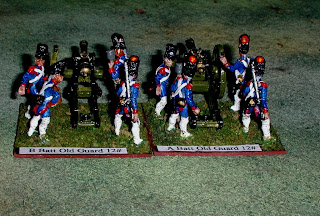
    The Artillerie a Pied de la Garde was formed in April, 1808, with six companies, plus a company of ouvriers-pontonniers. They were usually equipped with twelve pounder cannons. The uniform wasn't particularly different from that of the Line Foot Artillery, at least until the distinctive bearskin headress was added in 1810.


These are Essex figures, painted about 10 years ago and similarly recently enhanced with some magic wash. The 12# cannon are Sash and Saber guns; great models and a great value, too.


The white gaiters were worn for parades; like the visored bearskin, they are fairly unique, so my own Guard unit wears their "Sunday Best" for the tabletop!


The patch or "cul de singe" on the back of the Artillery bearskins was red with a yellow flaming grenade device; the bearskin also had a leather visor or "peak".


 The final addition to the Artillery of the Imperial Guard were the Young Guard or "Conscrit Artillerie" Foot Artillery companies; this began at just three in June, 1809, but reached as many as sixteen (!) companies by 1813. There uniform was essentiallly the same as the Old Guard Foot Artillery, except that the shako was worn (officers could wear the bearskin, however). 


This unit, also just finished last week, uses Old Glory  (I think!) Line artillery crew and guns. 


I should consider adding red epaulettes using some 'Green stuff" as the Young Guard companies did wear them (as did some of the Line Foot Artillery companies as well). 


Like all French foot artillery, armorers were distinguished by a solid red collar (instead of dark blue, with or without red piping), while ouvriers-pontonniers were distinguished by red lapels.


So that's it - something old, something new, Perry, Essex, Sash and Saber and Old Glory, all in the same post. Now, back to packing for Historicon next week!

Peter

Saturday, July 7, 2012

Scenario for Borodino, September 7, 1812

This is the semifinal draft of the scenario we'll be using at Historicon in less than 2 weeks, using Field of Battle rules, 2nd edition, by Brent Oman:

The Battle of Borodino: September 7, 1812

Troop Scale: 1 Infantry unit = 900 men, 1 Cavalry unit = 600 men, 1 Artillery unit = 12 guns.

Table Size: 28 feet long x 5 feet wide (7.5 feet wide for the 6 feet on both flanks). This would give a nominal ground scale of roughly 1” = 12.5yards, about half of standard Field of Battle, with the unit strengths above being 50% greater than FoB standard. To get an idea of the incredible troop density of this battle, to be properly in scale, the table would need to be HALF of the size we're using, and have 50% more units on it. We have opted for the more playable solution above!

Background: Napoleon's massive Grand Armee crossed the River Niemen into Russia on June 23, 1812. Since then, a decisive battle eluded him and the weary French. Finally, almost within sight of Moscow, Kutusov and the Russians offered battle. The result, while not the largest battle of the Napoleonic wars by any means, was the bloodiest battle of the entire Napoleonic Wars, and indeed one of the bloodiest of all time.

Map: The Kolotcha River is Class III terrain. The streams are all class II terrain. The woods are all class 2 terrain. The Redoubts and Fleches are all class 2 terrain. The wolf pits to the North of the Great Redoubt are an additional class II terrain feature for Cavalry only. The village of Borodino is class II terrain as well.

Scenario Rules:

1) C-in-C Morale Pool: 
This equals 10% of the Army’s total Morale Points (additional), thus 19 for Napoleon, and 18 for Kutusov. We’ll use the Gold Coins to depict these, and poker chips for the other Morale Points of the individual Corps (and equivalent commands). On any friendly LEADER CHECK card, the Army C-in-C may transfer as many MP as desired to as many Corps as desired. The transfer is instantaneous. There is no way to replenish these, however. Additionally, these Army Morale Points are needed to commit reserves, and potentially to avoid taking Army Morale Checks for the entire army.


2) Corps Morale Check: 
When the ARMY MORALE CHECK card is turned, any friendly Corps that are at Zero Morale Points must check as per FoB2, by rolling the Corps Commander’s LD vs a D12; If the LD* roll fails to beat the opposing D12 roll, then the entire Command will be placed Out of Command and  moved 1 segment’s move to the rear immediately (artillery will limber up if needed in order to make the withdrawal).  The entire command  will then be removed from the table on the next friendly MOVE card of any kind! (* use a D6 in place of the LD if the Corps Commander is presently a casualty!)

3)
Army Morale Check: 
In addition, when the ARMY MORALE CHECK card is turned, if that army has one or more Corps that have failed Corps Morale, AND more such failed Corps than the enemy army, they are potentially subject to making a Morale check for the whole army in the same fashion, i.e., the Army C-in-C’s LD vs D12, with the army withdrawing and thus ending the game if the LD roll fails to beat the D12. If , however, there are Army Morale Points (C-in-C’s AMP’s) remaining, then the difference in failed commands between the two armies MUST be paid from the C-in-C’s pool, one AMP for each and if the entire difference is paid, then no roll is necessary.

4) French Supply Train: 
These are located at the road entry point on the far French left (see map). The Army is far from France, and already under provisioned; loss of these supplies is likely to have dire consequences! For game purposes, the Supply Train may not move.


5) Russian Cossacks an Opolochenie (Militia): 
These units lose an Army Morale Point ONLY when they are reduced to zero UI, are forced to retreat off the board, or rout for any reason, in which case the unit is permanently removed from play.


6) Russian Toughness and the Culture of the Bayonet: 
The ratings for the Russian Jagers and Line Infantry reflect an UP one to their DD and a Down 1 to their CD when compared to comparable French units.

7) Russian Resiliency: 
Russian Leaders get an UP 1 to their LD roll when attempting to rally their troops.

8) Russian “Army” Commanders (Bagration and Barclay de Tolly): Each of these “wing” commanders may use their LD to re-roll a MOVE for any ONE subordinate (including Corps Commanders) on each MOVE card. There is no penalty for such attempts (i.e., it doesn't subject them to Survival rolls). Finally, they may also attempt to rally any troops within their Army, but this WILL subject them to loss on the survival check, with their entire Army going Out of Command immediately if they fail on a check taken for this reason (Command may be reasserted by subordinate officers on the next LEADERSHIP card). Bagration and/or Barclay will not be replaced if lost, for any reason.

Deployment: 
French (Allied) and Russian forces starting on the table are deployed as shown on the Deployment Map.


Reinforcements: See the Reserve Entry Map and table for each Army at the end of this document; this lists all the (many) formations that start off the table at the start of the game, but are available to enter as reinforcements. Each force has a cost in C-in-C Morale Points that must be paid as soon as the that side's designated C-in-C informs the GM of his intent to commit these reserves; if insufficient points are left, then the formation may not enter the table! The table also list how many move segments that force must expend before reaching the table edge; this will depend on the particular formation and the entry point chosen, which must also be revealed to the GM at the time the troops are dispatched. MOVE segments are rolled for secretly with the GM on friendly MOVE cards in the exact same fashion as for on table commands, including NO move on a LD roll of zero (subject to Corps, etc re-rolls, if any). When a formation reaches 1 segment away from the table edge (or less!), the opposing side is made aware of their presence. Surplus movement segments may be continued onto the table in the same fashion as any other command, so... watch out! Entering troops must enter within 12” either side of the designated entry point. Play testing suggests that waiting too long to commit at least some of the reserves is probably unwise, but, ot course, retaining some flexibility (and or C-in-C Morale Points) has its own value as well. Ah well... such is the burden of Command!

Victory Conditions: It’s all about the carnage! Napoleon must destroy the Russian field army. The Russians must maintain a viable field army. Play continues until one side concedes or fails Army Morale. At that point, compare the number of Corps (or equivalent) that have failed Corps Morale on each side. If the losing side has less than 50% more failed Corps than the victors, it is a Marginal Victory; 50% or more but not twice as many failed Corps is a Tactical Victory; Twice as many but not Three times as many is a Major Victory, and Three times as many (or more) is a Decisive Victory.


French / Allied OOB: Emperor Napoleon I commanding
Sequence Deck = Excellent Leadership: D12 + 1 CR 26”
C – in – C Morale Pool: 19
104 Inf, 25 A, 37C – 187 Corps Morale points. Units indicated as ‘Line’ are assumed to be French line, etc.

File:Vereshagin.Napoleon near Borodino.jpg

Borodino Flank (Kolocha River and North)

IV Corps, Prince Eugene, Viceroy of Italy Leadership D10;
Command Radius 20”, 46 Morale Points (counts as TWO Corps if fails Morale)
1 12# Foot Battery

Italian Royal Guard, GD Pino LD 10, CR 20”
1 Italian Foot guards
1 Guard Conscripts
1 Royal Velites
13th Division, GD Delzons LD 8, CR 16”
1 Legere
1 Provisional Croatian
6 Line
1 6# Foot Battery
14th Division, GD Broussier LD 10, CR20”
1 Legere
1 Joseph Napoleon
6 Line
1 6# Foot Battery

1st Division, GD Morand (detached from I Corps) LD 12+1, CR 26”
2 Legere
5 Line
1 Horse Battery

3rd Division, GD Gerard (detached from I Corps) LD 12+1 CR 26”
1 Legere
6 Line
1 Mecklenburg-Strelitz
1 Horse Battery
Italian Guard Cavalry, GB Traire LD 10, CR 20”
1 Italian Guard Dragoons

IV Corps Cavalry, GD Ornano LD10, CR 20”
1 Italian Chasseurs a’Cheval
1 French Chasseurs a’Cheval
2 Bavarian Chevauxleger


III Reserve Cavalry Corps, GD Grouchy LD 12, CR 24”
Morale Points: 6
1 Horse Battery

3rd Light Cavalry Division, GD Chastel, LD 12, CR 24”
1 Hussar
1 Chasseur a’Cheval
2 Bavarian Chevauleger

6th Heavy Cavalry Division, GD La Houssaye, LD12, CR 24”
2 Dragoon


Center

I Corps, Davout, Marechal d’Empire LD 12+1, CR 26”
Morale Points 35 (Counts as TWO Corps if fails Morale)
1 12# Battery

2nd Division, GD Friant LD 12+1, CR 26”
2 Legere
5 Line
1 Joseph Napoleon (Spanish)
1 6# Foot Battery
4th Division, GD Dessaix LD 12+1, CR 26”
6 Line
1 Horse Battery
5th Division, GD Compans LD 12+1, CR 26”
9 Line
1 Horse Battery
I Corps Cavalry, GD Girardin LD 12+1, CR 26”
2 Chasseur a’Cheval


III Corps, Ney, Marechal de France LD 12+1, CR26”
Morale Points 26
1 12# Batttery

10th Division, GD Ledru LD 12+1, CR 26”
1 Legere
5 Line
1 Portuguese Line
1 Horse Battery

11th Division, GD Razout, LD 12, CR 24”
7 Line
1 6# Foot Battery

25th (Wurttemberg) Division, LG Marchand, LD 10, CR 20”
1 Wurttemberg Line
1 Wurttemberg Light
III Corps Cavalry, GM Wollwrath, LD 12, CR 24”
1 Wurttemberg Chevauleger
2 Chasseur a’Cheval
1 Hussar


VIII Corps, Junot (Westphalian), GD Junot, LD 10, CR 20”
Morale Points 11
1 6# Foot battery

23rd Division, GL Tharreau, LD 8, CR 16”
5 Westphalian Line

24th Division, GL Ochs, LD 10, CR 20”
1 Westphalian Foot Grenadiers
1 Westphalian Guard Jagers

VIII Corps Cavalry, GD Chabert, LD 10, CR 20”
1 Westphalian Guard Chevauxleger
1 Westphalian Hussars


I Reserve Cavalry Corps, GD Nansouty, LD 12+1, CR 26”
Morale Points 8
1 Horse Battery

1st Light Cavalry Division, GD Bruyere, LD 12, CR 24”
1 Polish Uhlan
1 Fr. Hussar
1 Prussian Hussar
1 Chevauleger

1st Cuirassier Division, GD St. Germaine, LD 12+1, CR 26”
2 Cuirassier
5th Cuirassier Division, GD Valence, LD 12, CR 24”
1 Cuirassier
1 Chevauleger

II Reserve Cavalry Corps, GD Montburn, LD 12+1, CR 26”
Morale Points 9
1 Horse Battery

2nd Light Cavalry Division, GD Pajol, LD 12+1, CR 26”
1 Hussar
1 Chasseur
1 Prussian Uhlan
1 Polish Hussar

2nd Cuirassier Division, GD Wathier, LD 12+1, CR 26”
2 Cuirassier

4th Cuirassier Division, GD Defrance, LD 12, CR 24”
2 Carabinier


IV Reserve Cavalry Corps, GD Latour-Maubourg, LD 12, CR 24”
Morale Points 6

4th (Polish) Light Cavalry Division, GD Bruyere LD 10, CR 20”
1 Polish Uhlan

7th Cuirassier Division, GD Lorge, LD 8, CR 16
1 Saxon Cuirassier
2 Westphalian Cuirassier
General Artillery Park of the Army, GD Count Rapp, LD 12, CR 24”
3 6# Foot Batteries


Imperial Guard, Mortier, Marechal d’Empire , LD 12, CR 24”
Morale Points 26

Guard Reserve Artillery, GD Sorbier, LD 12, CR 24”
1 Old Guard 12# Foot Battery
1 Old Guard Horse Battery

2nd Division, (Young Guard) GD Roguet, LD 12+1, CR 26”
1 Tiralleur
1 Voltigeur
1 Fusilier Chasseur
1 Fusilier Grenadier
1 Young Guard 6# Foot Battery

3rd Division, (Old Guard) GD Curial, LD 12+1, CR 26”
3 Chasseur a Pied
3 Grenadier a Pied
1 Old Guard 12# Foot Battery

Vistula Legion, GD Claparede, LD 12, CR 24”
4 Vistula Legion

Guard Cavalry, Marechal Bessiers, LD 12+1, CR 26”
1 Empress Dragoon
1 Grenadier a Cheval
1 Chevauleger lancier de la garde


Utitiza Flank

V Corps, Prince Poniatowski Leadership D12; Command Radius 24”
14 Morale Points
1 Polish Horse Battery

16th Division, GD Zayonchek, LD 10, CR 20”
6 Polish Line
1 6# Battery

18th Division, GD Kniaziewicz, LD 12, CR 24”
5 Polish Line
1 6# Battery

V Corp Cavalry, GD Kaminski, LD 12+1, CR 26”
1 Polish Uhlan
1 Polish Chasseur


Russian OOB: General of Infantry Kutusov commanding
Sequence Deck = Average Leadership: D10 Command: 20”
C-in-C Morale Pool = 18
89 Inf, 36 A, 41C – 179 Corps Morale points.

File:Kutuzovborodino.jpg

Borodino Flank (Kolocha River and North)

Barclay de Tolly, Commander 1st Army of the West, LD10, CR 20”
Morale Points: 9

Artillery Reserve, 1st Army of the West, GM Koutaissof, LD 8, CR 16“
1 12# Foot Battery
2 x 6# Foot Batteries
3 x 6# Horse Batteries

3rd Guard Infantry Brigade, Col Karl Bistrom I, LD 10, CR 20“
3 Guard Jager/Finland Jager


I Cavalry Corps, Ouvarov, LD 10, CR 20”
Morale Points: 14

Guard Light Cavalry Division, Chalikov, LD 12, CR 24”
Guard Hussar
Guard Uhlan
Guard Cossacks
2 Line Hussars
1 6# Line Horse Artillery Battery

Platov’s Cossacks, General Platov, LD 8, CR 16”
9 Cossack Units
1 Cossack Horse Battery


II Corps, Baggouvot, LD 10, CR 20”
Morale Points 15

4th Division, Prince Eugene of Wurttemberg, LD 10, CR 20”
4 Line
2 Jager
1 12# Foot Battery
1 6# Foot Battery

17th Division, Olsuofieff, LD 8, CR 16”
4 Line
2 Jager
2 x 6# Foot Batteries


IV Corps, Count Ostermann-Tolstoy, LD 10, CR 20”
Morale Points 14

11th Division, Bakhmetieff II, LD 8, CR 16”
4 Line
2 Jager
1 12# Foot Battery
1 6# Foot Battery

23nd Division, Bakhmetieff I, LD 8, CR 16”
3 Line
1 Combined Grenadier


VI Corps, Docturov, LD 8, CR 16”
Morale Points: 17

7th Division, Kapsevitch, LD 8, CR 16”
4 Line
2 Jager
1 12# Foot Battery

24th Division, Lichatcheff, LD 10, CR 20”
4 Line
2 Jager
2 x 6# Foot Batteries


V (Guard) Corps, Grand Duke Constantin LD 12, CR 24”
Morale Points 19

Guard Infantry Division, Lavarov, LD 10, CR 20”
6 Guard Grenadier
1 Guard 12 # Foot Battery
1 Guard 6# Foot Battery
1st Combined Grenadier Division, Prince Kantakuzin LD 10, CR 20”
3 Combined Grenadier

1st Guard Cavalry Division, Depreradovitch, LD 10, CR 20”
3 Guard Cuirassiers
1 Guard Dragoon
1 6# Guard Horse Artillery Battery


II Cavalry Corps, Korff, LD 8, CR 16”
Morale Points: 9
1 6# Horse Battery

1st Brigade, Col Davydov, LD 8, CR 16”
1 Dragoon
1 Hussar
1 Uhlan

2nd Brigade, Maj General Klebev, LD10, CR 20”
4 Dragoons
2 Hussars


III Cavalry Corps, Kreutz, LD 10, CR 20”
Morale Points: 5
1st Brigade, Maj General Dyatkov, LD10, CR 20”
2 Dragoon

2nd/3rd Brigade, Maj General Skalon
1 Hussar
1 Uhlan


Center

2nd Army of the West, Prince Bagration, LD 8, CR 16”
Artillery Reserve, 2nd Army of the West, GM Lowenstern, LD 10, CR 20“
Morale Points: 8
4 x 12# Foot Batteries
4 x 6# Foot Batteries

VII Corps, Rayevski, LD 10, CR 20”
Morale Points: 17

26th Division, Paskevich, LD 10, CR 20”
4 Line
2 Jager
1 12# Foot Battery

12th Division, Vasil’chikov, LD 10, CR 20”
4 Line
1 Jager
1 12# Foot Battery


VIII Corps, Borozdin II, LD 8, CR 16”
Morale Points: 20

2nd Grenadier Division, (in reserve), Prince Charles of Mecklenburg, LD 8, CR 16”
6 Grenadier
1 12# Foot Battery
1 6# Foot Battery

27th Division, Neverovsky, LD 8, CR 16”
4 Line
2 Jager
1 6# Foot Battery

2nd Combined Grenadier Division, Voronzov, LD 8, CR 16”
2 Combined Grenadier


IV Cavalry Corps, Sievers, LD 8, CR 16”
Morale Points: 10
1 x 6# Horse Battery

1st Brigade, Panchulidzev, LD 8, CR 16”
2 Dragoon
2nd Brigade, Col. Schtakelberg, LD 10, CR 20”
1 Uhlan
1 Hussar

2nd Cuirassier Division, Knorring, LD 10, CR 20”
3 Cuirassier


Utitsa Flank

III Corps, Tuchkov I, LD 12, CR 24”
Morale Points: 10

3rd Division, Konovnitizin, LD 8, CR 16”
3 Line
1 Jager

1st Grenadier Division, Strogonov, LD 12, CR 24”
5 Grenadier
1 6# Foot Battery


Irregular Forces of the Left Wing, LG Count Markov, LD 8 CR 16”
Morale Points: 12

Karpov’s Cossacks, Karpov, LD 10, CR 20”
3 Cossacks

Moscow Opolochenie, Maj Gen Feodor Talyzin I, LD 8 CR 16”
9 Opolochenie

Smolensk Opolochenie, LG Lebedev, LD 12, CR 24”
3 Opolochenie


BORODINO REINFORCEMENT TABLE: FRENCH/ALLIED


FRENCH C-in-C Morale Pool:  19

Entry
FRENCH Reserves:
M
o
v
e
S
e
g
Cost (AMP)
Formation Name
S
T
U
V
W
X
Y
Z
4
Old Guard Infantry
-
-
2
1
1
2
-
-
2
Young Guard Infantry
-
-
2
1
1
2
-
-
2
Guard Cavalry
-
4
2
1
1
2
4
-
1
Guard Artillery
-
-
2
1
1
2
-
-
1
Vistula Legion
-
-
4
3
2
1
2
3
1
VIII Corps (Junot)
4
3
2
1
2
3
1
IV Res Cavalry Corps (Latour-M)
-
-
3
2
1
2
3
-


French Player Commands:

1.13th and 14th Infantry Divisions/IV Corps, IV Corps Cavalry 
2. 1st Division /IV Corps, Italian Royal Guards, Foot and Horse (Eugene)
3. 3rd Division/IV Corps plus III Reserve Cavalry Corps (Traire)
4. 2nd Division, Corps Arty/I Corps (Davout)

5. 4th and 5th Divisions/I Corps

6. III Corps (Ney)
7. VIII Corps (Junot)

8.Army Artillery Reserve, Guard Cavalry, Vistula Legion
9. Guard Artillery, Young Guard Infantry, Old Guard Infantry (Mortier)

10. I Reserve Cavalry Corps (Nansouty)
11. II and IV Reserve Cavalry Corps (Montbrun, Latour-Mabourg)
12. V Corps (Poniatowski)


BORODINO REINFORCEMENT TABLE: RUSSIAN

RUSSIAN C-in-C Morale Pool:  18

Entry
RUSSIAN RESERVES
M
o
v
e
S
e
g
m
e
n
t
Cost (AMP)
Formation Name
A
B
C
D
E
F
G
H
I
J
K
L
1
2nd Army of West Res. Artillery
-
-
-
-
-
-
4
1
1
-
-
-
2
Imperial Guard Infantry
-
-
4
3
2
1
2
3
4
5
-
-
2
Imperial Guard Heavy Cavalry
-
-
4
3
2
1
2
3
4
5
-
-
1
2nd Cuirassier Division
-
-
5
4
3
2
1
2
3
4
5
-
1
3rd Cavalry Corps (Kreutz)
-
-
3
1
2
3
4
5
-
-
-
-
1
1st Army of West Res. Artillery
-
-
3
1
2
4
-
-
-
-
-
-
1
2nd Infantry Corps (Baggouvot)
-
-
1
3
4
5
-
-
-
-
-
-
1
1st Combined Grenadiers
-
-
4
3
2
1
2
3
4
5
-
-
0
Platov’s Cossacks*
3
2
2
-
-
-
-
-
-
-
-
-
1
Guard Light Cav/1st Cav Corp*
3
2
2
-
-
-
-
-
-
-
-
-
Platov’s Cossacks and the Guard Light Cavalry may not enter any sooner than the SECOND Russian MOVE card!


Looting the Supply Train: Cossacks *only*; for each Russian MOVE card that has one or more Cossack units in contact with the Supply Train at the end of the MOVE, the French will lose the following number of Morale Points from each Corps (no payout to Russians if a Corps drops below zero for this cause): 1 - 2 Cossack Units = 1 Morale Point; 3 - 4 Cossack Units = 2 Morale Points, 5+ Cossack Units = 3 Morale Points
Russian Player Commands:
1. Ouvarov: Platov’s Cossacks and Guard LC
2. 2nd Infantry Corps
3. Guard Jagers plus 1st Army Artillery Reserve (de Tolly)
4.
4th Infantry Corps
5
. 6th Infantry Corps
6. 5th Corps (Guard)
7. 2nd and 3rd Cavalry Corps
8
. 7th Infantry Corps
9
. 8th Infantry Corps
10
. 4th Cavalry Corps plus 2nd Army Artillery Reserve (Bagratian)
11
. 3rd Infantry Corps
12. Opolchenie plus Karpov’s Cossacks


Phew! Aside from last minute revisions by the rest of the team, I think that's about finished! Although the scenario is officially listed for 14 players in the PEL, we figured we'd probably get more, and already have a lengthy add on list; the above allows up to 12 players a side, about the limit for any reasonable seating at the table. Now to start organizing and packing up the troops... HCon departure minus 11 days and counting!

Peter