Saturday, February 24, 2024

Battle of Stromschnellen Crossing, April 1809

 Two weeks ago, Czar Barry drove all the way down from Maine for the game. We played Battle Command, and it reminded me again just how much I like those rules (and the closely related Field of Battle, too... of course! I took the Austrians as FML Hiller, and Barry played the role of  Imperial ADC, General Jean Rapp. To keep everything simple, all the commanders were rated as LD 10.


Starting Deployment; the Austrian defenders hope to use the defensive terrain around the town of Sitzmark to but time for their wagon train to cross over the bridge, and their sappers to set the charges to blow the bridge thereafter, whilst exiting as many of their troops over the Stromschellen river before that. A Bavarian Division with supporting troops from the Wurttemburg Royal Guard enters from the left, a combined Baden and Hessian Division enters in the center, and a Wurttemburg Divisuion enters from the right. 

Confederation of the Rhine, 

General de Division Jean Rapp  LD10


Bavarian Division,  Crown Prince Ludwig  LD10

Bavarian Brigade  von Zandt

1 Jager DD6 CD 12

4 Line  DD6, CD 10

1 Bavarian Dragoon DD6 CD 12

6# FA Battery DD6 CD 12


Reserve Brigade  von Kornhold  LD 10

Wurttemberg Garde zu Fuss  DD 8, CD 12

Wurttemberg Gardes du Corps  DD8, CD 12

Wurttemberg Leibjager Garde  DD 8, CD 12

Wurttemberg 6# Horse Battery DD6 CD 12


Wurttemberg Division, Prince Wilhelm

1st Brigade  von Scharfstein  LD 10

2nd Light Infantry DD6 CD 12

3rd, 5th, and 6th Line  DD6, CD 10

6# Foot Battery DD6 CD 12


2nd Brigade  von Neubronn  LD 10

1st Fussjager DD6 CD 12

1st, 2nd, and 4th Line  DD6, CD 10

6# Foot Battery DD6 CD 12


Cavalry Brigade  von Wollwarth  LD 10

Wurttemberg Chevaulegers #2 "Leib" DD6 CD 12

Jager zu Pferd #3 Herzog Louis  DD6, CD 10


Baden and Hessen-Darmstadt Division Prinz Karl von Baden  L:D 10

Baden Brigade  Kister LD10

1 Jager DD6 CD 12

4 Line  DD6, CD 10

6# Foot Battery DD6 CD 12


Hessen-Darmstadt Brigade  Prince Emil  LD 10

3 Line Infantry  DD6, CD 10

6# Foot Artillery DD6 CD 12


VI Corps, FML von Hiller  LD 10

Saper Company  DD 8, CD10   (2 UI)


Advance Guard Division, GM von Nordmann  LD 10

Jager Battalion  DD8, CD12  Rifles

Grenz Battalion  DD6, CD 10

1st Erzherzog Karl Legion  DD6, CD 8

1st Vienna Volunteers  DD 6, CD 8

6# Cavalry Battery  DD6 CD 12


1st Division, FML von Kuttulinsky  LD 10

4 Austrian Line  DD6, CD 10

6# Foot Battery DD6 CD 12


Light Cavalry Brigade Weissenwolf  LD 10

1 Hussar  DD 8, CD 10

1 Uhlan DD6 CD 12


2nd Division, FML von Vincent  LD 10

4 Austrian/Hungarian Line  DD6, CD 10

6# Battery DD6 CD 12


Reserve Division, GM Rohan  LD 10

1 Grenadier DD8, CD 12+1

12# Foot Battery  DD6, CD 12+1


Cuirassier Brigade  von Schneller  LD 10

2 Austrian Cuirassier DD 8, CD 12+1


Wagon Train, Oberst Langsam  LD 8

4 Wagons  DD 4, CD 6

(2 UI)


Close up of the defender's position


The Wurttemberg Division advances swiftly, taking some casualties from the Austrian artillery.


The Baden Brigade advances on the Erdbeerenfeld farm, backed up by the Hessians.


The Wurttemberg Light Infantry takes the bulk of the casualties covering the advance of the columns.


Baden Jagers are in the farm complex already, and not a wagon has retreated over the river as yet!


Not to be outdone, the Bavarians press the attack as well, taking some point blank fire in the process. 


A Bavarian column supported by some Dragoons charge the crack Austrian Jagers; effective rifle fire drops many of the Bayern!


The Bavarian attack columns are repulsed in the center as well!


Oberst Von Langsam gets anxious as not a single wagon from his train has yet to cross the bridge!


Two Austrian Cuirassier regiments charge the Wurttemburg Dragoons!


Austrian Grenz charge the Bavarian Light infantry in the Hasenhüpferwald!


Austrian Jagers form square, with a regiment of Bavarian Dragoons in charge range! Two of the 4 wagons have finally crossed the river!

General Rapp receives a string of messages from the Emperor urging him to make haste, and thus a Wurttemberg Infantry brigade prepares to charge the Kaiserlick guns on the Harschberg. 


Bavarian artillery fire has blown a large hole in the Austrian left center; routers crowd the wagons seeking the relative safety of the far side of the river!!


Eagle's eye view of the field; the Bavarian Division has suffered heavy losses (upper left corner). 


View from the Confederation lines. 


Volley and counter-volley, charge and counter charge on the Harschberg!


The Wurttemberg Royal Guard Cavalry and Infantry charge into the previously opened gap in the Austrian defensive line!!


The Royal Footguards are routed, as the whitecoats begin to pull back, constricting their perimeter! All of the wagons have now crossed, but the bridge is not yet ready for demolition!


Wurttemberg infantry presses the attack!


Exit stage left, even!


The Footguards have rallied!


More Austrians pass over the bridge, as their sappers work furiously to prepare the last of the charges!


Austrian Cuirassiers chase off the Wurttemberg Dragoons and Jagers zu Pferd. 


The Austrians are out of Morale points, and constrict their perimeter further. The Sapper captain reports that the bridge is mined and ready to blow on the orders of FML Hiller. 


Wurttemberg Light Infantry makes a clever move to shoot the Austrian Cuirassiers in the flank. Evidently they had too much beer with lunch, as their fire is utterly ineffective!!


The Wurttemberg line infantry columns continue to press onward.


Austrian Uhlans charge the Wurttemberg Guards du Corps, as the Bad4rs advance through the Erdbeerenfeld farm complex. 


Situation in the center at the end of the game. The wagons have escaped, and the bridge is ready to blow on the next Event card, but the Austrians have taken heavy losses and will doubtless have to sacrifice more than a few of their units in Sitzmark town and beyond to allow for the destruction of the bridge; a minor victory at least to General Rapp!

Monday, February 19, 2024

Bavarian Foot Artillery of the Napoleonic Wars

 In 1799, the new Elector of  Bavaria, Maximillian-Joseph, ordered a reorganization of the Bavarian Artillery arm. In 1800, the Bavarian artillery consisted of a 10 company regiment, organized in to three companies each of Bombardier-Kanonier-Kompanienl; a single small  Reitende-Artillerie-Kompanie (nascent Horse Artillery). The book strength of the Artillery companies was 100, serving 8 guns. 

For the 1809 campaign, the strength of the Bavarian Artillery had risen to 13 companies. 1 mobile company served in the Tyrol, and the remainder was organized into 3 field divisions, each consisting of
one Leichte-Artillerie-Kompanie of six 6pdr field guns and two 7pdr howitzers, two Artillerie zu Fuß Kompanien each of six 6pdr field guns and two 7pdr howitzers , and one Reserveartillerie zu Fuß Kompanie of six 12pdr guns and two 7pdr howitzers.


In 1811, the Artillery was expanded again, and now consisted of 4 artillery battalions, each having the same organization as the 1809 field divisions, with the addition of a third Artillerie zu Fuß Kompanie. Thus, there were now 20 companies in total. 

The uniform coat was change from the traditional Bavarian scheme of grey with cornflower blue facings to dark blue with black facings in 1791. The Raupenhelm was introduced for the Artillery in 1800, and that time. The uniform was updated in 1804, and did not change significantly thereafter over the course of the Napoleonic Wars. 


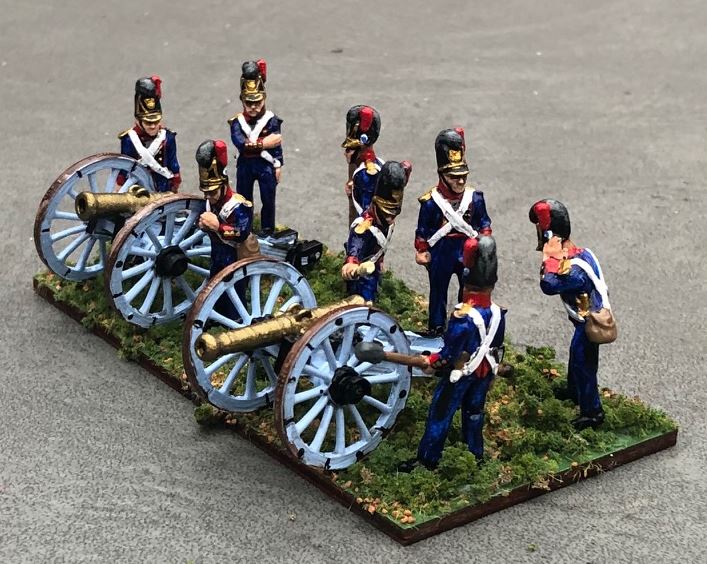
Bavarian artillery carriages, limbers, etc, were painted light blue. The crew and gun figures are once more by Lucas Luber and Piano Wargames. 

Saturday, February 17, 2024

Snow Days, Zoom Plays, and a Package today!

We had a "snow day" with about 10" of snow on Tuesday. Left to right, Annie, Rowan, Maddie, and Brooke. What are they looking for so eagerly?

The package from Piano Wargames, of course!  The spoils of the Danube Campaign, Part 1 Kickstarter arrived today from Germany. Above are the French Chasseurs a Cheval; I got enough for 2 x 8 figure regiments like this; spare figures usually become Cavalry command figures or aides. 

French Dragoons; also enough for 2 regiments plus a few spares. 

French foot artillery.

A French Legere regiment.

A French Line regiment; once again enough figures for 2 units like this. When I eventually get around to painting them, I will have to decide if they will be French, or some other nation; candidates include Swiss, Berg, Dutch, etc. 

Kickstarter bonus figures - Berthier, and the final hours of Marechal Lannes. 

Davout

French ADC's and infantry officer. 

Austrian High Command

Austrian ADC's/Infantry officers

Landwehr

Austrian Chevauxlegers

Austrian Hussars; I resisted the Uhlans as I already have 2 units of same, and there were never more than 4 altogether. 

Got in a Zoom game this week with Tim hosting, and me as the English and David as the French at Crecy. The last of the 3rd wave of the French attack is seen just before they decide that the day is lost and quit the field. The Black Prince was captured twice, and rescued twice, while the French King wound up in English hand, and having to pay, well, a King's Ransom!

Saturday, February 10, 2024

Bavarian Dragoon Regiment #1 Minucci


At the beginning of the Revolutionary Wars, the Bavarian cavalry arm was in very poor shape. Multiple reorganizations followed. In March of 1804, the last of the Cuirassier regiments was converted into Dragoons. 


The two Dragoon regiments had identical uniforms, save only for the color of their buttons and conta-epaulettes: Silver/pewter for the first, and brass for the second. 


Both regiments had scarlet lapels, cuffs, and collars, with white turnbacks edged in red. 


A red cummerbund was worn by both regiments. 


Known uniform variants for the trumpeters include reversed colors, i.e., a red jacket with white facings. 


These are once again the great Piano Wargames figures by Lucas Luber. I am hoping the next Kickstarter will include the Chevauxlegers, of which there were 4 regiments (six in 1811, after the two Dragoon regiments were converted to Chevauxlegers). 


Sunday, February 4, 2024

Setup for the Battle of Stromschnellen Crossing

I set up the table for next weekend's Napoleonic game with Battle Command. Here we are looking South across the unfordable Stromschnellen river. The town of Sitzmark, with its vital bridge are in the foreground

A ways outside of the town is the Erdbeerenfeld farm, and the wooded areas of the Hasenhüpferwald

In the right foreground is the steep Mühleberg, and to the left and close to the river is the Harschberg hill. 

Following the battle of Eckmuhl, the Corps of Austrian General Hiller became seperated from the main body of the Austrian army under Erzherzog Karl. In this version of history, the Emperor assigns hsi Imperial ADC, General jean Rapp, to command an ad hoc Corps composed entirely of troops from the Rheinbund. 

Hiller needs to retreat across the river without allowing the vital bridge to fall into enemy hands. Unfortunately, he also has to get the vehicles of his Corps provisions train across the river before he can start to evacuate any of his troops.

Close up of a Bavarian brigade, reinforced by the troops of the Wurttemberg Royal Guard. The dice dictated that they would enter from the East

Entering from the South is a force composed of a brigade each of Baden and Hessian troops, with some supporting cavalry. 

Finally, entering from the West are two Wurttemberg brigades, once again with their supporting cavalry. 

Overview of the battle from the Southwest. 

Thursday, February 1, 2024

Bavarian Light Infantry Battalion #1


The first Bavarian Leichte-Infanterie Bataillone were formed from the earlier Feldjägers. There were 4 such battalions in 1801, rising to six in 1803 and 7 in 1808. The sculpts for this battalion in "skirmishing" poses is once again by Lucas Luber of Piano Wargames in Germany. 

Each battalion had 4 Fusilier companies and one Jäger company, nominally of  about 140 men in peacetime, rising to 200 men per company in wartime. 

The battalions were generally known by the name of their commander. As these changed often, this could be confusing. For example, this battalion was known as "Metzen" from 1801 - 1807, "Habermann" from 1807 - 1809, "Gedoni" 1809 - 1811, "Hertling" 1811- 1812, and finally "Fick" from 1812 - 1814!

The uniforms of the 7 battalions were the same aside from the collars and the colors of the buttons. All units had dark green jackets with  black lapels and cuffs, both piped red, green shoulder straps piped red, and red turnbacks. 

The light battalions had both drummers and hornists. These were distinguished by added lace in the button color (white or red), with green plumes for the hornists (and red, drooping plumes for the Sappers, or "Zimmerman")

Commissioned Officers wore the traditional silver and blue sashes common the Bavarian officer corps at all levels. In 1811, the battalions were reorganized along the French model, having six companies, one of which was the Jäger company (Green plumes, and about 40 of the men carrying rifles), and one the Carabinier company (red plumes). 


Battalion Distinctions, Bavarian Light Infantry, 1804 - 1809

Battalion #

Collar

Buttons

1

Red

Brass

2

Red

Pewter

3

Black piped Red

Pewter

4

Black Piped Red

Brass

5

Yellow piped Red

Pewter

6

Yellow piped Red

Brass

7

Light Blue

Pewter


Wednesday, January 24, 2024

Wurttemberg Garde zu Fuß Battalion


In 1802 the Grenadier Battalion Zöbel was renamed the Leib-Grenadier-Bataillon, with  Duke Frederick as its inhaber. He renamed the unit the Garde zu Fuβ Bataillon in January 1803. In 1807, the organization of the battalion was changed to mirror that of the line units, and in 1809 a 5th,  light infantry company was added to the Footguards, initially called the Garde-Jäger-Kompanie, and then later (1810), the Garde-Fusilier-Kompanie.  Early in 1814,  following the change from membership in the Rhine Confederation to an alliance with the Allies, three further fusilier companies were raised.  The four light infantry companies were thus formed into a second battalion,  and the resultant, two battalion unit  (one each of Grenadiers and Fusiliers) was renamed as the Garderegiment zu Fuß.

I just love the variety of poses Lucas has sculpted for these figures. 

Note the figure smoking his pipe!


The flag was once again laser printed from the free download files available from the Piano Wargames website. 

Black facings piped in white are worn on the collars, cuffs , and lapels, ornamented by white buttonhole lace (litzen). The turnbacks were initially also black piped white, and then later (1808) just white. 

The uniform of the Fusiliers was identical, except that a black double billed shako with the sides decorated with white chevrons and bearing a tall white  plume was worn in place of the bearskin. The only other difference for the Fusiliers was the wearing of  dark green epaulettes in place of the white one worn by the Garde-Grenadiers.