Sunday, January 26, 2014

British Royal Horse Artillery - Napoleonic Wars

The Royal Horse Artillery was formed i n 1793. It had seven troops (or 'brigades" by 1801, and twelve by 1812. Each troop had six guns, usually 1 howitzer and 5 guns (6lbers or 9lbers); there was one troop equipped exclusively with howitzers. The uniforms of the Horse Artillery changed little from 1799 on, resembling the pre-1812 Light dragoon uniform.


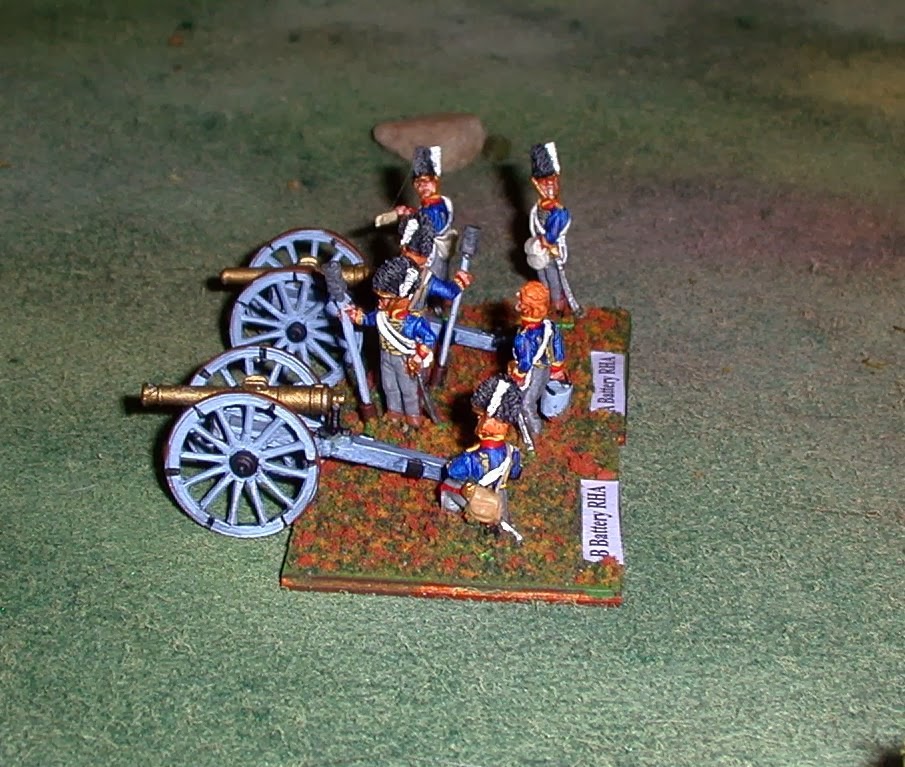
My first troop of RHA; this unit is equipped with 9lber guns.


The artillery models are by Foundry; there is casting flaw in the muzzle of one of the guns. 


The crew are 28mm Old Glory figures.

  
My second troop has one 6 lber and one howitzer gun model each. 


I like having some howitzer models, plus the howitzers allow me increased flexibility for 9 or 6 lber batteries depending upon where the howitzers are assigned. 


I painted the gun carriages Delta Ceramcoat  Wedgewood Blue (a light blue-grey color), washed with Payne's grey, which has a bit of bluish cast as well. Still, the carriages are not quite as blue as they look in the above photo. 


This third troop has all 6 lber gun models.


British long field guns had the "block trail" construction, which lightened the carriages and increased the mobility of the guns. 


This time I painted the rims of the wheels mud-brown color, as some have suggested.


Here are all three troops; I actually painted 8 gun models at the same time; the surplus will be assigned to the Foot artillery when their time for painting comes!


The six guns here would make a 1:1 battery, except that it would have a total of 108 crew and 84 drivers!. 


A few additional colors used:
Braid on jackets: CC Straw Pale mixed 2:1 with CC yellow
Pants: Bridgeport Grey washed with Charcoal about 1:4 dilution.

That brings my British Napoleonic forces so far to 7 Line Infantry, 1 Light Infantry, 1 Light Dragoon, 1 Hussar, and 3 troops of RHA. Getting there!

Peter

Wednesday, January 22, 2014

Assyrian Light Infantry

While I am busy reading through and digesting my copy of Brent Oman's new Pulse of Battle rules (1500 BC - 500 AD) , here's some Assyrian Light Infantry to set the mood!

These fellows are pretty much basic Assyrian light archers, wearing no armor (save their characteristic Assyrian style helmets) and traditional Assyrian costume.


"On my command... Arrows!"


The un-fringed waist belt is an interesting component of the dress of this unit. 


While not extensively used, Javelin armed light infantry could e found among the ranks of the Assyrian army. 


These skirmishers wear sheepskin cloaks. 


Javelinmen such as these would likely be recruited from the surrounding hill tribes and/or Uartu, probably serving as allies/auxilliaries. 


The Assyrians did use significant numbers of slingers; these are the Light/skirmishing version. 


Slingers were supposedly  felt to be especially effective for sieges.


"Goliath, meet David...  "


Another unit of Assyrian Light Infantry archers, wearing a simpler costume, and no helmets. 


Their blue tunics mark them as belonging to my Division Nabu.


The black lining really brings out the colorful fringes on the Assyrian garb, I think.


This unit of light archers wears a very simple costume, without helmet or boots/sandals.


Their costume is characteristic of the Kingdom of Elam, which was often either at war with or allied to Assyria or Babylonia.  It was centered around the cities of Susa, and later Ashan (see map later).  The Babylonians called them Akkadians. Their territory ultimately became part of Persia, and/or Parthia.


The Kingdom of Elam was ancient, located in what is now part of Iran. Its language was evidently rather unique linguistically, and its writings have not yet been deciphered. Elamite was among the languages recorded as being heard in the biblical account of Pentecost. 


Map of the Kingdom of  Elam (from the Center for Ancient Iranian Studies - CAIS)


A short You-Tube video about Elam (the Hebrew name for the Kingdom)

Friday, January 17, 2014

The Norwegian Army - 1814

We'll lead off this post with another wonderful photograph of Norwegian Re-enactors. This pictures and others in this post are from the fascinating website of the Elverum Ski Company at: 


Update 2016: this site no longer exists, sadly, but has been preserved by the Way Back Machine:
https://web.archive.org/web/20130823025932/http://elverumske.no/esc_english/main_eng.htm


The Norwegian Army – 1814, by Eric Starnes  jestarnes66@gmail.com

Artillery: 6 enlisted foot companies and 1 enlisted mounted company. Note: most batteries consisted of either 6 or 3 pdrs. I can provide a more detailed breakdown, though in general, the batteries consisted of 10 guns – 8 - 3 pdrs. or 6 pdrs. and 2 howitzers.
Uniform: Red double-breasted jacket with mid-blue collar, cuffs, lapels and shoulder straps. Pants were grey for foot artillery and grey riding pants for the mounted company. Shako was black with yellow cords. The mounted company had a black shako with brass plate, yellow cords and black plume attached to the top front of the shako. Horse furniture for the mounted company was red with blue piping. Belts were white for both foot and mounted companies.


Another great photo from the Ski Company re-enactor's site. The (Light - 3 lber)  artillery unit depicted might be Danish or Norwegian - the uniforms were nearly identical. Note the (dark) red carriage and (dull) yellow paint on the metal fittings.


Engineer Corps:
Uniform: Red double-breasted jacket with black collar, cuffs, lapels and shoulder straps. Grey pants. Shako was black. Officers wore the same uniform as the men, though some officers wore a long tailed coat with yellow turnbacks [note: all branches of the Norwegian army had officers who wore the long-tailed coat with yellow or white turnbacks, men wore jackets with no turnbacks]. Belts were black.


Cavalry:
Akershusiske Mtd. Jagerkorps: 3 companies of 75 men each.  Uniform: Grey single-breasted jacket with green piped white collar and cuffs. Lapels were piped in green on either side of silver buttons. Shoulder straps were white with a green stripe in the middle. Grey pants. Black shako without plate, green cords and green cockade on top front, black belts and buff gauntlets. Horse furniture was grey piped green. The shade of green was a rather lightish shade of green, somewhat of a Kelly green. Portmanteau was black with black straps.


Sondenfjeldske Dragonregiment: 12 companies of 50 men each divided into 6 squadrons [3 mounted and 3 on foot]  Uniform: Red single breasted jacket with yellow collar, and cuffs, lapels and shoulder straps. White belts and grey pants. Helmet was black with a black comb and a yellow turban. Horse furniture was red piped yellow. Portmanteau was black with black straps.
Trondhjemske Dragonregiment [also known as the Nordenfjeldske Dragonkorps]: 4 companies of 50 men each divided into 2 squadrons. Uniform: Same as Sonfenfjeldske but facing color was dark green.

More Norwegian and Danish Re-enctors


Infantry:
3 Enlisted regiments: 2 enlisted jager companies, 8 enlisted musketeer companies, 2 national jager companies, 10 national musketeer companies. They were organized as follows: 2 enlisted battalions of 500 men each [1 jager, 4 musketeer companies], 2 national battalions of 600 men each [1 jager and 5 musketeer companies]

Uniform: Red jacket without turnbacks, grey, blue or white pants with black gaiters. Black shako with white cords and cockade in facing color. White belts for musketeers and black belts for jagers. Regimental facing colors for collar, cuffs, lapels and shoulder straps were:
Sondenfjeldske - dark blue with white piping and yellow buttons
Nordenfjeldske - dark blue facings with white piping and white buttons
Oplandske – dark green facings with white piping and white buttons


Norwegian Line Infantry Uniform
 (but Eric says white cords (same as for the Danes),  probably correctly)


6 National regiments: 2 enlisted companies, 3 national jager companies and 15 national musketeer companies, organized into 3 battalions [1st and 2nd battalions had 1 enlisted co., 1 national jager co. and 5 national musketeer cos., 3rd battalion had 1 national jager co. and 5 national musketeer cos.]
(Peter's note:  "National" in this context pretty much equals "Militia/Landwehr" units)

Infanty Uniform: Same as the enlisted units (except for the Jager and Sharpshooter Regiments)
Telemarkske - dark green facings with white piping and white buttons
Vesterlenske – black facings with white piping and yellow buttons
Bergenhusiske – black facings with white piping and white buttons
Trondhjemske - yellow facings, white piping and white buttons
2. Trondhjemske – yellow facings, no piping and white buttons


Norwegian Re-enactors at the Tojhus Musee - and they do seem to have the red mixed with yellow cords on their shakos after all!


Akershusiske Sharpshooters – Dark. grey jacket and pants with green piped white collar, cuffs and shoulder straps. Officers dressed same as men but in a fur lined jacket.
Norske Jagerkorps: 4 enlisted companies of 120 men.
Uniform: Same as Akershusiske Jagers but with white piping on collar and green piping on either side of jacket lapel buttons, which were white.
Valdreske National Sharpshooter Battalion: 1 national jager and 5 national sharpshooter companies [600 men total]
Uniform: Same as Akershusiske Jagers except collar piped in white on top and bottom and on either side of jacket lapel buttons which were yellow.
Bergenhusiske National Sharpshooter Battalion: 1 national jager and 6 national sharpshooter companies [700 men total]
Uniform: same as Akershusiske but without piping and yellow buttons.


Norwegian  Jagers/Sharpshooters, 1814


Sondenfjeldske Ski Battalion [acted as jagers in summer]: 1 national jager and 5 national sharpshooter companies [600 men total]
Uniform: Dark grey single breasted jacket and pants with black collar, cuffs and shoulder straps. Buttons were yellow piped in green on either side of lapels. Black gaiters and shako with green cords and cockade for men and yellow cords and green cockade and plume for officers. Officers' uniforms had grey fur on collar and cuffs. Lapels had brass buttons on either side linked with gold cords.

Norwegian Ski Troops, 1814

Nordenfjeldske Ski Battalion [acted as jagers in summer]: 1 national jager and 5 national sharpshooter companies [600 men total]
Uniform: Dark grey single breasted jacket and pants with black collar, cuffs and shoulder straps piped white. Buttons were pewter, buttonholes piped in green on both side of lapels. Black gaiters and shako. Cords and cockade green for men. Officers’ uniforms: dark grey jacket and pants. Jacket had pewter buttons linked by gold thread across chest. Collar and cuffs were grey fur. Shako was black with yellow/gold cords, green cockade and plume. 


 The marvelous Elverum Ski Company Re-enactors once again, here  wearing the 1814 Uniform 

From their website (listed earlier): "The original Elverumske Skieløber Compagnie was first established in 1747, one of three companies (the Elverumske, the Hofske, and the Åmotske) that formed the Sønnenfjellske batallion of skiborn troops. A 3-company Nordenfjellske ski batallion (consisting of the Holtålske, Snåsenske, and Merårkerske companies) was formed at the same time. The men of the ski batallions were trained and organized as light-infantry soldiers, and were mainly employed on reconaissance and patrol duties. With the coming of the winter snows, however, ski-trained troops acquired great mobility and could, in some respects, function as light cavalry. The men were all conscripts, and remained on the Army List for a period of nine years. After basic recruit training, they were required to report for 12 days' service each year. The company could be speedily mobilized in the event of war. Defeat in 1814 saw the break-up of Denmark-Norway, and the union of Norway with Sweden. After 1814, the new military command considered the ski companies to be of minor importance, and they were disbanded in the period from 1818 to 1826."

More great shots of the Elverum Ski Company

Crossc-ountry trekking in Norway

Rear view


Engraving depicting Norwegian Ski troops


Summertime target practice!


Back to Winter!


Officer


Trooper


The Ski Company at a monument to their namesake's fighting Swedish occupation in 1814. 


Figure Suggestions – 15mm

Artillery – 
www.falconfiguresuk.com
makes appropriate figures that are available in their Danish Nap. line.  DAN 08 – which contain 8 figures
(ADD - may no longer be available)

www.miniaturefigureines.co.uk
makes appropriate figures that are available in their Danish Nap. line as well but you’ll have to substitute the top hat for the shako.

Cavalry –
For the Sondenfjeldske and Trondhjemske Dragoon regiments, Falcon Figures [website listed above] make figures:   DAN 09 – Dragoon command [contains 3 command],  DAN 10 – Dragoon troopers [contains 4 troopers]
Also Minifigs [website listed above] makes figures as well [these are what I use, as I like Minifigs cavalry]
For the Akershuske Mtd. Jagers, basically any dragoon figures in shako will work, like Nap British Dragoons. You may have to fudge some of the details [like turnbacks] but in 15mm that’s fairly easy.

Infantry –
As with the artillery and cavalry, Falcon Figures makes 1813 Danes in shako which are great for Norwegians:    DAN 02 – line infantry command [contains 6 figures],  DAN 03 – line infantry [contains 8 figures],  DAN 04 – light infantry command [contains 6 figures],  DAN 05 – light infantry [contains 8 figures]
The light infantry can be used for the Sharpshooter, Jager and Ski battalions as well.

Alternatively, one could buy Nap 1815 Brunswickers in the short coat manufactured by Essex or Minifigs for a little variety.

www.essexminiatures.co.uk
If you can find the old Jacobite line, they also have appropriate figures as well, though they’re a little lacking in detail and are a little on the stiff side for my liking.

FIgures - 28MM
Eagle figures makes some Danes, most of which could be used as Norwegians as well:
http://www.eaglefigures.co.uk/wordpresstrial/?page_id=12&slug=index&cPath=3_31

Perry Miniatures now have Danish/Norwegian Line infantry and grenadiers, in both the earlier and later uniforms:
https://www.perry-miniatures.com/index.php?cPath=23_28_91


Royal Arms of Norway

Sunday, January 12, 2014

Assyrian Cavalry

    The Assyrians were one of the first major powers of Ancient times to incorporate large numbers of Cavalry into their army. Over time, they started to replace the more traditional Chariots. The Assyrian Cavalry included archers and spearmen ("lancers"), both light and heavy; the heavy cavalry in particular may well have been dual armed with both.


Assyrian Heavy cavalry Horse Archers


As noted above, they may have carried spears as well. The torso armor was the same "mail" of small plates of iron sewn together into a short sleeved shirt of armor seen on their infantry. 


As with the rest of the army, the cavalry units nominally belong to a certain "Division" depending upon the color of their tunics; these Cavalry wear the light orange of Division Shamash. 


A second unit of (Minifigs 25mm) Assyrian Heavy Horse archers.


The units have sub units of 2 stands each, distinguished by their own color to the fringes, etc, in this case, one red and the other white. 


The light purple tunics indicate that these fellows belong to Division Nergal. 


Assyrian Light Horse archers


Presumably they performed the scouting, harassing, screening and raiding functions that would characterize Light Cavalry for the next 1,000 years!


The green tunics place them in Division Ishtar.


Assyrian Horse archers are seen in this bas-relief; an effective saddle had not yet been invented; stirrups would also come much later in Ancient history.