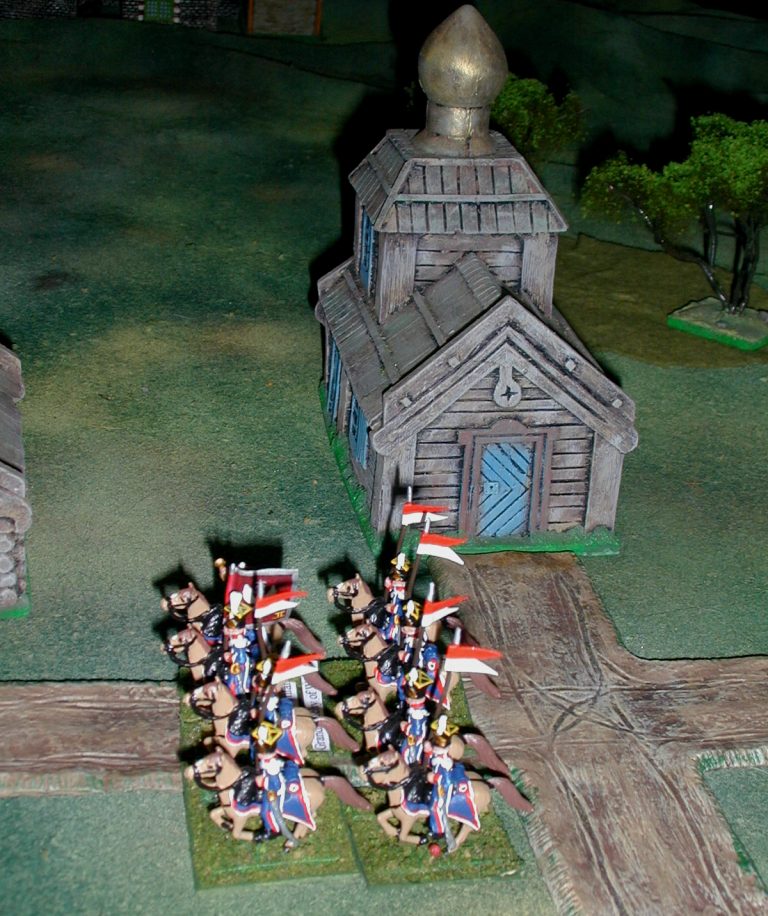
The Emperor and the Kaiser were at war. As this circumstance was more the rule than the exception, it hardly requires explanation. Suffice it to say that the Emperor's attempt to seize the crown of Spain for his brother was viewed by the Kaiser as both outrageous and offering the opportunity to invade the territory of the Emperor's ally while he was still distracted in Spain. In the course of said invasion of Bavaria, General Count Herbert von Carrion was ordered by the Kaiser to seize the bridge over the Raubersfluss and destroy it, whilst General Prince Sorbet, was ordered to seize the bridge without delay, as the Emperor was racing to the Front in his carriage, and he and his entourage needed to pass over the bridge swiftly to commence his chastisement of the forces of the Kaiser for their acts of aggression.
Turn 1 - Start
To start the turn, a green ("free") D6 is rolled - a 5. This indicates the turn will start with phase 5, which is the Artillery actions phase. The opposing C-in-C's then roll their leadership dice. Von Carrion, being Headstrong, starts with 4, while Sorbet, having a cooler disposition (Average), has but three. Sorbet rolls his three yellow "leadership" dice, a 3, 3, and a 6 for a total of 12, while Von Carrion rolls a 2,5,2, and a 1 for a total of 10. Sorbet has won the initiative, and chooses to act first, as his guns are well positioned to advance and are well lead.
Turn One, Phase 5 - French Initiative.
First, the light foot battery attached to the 6th Infantry brigade is chosen. The Brigade commander is the Compte de Champagne, who is Average (3 Leadership Dice). As phase 6 (Rally and Restore) will follow this one, Sorbet knows any Leadership dice expended in this phase will be restored in the next, so he may as well make use of his sub commander's Leadership dice! In order to pass leadership dice to a unit under his command, the Leader in question must roll their Leadership dice and roll equal or less than the distance to the unit. Champagne rolls his thee yellow Leadership dice, and scores an 11. Von Carrion measures the distance to the French battery: just under 11". Drat! The test is successful, and Champagne passes all three of his Leadership dice to the battery. Now Sorbet must decide whether to roll one or two red "resource" dice. He must roll at least one, and no more than 2. Resource dice, once used, are gone forever, and as the battery is unlimbered, which counts as Column of Route formation, it will get two additional green "free" dice to roll. However, it takes 6" of movement for the battery to unlimber, and it will not be able to fire until the next Rally and Reload phase comes up. The attempt to unlimber must be declared before any dice are rolled. As it happens, that is the very next phase, and by rolling a single resource die, the battery will be rolling six dice for movement. As it is a crack battery, it will also be able to re-roll its lowest die, as well as the lowest multiple. One resource die seems adequate here. Champagne rolls: 1,2,3,3, 5,5. As a Crack unit the 1 is re-rolled - a 2! All but poor units can re-roll their lowest multiple, now the two 2's, which he does, and gets a 3 and a 4. The battery's final total movement roll is thus 3+3+3+4+5+5, or 23"! Von Carrion scowls and comments "don't forget to deduct the 6" for unlimbering!" "Quite alright", replies Sorbet coldly; "I didn't want to move them that far anyway". Indeed, the 17" move ends with the battery even with the village of Raubersdorf, unlimbered, and looking to make Von Carryon's attempt to ford the Raub river quite hazardous. "Remember to chuck out one resource die for that, Sorbet" grouses Von Carrion. Sorbet tosses a red resource die airily into his previously empty discard bin. "Rather well spent, eh?" he observes.
Moving on to his remaining batteries, another light foot battery is attached to the 3rd Infantry Brigade, commanded by the Baron of Burgundy. An Average Leader and thus having 3 Leadership dice, he is within 2" of the battery, and thus no roll is necessary to transfer dice, as it is impossible to roll less than 3 on 3 dice! Burgundy decides to use 1 Resource die only, and pass only two of his three yellow dice. He rolls a 1,2,3,6,6. This battery is average, and thus cannot re-roll the lowest die, and he certainly doesn't want to re-roll the only multiple (the pair of sixes), so the roll stands. Having declared his intent to unlimber, 6" is deducted resulting in a move of 12", and the battery once again , marked with a puff of "smoke". Another red resource die is tossed into the French Discard bin.
There remains a Heavy 12 lber battery and a Horse Artillery Battery under the command of Sorbet's Artillery chief, Colonel Amusez-BoucheBouche elects to re-roll the three "3's", the lowest multiple. He scores a 2, 3, and a 6; added to the two 5's that makes 21". He deducts 6" for the turn and 6" for the unlimbering for a final move of 9". The battery is once again marked with smoke, and 2 red resource dice are discarded (one for each of the 2 batteries). "I could fire my Horse battery at your chaps, von Carrion, but it doesn't seem quite prudent, now does it?" Sorbet observes airily. "Then that ends your part of the phase, and it is it time for my lads to act" rumbles von Carrion in his low baritone.
Resource dice used: 4 French

Turn One, Phase 5: Austrian Initiative
Von Carrion is none too pleased; Sorbet has managed to position his artillery most favorably. Perhaps he can orchestrate an effective counterpoint!
Herzog Andante's Advanced Guard command has a light Foot battery in position to advance upon the critical bridge. Andante is Inept, which means he has but a single Leadership die, and can only roll ONE resource die when advancing upon the enemy. Von Carrion, the C-in-C is Headstrong, which means his troops add a free die when moving, must re-roll the lowest die, and must move the full distance rolled! As the Rally and Restore phase is next, Andante decides to add his lone LD. He is 2" away and rolls a "1", so the attempt is unsuccessful. The battery declares its intent to unlimber, and rolls 1 red, and 3 green (two for being in Column of Route/Limbered formation, and one for a headstrong C-in-C) dice 3,5,5,5! Re-rolling the "3" results in another 3. Andante is afraid this will bring the battery too far forward, and chose to re-roll a pair of 5's; he gets a 1 and a 4. The final total is thus 15", and deducting the 6" to unlimber, the battery moves forward 9" and is marked with smoke. This is a good position, so Von Carrion smiles blandly and comments "Looks like your guns aren't the only ones to be well sited, eh?". Prince Sorbet contemplates wiping the smile off his opponent's face by firing at the newly advanced battery with his Horse battery, but decides not to... at least for now.
Von Carrion turns to his large Infantry Division, commanded by the Very Dependable Baron Subito, which has 2 Light Foot batteries attached. He decides not to bother adding any Leadership dice, and rolls 1 red and three green dice, totaling 13; deducting 6" gives him a 7" move which allows the battery to move up even with the first one. For the second battery, he rolls 2,2,3,6. Looking at the situation, he decides that it might be better to move this battery (rated "average") farther and up against the Raubersgrube hill, so he rolls the pair of 2's (lowest multiple) and scores a 3 and a 5! Total is now 17, so deducting the 6" for limbering leaves 11" which puts the battery in pretty much the position Von Carrion had in mind. This leaves the Light Foot Battery attached to the Reserve Division, leading the column on the road. This Division is lead by the Foolhardy Graf Largo; foolhardy leaders ALWAYS must roll 2 resource dice whenever possible, so he takes a test and adds one of his 3 leadership dice. The battery, which is again average, declares his intent to both maneuver and unlimber, and rolls 2 red, 1 yellow, and 3 green dice: 2,3,5,5,6,6. Von Carrion could choose to re-roll the pair of 5's, but this looks to be about the right score for what he has in mind (having a headstrong C-in-C, he MUST take the whole movement available), so the battery is advanced into position. The final battery, a horse gun attached to the Light cavalry, is blocked by a massed column of infantry in front of it and so chooses not to move. A total of 5 resource dice have been thrown into the Austrian discard bin for this phase. Pleased with his maneuvers, Von Carrion hears a sweep of strings in the sound track accompanying the battle. It appears that only he can hear the music, but what of it?
Resource Dice used: 5 Austrian

This phase concluded, the game moves on to Phase 6, "Rally, Restore, Reload". Neither Sorbet nor Von Carrion have used used any of their Leadership dice, so Von Carrion tosses 4 dice - 1,2,3,5 = 11 in total. Sorbet gives a flick of his somewhat limp wrist and his three dice come up 2,4,6! The French have won the toss again, and Sorbet opts to act first.
Turn One, Phase 6 - French Initiative
This phase allows the following, in any order:
A) Attempt to rally units in disorder or Rout. As he has none, Sorbet need not waste his limited intellectual prowess on considering this option!
B) Eliminated Officers are replaced. While Sorbet can definitely think of some leaders he's like to eliminate, he has not lost any so he passes over this option as well.
C) Leadership dice are restored. His army has certainly used a few, knowing this phase was next.
D) All units, except Cavalry and Skirmishers, remove fire marker puffs and my fire again.
The Prince realizes that his Horse Artillery Battery does not have a Fire marker on it; thus he may as well fire it now, or the chance for an extra shot will be lost. In addition, as Leadership dice are due to be replenished, he may as well try to augment the battery's fire with Leadership dice now. Colonel Bouche has already used but one of all his leadership dice and the battery appears to be well over 6" away from him. He prefers not to use dice from his new allotment and have few left for the rest of the turn. Only a unit's commanding officer, or the C-in-C, may transfer Leadership dice, and as Sorbet has used none, he has his full quota yet available. A scheme starts to coalesce within his cortex.
"Say there, Von Carrion, I rather fancy a shot by my horse battery, which as you will note is fully loaded already. As I shall replenish my Leadership Dice regardless, I'm going to use them to support the fire of the battery. All right by you, my good fellow?"*
* (Sorbet has conveniently forgotten that adding Leadership Dice to offensive fire is not allowed, although he manges to remember it when Van Carrion attempts it later in the battle)
"Check to see if you pass first", Von Carrion replies in rapid staccato .
"Oh yes, bother, there is that. Well, here goes!" He rolls three yellow dice - a 1... and another 1. Curses! The final die comes up a glorious 5. They measure the distance from Sorbet to the battery - just over 6", so the dice are passed successfully. He chooses his target - the closest unlimbered Austrian battery. He chooses to roll 2 red resource dice, plus his three yellow leadership dice. He also gets a green free die because the battery is elite. He then measures the distance to the target - almost 21, extreme range! As it is the battery's first fire, he will be able to re-roll his lowest die.
As Sorbet prepares to select his dice, Von Carrion remarks "Well, two can play at THAT game, Old Bean. I have four Leadership dice of my own to add to the defense roll by my battery.
"Roll your check, then" Sorbet responded, more than a bit tartly. Von Carrion rolls - 3, 2, 1... Blast it all - and then a 5! The battery turns out to be just over 10" away, so Von Carrion has succeeded as well. The Austrian battery, with the odds in its favor, chooses to roll only one red die, plus 4 yellow ones, plus a green (free) die for being fired at at extreme range, plus another because the battery is deployed, plus yet another because it is the first fire by that battery at a target at long or extreme range. Because the Austrian battery has a fire marker still on it, it will also be able to re-roll its lowest die.
Sorbet rolls - 1,1,2,3,5,6. He re rolls his lowest multiple, the two 1's, getting a 1 and a 6. He the re-rolls his lowest die, the lone 1, and gets a 4. His final total is 26.
Von Carrion rolls - 2,2,2,2,5,6,6,6. Total of 29. He could re- roll some or all of the 2's, as well as his lowest die, but there is no need as he has already bested Sorbet's. As this was long range fire, had he failed to beat Sorbet's score, he could have done another complete re-roll, although that would cost fresh Resource dice. "Imagine your gunners are bit whipped from their gallop forwards, eh Sorbet?"
"Well, I have no more units that can fire, so I'll reload all my guns and take their fire markers off. I don't think I'll try any more long range fire just now, so that leaves me nothing more to do than to replenish all my leadership dice", which he does. Sorbet discards two red dice and Von Carrion one.
Resource Dice used: 2 French (6 total), 1 Austrian (6 total)
Turn One, Phase 6 - Austrian Initiative
Having the same options, and no units than can fire before they remove their fire markers, Von Carrion silently removes the fire markers and replenishes his Leadership Dice.
Both eminent generals roll their freshly replenished Leadership Dice for initiative for Phase 1. Sorbet rolls 2,4,6; Von Carrion 1,1,2,5. Sorbet has outscored him for the third time in a row despite rolling fewer dice.
Turn One, Phase 1 - French and Austrian Initiatives
"Specialized Actions", which allows skirmishers and cavalry to reload, Engineering actions, and ships, balloons, trains etc to take action. In later periods, repeating rifles and Machine guns may also reload on this card. As it is, neither side has any actions they can take in this phase at present, so Sorbet graciously allows the Austrians to "act" first this time out. Von Carrion's stomach rumbles and he belches in response to the jab by Sorbet. Maybe those chili cheese fries he had for lunch at the pub before the battle weren't the best idea, after all.
Turn One, Phase 2 - French and Austrian Initiatives
"Officer Actions" which basically allows all leaders to use 4 Free dice for movement. On the initiative roll, Sorbet rolls a 9, and Von Carrion an 11; as a counterpoint to Sorbet's equally meaningless earlier courtesy, Von Carrion declares, "Gentlemen of France, you may act first!". Both generals adjust the positions of their generals using 4 free dice for each general moved; none needed to move further than their rolls allowed. Initiative for the next phase was diced for; Sorbet scored 15 and Von Carrion 20. He chooses to go first.
Turn One, Phase 3 - French and Austrian Initiatives
Phase three is Cavalry Actions. Von Carrion's Light cavalry is still blocked by the infantry in front of them, but his Heavy cavalry brigade is free to move on the far right Austrian flank. Graf Forte, their commander, is every bit as Headstrong as Von Carrion himself. He is 5" from one Cuirassier unit and 6" from the other; he easily passes the test to pass along one Leadership die to each unit. As they are Heavy Cavalry, they get a free die and re roll the lowest. As their commander is Headstrong, they get another free die and another re-roll of the lowest. Each unit rolls 1 red, 1 yellow, and two green dice; they will have to move the entire distance. The right hand unit rolls - 1,1,2,3! As the unit is average, it can re- roll the lowest multiple, and scores a 4 and a 6! The 2 is now the lowest die so that is re-rolled for a 3, and the next lowest a 3 is re-rolled for a 5. Final move distance -18", quite different form 7". The second unit rolls 3,4,6,6. Re rolling the 3 becomes a 6, and re-rolling the 4 becomes a 2 - final move distance is 20" Two resource dice are discarded.

The initiative passes to Sorbet. His Light cavalry are blocked by the infantry to their front, and he debates facing them to their left so that they can cross the Raub, but as they still won't be able to move, he decides the resource dice are better saved for a time when the Cavalry can make better use of their mobility. Besides, this way he can keep Von Carrion guessing about his plans. "I think I'll pass on this phase, Von Carrion!' he remarks.
The two generals roll their Leadership Dice again, and this time Von Carrion easily outscores Sorbet, and chooses to go first.
Resource Dice used: 0 French (6 total), 2 Austrian (8 total)
Turn One, Phase 4 - Austrian Initiative
This is the Infantry Actions Phase. "Ah-hah" trumpets Von Carrion; "At last we come to the meat of the turn, my dear Sorbet!" He chooses his left flank Advanced Guard Infantry Brigade to move first. This has 4 units in a massed column poised to cross the Raub. General Andante is Inept, but he is within 1" of the formation and thus may pass his lone Leadership Die without needing to test. Each of the 4 units in the Massed Column will roll one red resource die, and the highest roll only will count; to that will be added a green die (for Massed Column formation) a second green die (for a Headstrong C-in-C) and the Leadership Die. Von Carrion rolls a 5, then a 6! There is no need to roll the remaining two red dice, but they still echo as the four dice are tossed into the Austrian Discard bin. He rolls a 3, a 4 and a 4 on the additional dice, a total of 17. The stream is Class III, however, and thus any dice scores of 1, 2, or 3 are ignored. As the C-in-C is Headstrong, they must still move the maximum possible distance. Because they are entering difficult terrain, 6" (the rule of six) is deducted from their move. This leaves them with 8", enough to cross with room to spare. Andante has two units of Landwehr under his command as well. One is in line, and rolls a "3" on its single red die (he has no more Leadership Dice to pass), and another "3" on the green die (for a Headstrong C-in-C). Being an Inept commander, Andante cannot re roll dice of 3 or less, so they move forward 6". The second unit is in Attack column and thus will get an extra free die for that and another (Headstrong). Von Carrion announces his intent to change formation, and rolls a 3, 5 and a 6! He could re-roll the 3 (lowest die, because of being in attack column), but it seems unwise. Deducting 6" for deploying into line, the second Landwehr unit moves up behind the artillery line. Two more red dice are gone.

Next, Von Carrion turns to his large Line Infantry Division. Its commander is Very Dependable, and he is within 6" of two separate, 4 unit strong Column masses. The one closest to the guns doesn't need any more dice, but he hopes to seize the Raubersgrube with the Mass to his right. He easily passes the test with his 4 Leadership dice, and passes 2 dice to that mass. Both masses will get the best of four Resource die rolls, plus 2 green dice (Mass and Headstrong C-in-C), and the right mass will get the 2 yellow dice as well. The left Mass, not surprisingly, rolls a 6 as its best of 4 red dice, and then another 6 and a 5! Egads, at this rate the Mass will overrun the Artillery line, disordering both. Von Carrion re-rolls the lowest die, the 5, and get a lower score as he had hoped, a 3. Desperate, he re- rolls the lowest multiple (pair of 6's) as well, scoring a 2 and a 4. The resulting 9" move is enough to move up in support of the guns without going right through them. "Rather against the spirit of the thing, don't you think, old boy" grouses Sorbet. The right hand mass gets a 5 as its best of 4 red die rolls, and then rolls only 1,2,2,3 with the remaining dice. He re-rolls the lowest die (Mass), and the one becomes a 2. He re-rolls the lowest multiple (three 2's) and gets 5,5,6. The final total is 24! The mass moves forwards obliquely a little over 12", whereupon it encounters the Raubersgrube and must halt. 8 red dice are removed from play.
Finally, Von Carrion examines his Reserve Brigade, commanded by the Foolhardy Graf Largo. Each of the 4 Grenadier units is in column of Route, strung out along the road. Each will get 2 free dice for being in Column of Route, another for having a Headstrong C-in-C, and yet another for having a foolhardy sub-commander, PLUS they MUST roll 2 red resource dice (never one), AND move the FULL distance. The Austrian Grenadiers are rated as Guards, and thus do not get yet another free die as Elites do, but as they all rolled up Crack, they may re-roll their lowest die. Feeling his heart pound a bit like a tympani, Von Carrion resolves to act rather than await events. He declares the intent to change formation with all 4 units, and decides there is clearly no need to add Leadership dice to the equation! Taking a breath deep as though he were about to sing an aria, he rolls for the Grenadiers, from closest to farthest: 1,1,2,3,4,5 = 16, 10" after deducting 6" (the rule of six) for deploying into line, then 1,1,2,3,6,6 = 20", 14" after allowing for the formation change to line. The next rolls 1,2,2,6,6,6 for 23", less 6" for changing into Attack Column is 17", and the final unit rolls 2,3,4,4,5,5 - here he chooses to reroll the lowest, so the 2 becomes a 4; 20" after deducting for changing into Attack Column. Miraculously, this stacks the now deployed Grenadiers one behind the other almost perfectly! Eight more red resource dice are expended. "I say, are you about DONE there, Vee-Kay?" whines Sorbet. "Why yes, I do believe I am. Your go, Prince."
Resource Dice Used: 0 French (6 total), 22 Austrian (30 total)

Turn One, Phase 4 - French Initiative
Sorbet starts with the 6th Infantry Brigade on his far right, lead by the boringly Average Compte de Champagne. The Brigade is in Column mass, and he decides to throw all of Champagnes Leadership Dice into the mix, easily passing the test as he is just over 4" in advance of them. The highest of 4 red die rolls is a 5, and that plus 1 green die (for Mass) and 3 yellow dice, plus a re-roll of a 2 yields a total score of 27"! The Mass moves forwards a little over 23" and then halts when it hits the edge of the plowed fields outside Raubersdorf (Class I terrain). Four red dice are discarded.
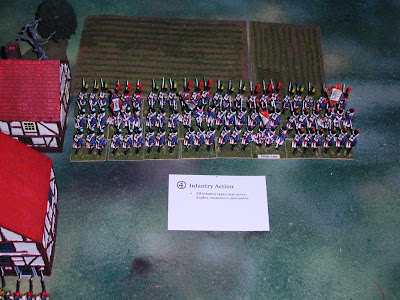
Next to them is the 5th Brigade, lead by the equally Bland Compte de Chambertin. These units are in separate attack columns, and once again Sorbet chooses to allocate all of the Compte's 3 Leadership dice, two and one respectively to the lead units, again passing his test to do so. When all is said and done, this results in the lead two units reaching Raubersdorf, while the rearward two units trailed behind considerably. Four more resource dice are discarded.
Following in turn is the Baron of Burgundy's 3rd Brigade, yet another officer of undistinguished vintage. Sorbet has him successfully pass all three of his Leadership dice to the unit closest to the river, declaring his intent that they should change formation. With five dice plus a re-roll of the lowest, the unit easily moves forward and deploys into line between the gun line and the river. The other 3 units move forward variable distances in a generally satisfactory manner. Another 4 red dice are gone forever.
The second Brigade is lead by the Baron of Bordeaux, evidently of more formidable stock as he is quite Headstrong in character. His Brigade is in column mass and will thus roll an extra green die for that and another for having a Headstrong sub-commander. "Say there, Sorbet, care to use any of your Leadership dice for them?" asks Von Carrion in an almost sing-song like voice. It seems both unwise and unnecessary to Sorbet, however, so he does not. After a re-roll of a low die, the Mass moves forward 12", directly behind the French gun line. Four more red dice are lost, tossed like a salad into the French discard bin.

That leaves the two small Light Infantry Brigades, poised to cross over the river Raub. Baron Boursin's 1st Brigade is in a 2 unit column mass. Both units are Elite Light Infantry. The Baron, needing a touch more seasoning, is only average, but he contributes one of his three Leadership Dice to the move. The Brigade gets a free die for Mass, a free die for being Light Infantry, and yet another for being Elite. The best of the two red die rolls is a 5, and with the three green and one yellow die added in, the total comes to 19! Von Carrion breaks into Sorbet's reverie, saying "Don't forget to deduct 6" for crossing the river; rule of six and all that, you know!" Although the subtraction leaves a bad taste in his mouth, he complies, and the Brigade moves 13" across the Raub. But Von Carrion is not finished; returning like variation on a theme in a Mozart Bassoon concerto, he chortles. "Duuu-uuude! Do I have a flank shot I have on your Lights?" (In the heat of the moment, he has quite forgotten the sophisticated affectation he so carefully cultivates. He swiftly recovers his composure.) "By the Kaiser's hare lip, I believe it is!"
"Looks to be extreme range" sniffs Sorbet petulantly.
"And what of it? My battery will take the shot! Let's see, that's two free dice for a flank shot, and as it's my first shot, I'll get to re roll the lowest die. Hullo, my own figure is within 7"; I shall pass 2 Leadership Dice to support the fire of the battery!"
Sorbet replies snipily "Oh no you don't, Vee Kay; Leaders can only add to Defense in Fire, and Attack in Melee… right there on page 24."
"Oh, bother!", ejaculates Von Carrion, who incidentally loathes being called Vee Kay, as Sorbet is well aware.
Now cool as a late summer cucumber, Sorbet asks in his sauciest tone, "Well, are you taking the shot or not?"
"Can't pass up the chance - I'll roll 2 resource dice plus the two free dice; how about you, Sorbet?"
"Patience, my bold friend. I think we should measure the range first." Tape measure in hand, Sorbet determines it is just a half an inch over 24" from the battery to the nearest Light Infantry. "Tough luck that, my man... out of range! I'll trouble you to give up those two resource dice, though, if you please!" Von Carrion does so with notable bad grace, as he also marks the Austrian Battery with smoke.
That leaves only the 3rd brigade, also of two Elite Light Infantry units. Its commander, the Compte de Camembert is a sharp one, emulating the tactics of the great Fabius Maximus of antiquity. This has no effect when his troops are advancing, only when retreating, and he has five Leadership dice. He opts to commit three of them, and as he is less than an inch from his troops, there is no chance he will fail to pass the dice. The best of his two red die rolls is a 4, and then he rolls three green and three yellow dice: 1,1,1,2,3,5. As he is crossing a Class III stream, any 1's, 2's, or 3's and their multiples are ignored, and he must also subtract 6" in addition. The net move is just 3". Three inches with SEVEN dice? Sorbet's mood deflates like a soufflé taken out of the oven prematurely. "Seems your Léger don't like getting their feet wet, Prince!" observes Von Carrion sharply. Sorbet scowls as he tosses 4 red dice in to the French discard bin.
Resource Dice Used: 20 French (26 total), 2 Austrian (32 total)

"Well, that would seem to about finish the first turn, eh Von Carrion? What say we adjourn upstairs while we take a glass, and then return for turn two?"
At this point, we must introduce our critic, Herr Ignatius Quintilius von Brenner, epicure and musicologist late of the court of His Majesty, the King of Saxony, and a friend of the two esteemed military gentlemen. Herr von Brenner?
"They both didn't do too badly in the first turn. Artillery fire at extreme range seldom accomplishes much except consuming resource dice, and Von Carrion really should have remembered that pre-measurement is never, ever, allowed, and been more cautious about taking a dicey shot like that in the first place. Those Headstrong commanders can move forwards rapidly, but they're almost like loose cannon, ha-ha, once they start in motion! Now you'll have to excuse me; that glass is sounding mighty good to me as well!"
Till next time when we pick up the tale of Sorbet and Von Carrion...
Good gaming!
Peter
Turn 1 - Start
To start the turn, a green ("free") D6 is rolled - a 5. This indicates the turn will start with phase 5, which is the Artillery actions phase. The opposing C-in-C's then roll their leadership dice. Von Carrion, being Headstrong, starts with 4, while Sorbet, having a cooler disposition (Average), has but three. Sorbet rolls his three yellow "leadership" dice, a 3, 3, and a 6 for a total of 12, while Von Carrion rolls a 2,5,2, and a 1 for a total of 10. Sorbet has won the initiative, and chooses to act first, as his guns are well positioned to advance and are well lead.
Turn One, Phase 5 - French Initiative.
First, the light foot battery attached to the 6th Infantry brigade is chosen. The Brigade commander is the Compte de Champagne, who is Average (3 Leadership Dice). As phase 6 (Rally and Restore) will follow this one, Sorbet knows any Leadership dice expended in this phase will be restored in the next, so he may as well make use of his sub commander's Leadership dice! In order to pass leadership dice to a unit under his command, the Leader in question must roll their Leadership dice and roll equal or less than the distance to the unit. Champagne rolls his thee yellow Leadership dice, and scores an 11. Von Carrion measures the distance to the French battery: just under 11". Drat! The test is successful, and Champagne passes all three of his Leadership dice to the battery. Now Sorbet must decide whether to roll one or two red "resource" dice. He must roll at least one, and no more than 2. Resource dice, once used, are gone forever, and as the battery is unlimbered, which counts as Column of Route formation, it will get two additional green "free" dice to roll. However, it takes 6" of movement for the battery to unlimber, and it will not be able to fire until the next Rally and Reload phase comes up. The attempt to unlimber must be declared before any dice are rolled. As it happens, that is the very next phase, and by rolling a single resource die, the battery will be rolling six dice for movement. As it is a crack battery, it will also be able to re-roll its lowest die, as well as the lowest multiple. One resource die seems adequate here. Champagne rolls: 1,2,3,3, 5,5. As a Crack unit the 1 is re-rolled - a 2! All but poor units can re-roll their lowest multiple, now the two 2's, which he does, and gets a 3 and a 4. The battery's final total movement roll is thus 3+3+3+4+5+5, or 23"! Von Carrion scowls and comments "don't forget to deduct the 6" for unlimbering!" "Quite alright", replies Sorbet coldly; "I didn't want to move them that far anyway". Indeed, the 17" move ends with the battery even with the village of Raubersdorf, unlimbered, and looking to make Von Carryon's attempt to ford the Raub river quite hazardous. "Remember to chuck out one resource die for that, Sorbet" grouses Von Carrion. Sorbet tosses a red resource die airily into his previously empty discard bin. "Rather well spent, eh?" he observes.
Moving on to his remaining batteries, another light foot battery is attached to the 3rd Infantry Brigade, commanded by the Baron of Burgundy. An Average Leader and thus having 3 Leadership dice, he is within 2" of the battery, and thus no roll is necessary to transfer dice, as it is impossible to roll less than 3 on 3 dice! Burgundy decides to use 1 Resource die only, and pass only two of his three yellow dice. He rolls a 1,2,3,6,6. This battery is average, and thus cannot re-roll the lowest die, and he certainly doesn't want to re-roll the only multiple (the pair of sixes), so the roll stands. Having declared his intent to unlimber, 6" is deducted resulting in a move of 12", and the battery once again , marked with a puff of "smoke". Another red resource die is tossed into the French Discard bin.
There remains a Heavy 12 lber battery and a Horse Artillery Battery under the command of Sorbet's Artillery chief, Colonel Amusez-BoucheBouche elects to re-roll the three "3's", the lowest multiple. He scores a 2, 3, and a 6; added to the two 5's that makes 21". He deducts 6" for the turn and 6" for the unlimbering for a final move of 9". The battery is once again marked with smoke, and 2 red resource dice are discarded (one for each of the 2 batteries). "I could fire my Horse battery at your chaps, von Carrion, but it doesn't seem quite prudent, now does it?" Sorbet observes airily. "Then that ends your part of the phase, and it is it time for my lads to act" rumbles von Carrion in his low baritone.
Resource dice used: 4 French

Results of the actions of Phase 5, French initiative;
the card is illustrative, and merely summarizes the options available
Turn One, Phase 5: Austrian Initiative
Von Carrion is none too pleased; Sorbet has managed to position his artillery most favorably. Perhaps he can orchestrate an effective counterpoint!
Herzog Andante's Advanced Guard command has a light Foot battery in position to advance upon the critical bridge. Andante is Inept, which means he has but a single Leadership die, and can only roll ONE resource die when advancing upon the enemy. Von Carrion, the C-in-C is Headstrong, which means his troops add a free die when moving, must re-roll the lowest die, and must move the full distance rolled! As the Rally and Restore phase is next, Andante decides to add his lone LD. He is 2" away and rolls a "1", so the attempt is unsuccessful. The battery declares its intent to unlimber, and rolls 1 red, and 3 green (two for being in Column of Route/Limbered formation, and one for a headstrong C-in-C) dice 3,5,5,5! Re-rolling the "3" results in another 3. Andante is afraid this will bring the battery too far forward, and chose to re-roll a pair of 5's; he gets a 1 and a 4. The final total is thus 15", and deducting the 6" to unlimber, the battery moves forward 9" and is marked with smoke. This is a good position, so Von Carrion smiles blandly and comments "Looks like your guns aren't the only ones to be well sited, eh?". Prince Sorbet contemplates wiping the smile off his opponent's face by firing at the newly advanced battery with his Horse battery, but decides not to... at least for now.
Von Carrion turns to his large Infantry Division, commanded by the Very Dependable Baron Subito, which has 2 Light Foot batteries attached. He decides not to bother adding any Leadership dice, and rolls 1 red and three green dice, totaling 13; deducting 6" gives him a 7" move which allows the battery to move up even with the first one. For the second battery, he rolls 2,2,3,6. Looking at the situation, he decides that it might be better to move this battery (rated "average") farther and up against the Raubersgrube hill, so he rolls the pair of 2's (lowest multiple) and scores a 3 and a 5! Total is now 17, so deducting the 6" for limbering leaves 11" which puts the battery in pretty much the position Von Carrion had in mind. This leaves the Light Foot Battery attached to the Reserve Division, leading the column on the road. This Division is lead by the Foolhardy Graf Largo; foolhardy leaders ALWAYS must roll 2 resource dice whenever possible, so he takes a test and adds one of his 3 leadership dice. The battery, which is again average, declares his intent to both maneuver and unlimber, and rolls 2 red, 1 yellow, and 3 green dice: 2,3,5,5,6,6. Von Carrion could choose to re-roll the pair of 5's, but this looks to be about the right score for what he has in mind (having a headstrong C-in-C, he MUST take the whole movement available), so the battery is advanced into position. The final battery, a horse gun attached to the Light cavalry, is blocked by a massed column of infantry in front of it and so chooses not to move. A total of 5 resource dice have been thrown into the Austrian discard bin for this phase. Pleased with his maneuvers, Von Carrion hears a sweep of strings in the sound track accompanying the battle. It appears that only he can hear the music, but what of it?
Resource Dice used: 5 Austrian

Results of the actions of Phase 5, Austrian Initiative
This phase concluded, the game moves on to Phase 6, "Rally, Restore, Reload". Neither Sorbet nor Von Carrion have used used any of their Leadership dice, so Von Carrion tosses 4 dice - 1,2,3,5 = 11 in total. Sorbet gives a flick of his somewhat limp wrist and his three dice come up 2,4,6! The French have won the toss again, and Sorbet opts to act first.
Turn One, Phase 6 - French Initiative
This phase allows the following, in any order:
A) Attempt to rally units in disorder or Rout. As he has none, Sorbet need not waste his limited intellectual prowess on considering this option!
B) Eliminated Officers are replaced. While Sorbet can definitely think of some leaders he's like to eliminate, he has not lost any so he passes over this option as well.
C) Leadership dice are restored. His army has certainly used a few, knowing this phase was next.
D) All units, except Cavalry and Skirmishers, remove fire marker puffs and my fire again.
The Prince realizes that his Horse Artillery Battery does not have a Fire marker on it; thus he may as well fire it now, or the chance for an extra shot will be lost. In addition, as Leadership dice are due to be replenished, he may as well try to augment the battery's fire with Leadership dice now. Colonel Bouche has already used but one of all his leadership dice and the battery appears to be well over 6" away from him. He prefers not to use dice from his new allotment and have few left for the rest of the turn. Only a unit's commanding officer, or the C-in-C, may transfer Leadership dice, and as Sorbet has used none, he has his full quota yet available. A scheme starts to coalesce within his cortex.
"Say there, Von Carrion, I rather fancy a shot by my horse battery, which as you will note is fully loaded already. As I shall replenish my Leadership Dice regardless, I'm going to use them to support the fire of the battery. All right by you, my good fellow?"*
* (Sorbet has conveniently forgotten that adding Leadership Dice to offensive fire is not allowed, although he manges to remember it when Van Carrion attempts it later in the battle)
"Check to see if you pass first", Von Carrion replies in rapid staccato .
"Oh yes, bother, there is that. Well, here goes!" He rolls three yellow dice - a 1... and another 1. Curses! The final die comes up a glorious 5. They measure the distance from Sorbet to the battery - just over 6", so the dice are passed successfully. He chooses his target - the closest unlimbered Austrian battery. He chooses to roll 2 red resource dice, plus his three yellow leadership dice. He also gets a green free die because the battery is elite. He then measures the distance to the target - almost 21, extreme range! As it is the battery's first fire, he will be able to re-roll his lowest die.
As Sorbet prepares to select his dice, Von Carrion remarks "Well, two can play at THAT game, Old Bean. I have four Leadership dice of my own to add to the defense roll by my battery.
"Roll your check, then" Sorbet responded, more than a bit tartly. Von Carrion rolls - 3, 2, 1... Blast it all - and then a 5! The battery turns out to be just over 10" away, so Von Carrion has succeeded as well. The Austrian battery, with the odds in its favor, chooses to roll only one red die, plus 4 yellow ones, plus a green (free) die for being fired at at extreme range, plus another because the battery is deployed, plus yet another because it is the first fire by that battery at a target at long or extreme range. Because the Austrian battery has a fire marker still on it, it will also be able to re-roll its lowest die.
Sorbet rolls - 1,1,2,3,5,6. He re rolls his lowest multiple, the two 1's, getting a 1 and a 6. He the re-rolls his lowest die, the lone 1, and gets a 4. His final total is 26.
Von Carrion rolls - 2,2,2,2,5,6,6,6. Total of 29. He could re- roll some or all of the 2's, as well as his lowest die, but there is no need as he has already bested Sorbet's. As this was long range fire, had he failed to beat Sorbet's score, he could have done another complete re-roll, although that would cost fresh Resource dice. "Imagine your gunners are bit whipped from their gallop forwards, eh Sorbet?"
"Well, I have no more units that can fire, so I'll reload all my guns and take their fire markers off. I don't think I'll try any more long range fire just now, so that leaves me nothing more to do than to replenish all my leadership dice", which he does. Sorbet discards two red dice and Von Carrion one.
Resource Dice used: 2 French (6 total), 1 Austrian (6 total)
Turn One, Phase 6 - Austrian Initiative
Having the same options, and no units than can fire before they remove their fire markers, Von Carrion silently removes the fire markers and replenishes his Leadership Dice.
Both eminent generals roll their freshly replenished Leadership Dice for initiative for Phase 1. Sorbet rolls 2,4,6; Von Carrion 1,1,2,5. Sorbet has outscored him for the third time in a row despite rolling fewer dice.
Turn One, Phase 1 - French and Austrian Initiatives
"Specialized Actions", which allows skirmishers and cavalry to reload, Engineering actions, and ships, balloons, trains etc to take action. In later periods, repeating rifles and Machine guns may also reload on this card. As it is, neither side has any actions they can take in this phase at present, so Sorbet graciously allows the Austrians to "act" first this time out. Von Carrion's stomach rumbles and he belches in response to the jab by Sorbet. Maybe those chili cheese fries he had for lunch at the pub before the battle weren't the best idea, after all.
Turn One, Phase 2 - French and Austrian Initiatives
"Officer Actions" which basically allows all leaders to use 4 Free dice for movement. On the initiative roll, Sorbet rolls a 9, and Von Carrion an 11; as a counterpoint to Sorbet's equally meaningless earlier courtesy, Von Carrion declares, "Gentlemen of France, you may act first!". Both generals adjust the positions of their generals using 4 free dice for each general moved; none needed to move further than their rolls allowed. Initiative for the next phase was diced for; Sorbet scored 15 and Von Carrion 20. He chooses to go first.
Turn One, Phase 3 - French and Austrian Initiatives
Phase three is Cavalry Actions. Von Carrion's Light cavalry is still blocked by the infantry in front of them, but his Heavy cavalry brigade is free to move on the far right Austrian flank. Graf Forte, their commander, is every bit as Headstrong as Von Carrion himself. He is 5" from one Cuirassier unit and 6" from the other; he easily passes the test to pass along one Leadership die to each unit. As they are Heavy Cavalry, they get a free die and re roll the lowest. As their commander is Headstrong, they get another free die and another re-roll of the lowest. Each unit rolls 1 red, 1 yellow, and two green dice; they will have to move the entire distance. The right hand unit rolls - 1,1,2,3! As the unit is average, it can re- roll the lowest multiple, and scores a 4 and a 6! The 2 is now the lowest die so that is re-rolled for a 3, and the next lowest a 3 is re-rolled for a 5. Final move distance -18", quite different form 7". The second unit rolls 3,4,6,6. Re rolling the 3 becomes a 6, and re-rolling the 4 becomes a 2 - final move distance is 20" Two resource dice are discarded.

The results of Phase 3, Austrian Initiative
The initiative passes to Sorbet. His Light cavalry are blocked by the infantry to their front, and he debates facing them to their left so that they can cross the Raub, but as they still won't be able to move, he decides the resource dice are better saved for a time when the Cavalry can make better use of their mobility. Besides, this way he can keep Von Carrion guessing about his plans. "I think I'll pass on this phase, Von Carrion!' he remarks.
The two generals roll their Leadership Dice again, and this time Von Carrion easily outscores Sorbet, and chooses to go first.
Resource Dice used: 0 French (6 total), 2 Austrian (8 total)
Turn One, Phase 4 - Austrian Initiative
This is the Infantry Actions Phase. "Ah-hah" trumpets Von Carrion; "At last we come to the meat of the turn, my dear Sorbet!" He chooses his left flank Advanced Guard Infantry Brigade to move first. This has 4 units in a massed column poised to cross the Raub. General Andante is Inept, but he is within 1" of the formation and thus may pass his lone Leadership Die without needing to test. Each of the 4 units in the Massed Column will roll one red resource die, and the highest roll only will count; to that will be added a green die (for Massed Column formation) a second green die (for a Headstrong C-in-C) and the Leadership Die. Von Carrion rolls a 5, then a 6! There is no need to roll the remaining two red dice, but they still echo as the four dice are tossed into the Austrian Discard bin. He rolls a 3, a 4 and a 4 on the additional dice, a total of 17. The stream is Class III, however, and thus any dice scores of 1, 2, or 3 are ignored. As the C-in-C is Headstrong, they must still move the maximum possible distance. Because they are entering difficult terrain, 6" (the rule of six) is deducted from their move. This leaves them with 8", enough to cross with room to spare. Andante has two units of Landwehr under his command as well. One is in line, and rolls a "3" on its single red die (he has no more Leadership Dice to pass), and another "3" on the green die (for a Headstrong C-in-C). Being an Inept commander, Andante cannot re roll dice of 3 or less, so they move forward 6". The second unit is in Attack column and thus will get an extra free die for that and another (Headstrong). Von Carrion announces his intent to change formation, and rolls a 3, 5 and a 6! He could re-roll the 3 (lowest die, because of being in attack column), but it seems unwise. Deducting 6" for deploying into line, the second Landwehr unit moves up behind the artillery line. Two more red dice are gone.

Phase 4, Austrian Initiative; the Advanced Guard Infantry cross the Rauber
Next, Von Carrion turns to his large Line Infantry Division. Its commander is Very Dependable, and he is within 6" of two separate, 4 unit strong Column masses. The one closest to the guns doesn't need any more dice, but he hopes to seize the Raubersgrube with the Mass to his right. He easily passes the test with his 4 Leadership dice, and passes 2 dice to that mass. Both masses will get the best of four Resource die rolls, plus 2 green dice (Mass and Headstrong C-in-C), and the right mass will get the 2 yellow dice as well. The left Mass, not surprisingly, rolls a 6 as its best of 4 red dice, and then another 6 and a 5! Egads, at this rate the Mass will overrun the Artillery line, disordering both. Von Carrion re-rolls the lowest die, the 5, and get a lower score as he had hoped, a 3. Desperate, he re- rolls the lowest multiple (pair of 6's) as well, scoring a 2 and a 4. The resulting 9" move is enough to move up in support of the guns without going right through them. "Rather against the spirit of the thing, don't you think, old boy" grouses Sorbet. The right hand mass gets a 5 as its best of 4 red die rolls, and then rolls only 1,2,2,3 with the remaining dice. He re-rolls the lowest die (Mass), and the one becomes a 2. He re-rolls the lowest multiple (three 2's) and gets 5,5,6. The final total is 24! The mass moves forwards obliquely a little over 12", whereupon it encounters the Raubersgrube and must halt. 8 red dice are removed from play.
Finally, Von Carrion examines his Reserve Brigade, commanded by the Foolhardy Graf Largo. Each of the 4 Grenadier units is in column of Route, strung out along the road. Each will get 2 free dice for being in Column of Route, another for having a Headstrong C-in-C, and yet another for having a foolhardy sub-commander, PLUS they MUST roll 2 red resource dice (never one), AND move the FULL distance. The Austrian Grenadiers are rated as Guards, and thus do not get yet another free die as Elites do, but as they all rolled up Crack, they may re-roll their lowest die. Feeling his heart pound a bit like a tympani, Von Carrion resolves to act rather than await events. He declares the intent to change formation with all 4 units, and decides there is clearly no need to add Leadership dice to the equation! Taking a breath deep as though he were about to sing an aria, he rolls for the Grenadiers, from closest to farthest: 1,1,2,3,4,5 = 16, 10" after deducting 6" (the rule of six) for deploying into line, then 1,1,2,3,6,6 = 20", 14" after allowing for the formation change to line. The next rolls 1,2,2,6,6,6 for 23", less 6" for changing into Attack Column is 17", and the final unit rolls 2,3,4,4,5,5 - here he chooses to reroll the lowest, so the 2 becomes a 4; 20" after deducting for changing into Attack Column. Miraculously, this stacks the now deployed Grenadiers one behind the other almost perfectly! Eight more red resource dice are expended. "I say, are you about DONE there, Vee-Kay?" whines Sorbet. "Why yes, I do believe I am. Your go, Prince."
Resource Dice Used: 0 French (6 total), 22 Austrian (30 total)

Phase 4, Austrian Initiative;
situation in the center after all actions are completed.
Turn One, Phase 4 - French Initiative
Sorbet starts with the 6th Infantry Brigade on his far right, lead by the boringly Average Compte de Champagne. The Brigade is in Column mass, and he decides to throw all of Champagnes Leadership Dice into the mix, easily passing the test as he is just over 4" in advance of them. The highest of 4 red die rolls is a 5, and that plus 1 green die (for Mass) and 3 yellow dice, plus a re-roll of a 2 yields a total score of 27"! The Mass moves forwards a little over 23" and then halts when it hits the edge of the plowed fields outside Raubersdorf (Class I terrain). Four red dice are discarded.

Phase 5, French Initiative, after the advance of the 6th Brigade
Next to them is the 5th Brigade, lead by the equally Bland Compte de Chambertin. These units are in separate attack columns, and once again Sorbet chooses to allocate all of the Compte's 3 Leadership dice, two and one respectively to the lead units, again passing his test to do so. When all is said and done, this results in the lead two units reaching Raubersdorf, while the rearward two units trailed behind considerably. Four more resource dice are discarded.
Following in turn is the Baron of Burgundy's 3rd Brigade, yet another officer of undistinguished vintage. Sorbet has him successfully pass all three of his Leadership dice to the unit closest to the river, declaring his intent that they should change formation. With five dice plus a re-roll of the lowest, the unit easily moves forward and deploys into line between the gun line and the river. The other 3 units move forward variable distances in a generally satisfactory manner. Another 4 red dice are gone forever.
The second Brigade is lead by the Baron of Bordeaux, evidently of more formidable stock as he is quite Headstrong in character. His Brigade is in column mass and will thus roll an extra green die for that and another for having a Headstrong sub-commander. "Say there, Sorbet, care to use any of your Leadership dice for them?" asks Von Carrion in an almost sing-song like voice. It seems both unwise and unnecessary to Sorbet, however, so he does not. After a re-roll of a low die, the Mass moves forward 12", directly behind the French gun line. Four more red dice are lost, tossed like a salad into the French discard bin.

Phase 4, French Initiative;
situation in the center after moves by the 2nd, 3rd, and 5th Brigades
That leaves the two small Light Infantry Brigades, poised to cross over the river Raub. Baron Boursin's 1st Brigade is in a 2 unit column mass. Both units are Elite Light Infantry. The Baron, needing a touch more seasoning, is only average, but he contributes one of his three Leadership Dice to the move. The Brigade gets a free die for Mass, a free die for being Light Infantry, and yet another for being Elite. The best of the two red die rolls is a 5, and with the three green and one yellow die added in, the total comes to 19! Von Carrion breaks into Sorbet's reverie, saying "Don't forget to deduct 6" for crossing the river; rule of six and all that, you know!" Although the subtraction leaves a bad taste in his mouth, he complies, and the Brigade moves 13" across the Raub. But Von Carrion is not finished; returning like variation on a theme in a Mozart Bassoon concerto, he chortles. "Duuu-uuude! Do I have a flank shot I have on your Lights?" (In the heat of the moment, he has quite forgotten the sophisticated affectation he so carefully cultivates. He swiftly recovers his composure.) "By the Kaiser's hare lip, I believe it is!"
"Looks to be extreme range" sniffs Sorbet petulantly.
"And what of it? My battery will take the shot! Let's see, that's two free dice for a flank shot, and as it's my first shot, I'll get to re roll the lowest die. Hullo, my own figure is within 7"; I shall pass 2 Leadership Dice to support the fire of the battery!"
Sorbet replies snipily "Oh no you don't, Vee Kay; Leaders can only add to Defense in Fire, and Attack in Melee… right there on page 24."
"Oh, bother!", ejaculates Von Carrion, who incidentally loathes being called Vee Kay, as Sorbet is well aware.
Now cool as a late summer cucumber, Sorbet asks in his sauciest tone, "Well, are you taking the shot or not?"
"Can't pass up the chance - I'll roll 2 resource dice plus the two free dice; how about you, Sorbet?"
"Patience, my bold friend. I think we should measure the range first." Tape measure in hand, Sorbet determines it is just a half an inch over 24" from the battery to the nearest Light Infantry. "Tough luck that, my man... out of range! I'll trouble you to give up those two resource dice, though, if you please!" Von Carrion does so with notable bad grace, as he also marks the Austrian Battery with smoke.
That leaves only the 3rd brigade, also of two Elite Light Infantry units. Its commander, the Compte de Camembert is a sharp one, emulating the tactics of the great Fabius Maximus of antiquity. This has no effect when his troops are advancing, only when retreating, and he has five Leadership dice. He opts to commit three of them, and as he is less than an inch from his troops, there is no chance he will fail to pass the dice. The best of his two red die rolls is a 4, and then he rolls three green and three yellow dice: 1,1,1,2,3,5. As he is crossing a Class III stream, any 1's, 2's, or 3's and their multiples are ignored, and he must also subtract 6" in addition. The net move is just 3". Three inches with SEVEN dice? Sorbet's mood deflates like a soufflé taken out of the oven prematurely. "Seems your Léger don't like getting their feet wet, Prince!" observes Von Carrion sharply. Sorbet scowls as he tosses 4 red dice in to the French discard bin.
Resource Dice Used: 20 French (26 total), 2 Austrian (32 total)

Phase 5, French Initiative;
situation after the Leger Brigades have crossed the Raub
"Well, that would seem to about finish the first turn, eh Von Carrion? What say we adjourn upstairs while we take a glass, and then return for turn two?"
At this point, we must introduce our critic, Herr Ignatius Quintilius von Brenner, epicure and musicologist late of the court of His Majesty, the King of Saxony, and a friend of the two esteemed military gentlemen. Herr von Brenner?
"They both didn't do too badly in the first turn. Artillery fire at extreme range seldom accomplishes much except consuming resource dice, and Von Carrion really should have remembered that pre-measurement is never, ever, allowed, and been more cautious about taking a dicey shot like that in the first place. Those Headstrong commanders can move forwards rapidly, but they're almost like loose cannon, ha-ha, once they start in motion! Now you'll have to excuse me; that glass is sounding mighty good to me as well!"
Till next time when we pick up the tale of Sorbet and Von Carrion...
Good gaming!
Peter