Tuesday, July 19, 2016

The Assyrian Came Down Like a Wolf on the Fold - To the Strongest! at Historicon 2016

I had my Egypt vs Assyria game scheduled to run at 10AM on Thursday, but we got to the Convention Center so early (about 8AM that were pretty much set up by 9:00 AM, so I started with a short introduction to the rules and the game at 9:30 AM.


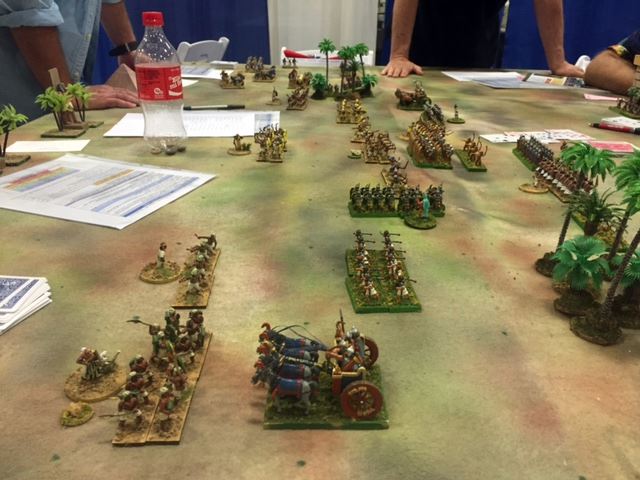
The set up from the Assyrian Right...


And from their Left.


Close up of the Assyrians - mostly late 1970's era "new" Mnifiogs, with Hinchliffe 4 Horse Chariots. .

And of the Egyptians - mostly 28mm Old Glory, with some Essex and Black Tree Designs added in. 


Assyrians from the opposite side.


Egyptians from the opposite side. The Pyramid is a paper print out I found on line for free. Just about fits in a 6" square "box". You didn't notice the grid? That's the idea; it's marked with dots at the corners only, so that you only see it when you want to!


A turn or so into the game. Bill is at the far (distant)  left, and John Mumby form Colorado at the far right


Neither side wasted time in advancing... the card play permitting, of course!


That's Dave in the bright shirt at left, Clif Castle at the distant right. The Oasis is being hotly contested. And in Fredericksburg in July, Hot meant 102 degrees Hot!


"Czar" Barry looks on  as the lines close. Barry helped me test out the rules at home. 


Ra's eye view of the field.


An ugly gap in the Egyptian center. 


This game we had 3 payers who were pretty familiar with the rules, and three who had never heard of them!


The Assyrian Cavalry has really pushed back the Left flank Egyptian Light Chariots. It takes some experience to handle the Light Chariots well - you HAVE to use their greater flexibility in movement to get onto the flank of the heavier Assyrian troops!
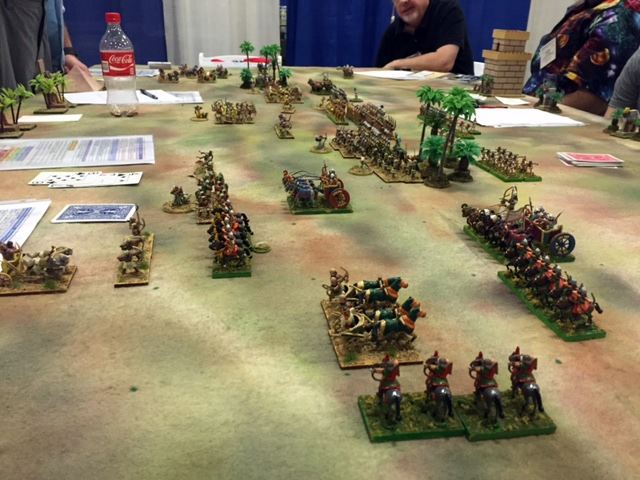

Things don't look much better for Pharaoh's men on their right flank, either!


In the center, though, the weight of Egyptian bow fire has taken its toll on the better armored Assyrian infantry. 


Situation near the end of the game. The Egyptians surrendered the last of their Victory medals soon thereafter - Assyria prevails! We had 8 players for the game (6 slots listed in the program), and everyone enjoyed it, and most would have bought a copy of the rules in the deal;er area... but no one carried it this year. I pointed every one to Simon Miller's Webstore. This is one set of rules where I think the electronic version is better than a print copy - although you can get both for a little extra!


Here's the composition of the armies I used for the game: 

New Kingdom Egypt
CMD
Description
Save
Spec/Ammo
Pts
VMs
1
Att General Chariot Heroic Ramses
3+

6
2
1
Light Chariots, Bow, Veteran
7+
4
6
1
1
Light Chariots, Bow, Veteran
7+
4
6
1
1
Light Chariots, Bow, Veteran
7+
4
6
1
1
Light Chariots, Bow, Veteran
7+
4
6
1
1
Light Chariots, Bow, Veteran
7+
4
6
1
1
Command Cost, Demoralized


36
4
2
Att General, Heroic Div Amun
3+

5
2
2
Medium Infantry, Shieldwall
7+

7
2
2
Medium Infantry, Shieldwall
7+

7
2
2
Medium Bowmen, Veteran Nubian
7+
7
8
2
2
Medium Bowmen
8+
6
7
2
2
Light Infantry - Bow/Sling
8+
3
4
1
2
Light Infantry - Bow/Sling
8+
3
4
1
2
Hero


1
-
2
Camp


1
3
2
Command Cost, Demoralized


44
8
3
Attached General, Division Set
2+

4
2
3
Shardanna Royal Gd - Auxiliaries
6+

8
2
3
Medium Infantry, Shieldwall
7+

7
2
3
Medium Bowmen
8+
6
7
2
3
Medium Bowmen
8+
6
7
2
3
Light Infantry - Bow/Sling
8+
3
4
1
3
Light Infantry - Bow/Sling
8+
3
4
1
3
Hero


1

3
Camp


1
3
3
Command Cost, Demoralized


43
8
4
Attached General, Division Re
2+

4
2
4
Shardanna Royal Gd - Auxiliaries
6+

8
2
4
Medium Infantry, Shieldwall
7+

7
2
4
Medium Bowmen
8+
6
7
2
4
Medium Bowmen
8+
6
7
2
4
Light Infantry - Bow/Sling
8+
3
4
1
4
Light Infantry - Bow/Sling
8+
3
4
1
4
Hero


1

4
Camp


1
3
4
Command Cost, Demoralized


43
8
5
Att General, Heroic, Division Ptah
3+

5
2
5
Medium Infantry, Shieldwall
7+

7
2
5
Medium Infantry, Shieldwall
7+

7
2
5
Medium Bowmen, Veteran Nubian
7+
7
8
2
5
Light Infantry - Bow/Sling
8+
3
4
1
5
Light Infantry - Bow/Sling
8+
3
4
1
5
Light Infantry - Bow/Sling
8+
3
4
1
5
Hero


1
-
5
Camp


1
3
5
Command Cost, Demoralized


41
7
6
Att General Chariot, Heroic  Seti
3+

6
2
6
Light Chariots, Bow
8+
3
5
1
6
Light Chariots, Bow
8+
3
5
1
6
Light Chariots, Bow
8+
3
5
1
6
Light Chariots, Bow
8+
3
5
1
6
Command Cost, Demoralized


25
3

TOTALS


243
(24)


Medals  = Total divided by 3
Reserve Ammo = 1 chit for every unit that can fire
Demoralized Command = Lost ½ of Victory medals


Later Assyria
CMD
Description
Save
Ammo/Spec
Pts
VMs
1
Att General Chariot, Essarhadon
2+

5
2
1
Hvy Chariot shock Vet extra bow
5+
3   Shock
15
2
1
Hvy Chariot shock Vet extra bow
5+
3   Shock
15
2
1
Cavalry, Javelin, Vet
6+
3
11
2
1
Cavalry, Javelin, Vet
6+
3
11
2
1
Light Cavalry, Bow
8+
3
5
1

Command Cost, Demoralized


62
6
2
Attached General: Division Ishtar
2+

4
2
2
Light Infantry - Bow/Sling
8+
3
4
1
2
Assyrian Hvy Inf -Shieldwall, vet
6+

9
2
2
Assyrian Hvy Archers/Slingers, vet
7+
7
9
2
2
Camp


1
3

Command Cost, Demoralized


27
5
3
Attached General Div. Shamash
2+

4
2
3
Light Infantry - Bow/Sling
8+
3
4
1
3
Assyrian Medium Inf Javelinmen
7+
2
7
2
3
Assyrian Hvy Inf - Shieldwall, vet
6+

9
2
3
Assyrian Hvy Archers/Slingers, vet
7+
7
9
2

Camp


1
3

Command Cost, Demoralized


34
6
4
Attached General Division Ashur
2+

4
2
4
Light Infantry - Bow/Sling
8+
3
4
1
4
Light Infantry - Bow/Sling
8+
3
4
1
4
Quradu Royal Gd, Shieldwall, Vet
6+

9
2
4
Assyrian Heavy Inf, 2 H mace, Vet
6+

9
2
4
Camp


1
3

Command Cost, Demoralized


30
6
5
Attached General Division Nergal
2+

4
2
5
Light Infantry - Bow/Sling
8+
3
4
1
5
Assyrian Medium Inf Javelinmen
7+
2
7
2
5
Assyrian Hvy Inf - Shieldwall, vet
6+

9
2
5
Assyrian Hvy Archers/Slingers, vet
7+
7
9
2
5
Camp


1
3

Command Cost, Demoralized


34
6
6
Att General Chariot, Sargon
2+

5
2
6
Hvy Chariot shock Vet extra bow
5+
3   Shock
15
2
6
Hvy Chariot shock Vet extra bow
5+
3   Shock
15
2
6
Cavalry, Javelin
7+
2
9
2
6
Cavalry, Javelin
7+
2
9
2
6
Light Cavalry, Bow
8+
3
5
1

Command Cost, Demoralized


58
6

TOTALS


245
(22)

Medals  = Total divided by 3
Reserve Ammo = 1 chit for every unit that can fire
Demoralized Command = Lost ½ of Victory medals


Sunday, July 17, 2016

Back from Historicon 2016

I left from the home a bit later, circa 9 AM ( I discovered a dead car battery circa 7:45 AM; excellent service from Triple A to replace the battery and have me on the road in a little over an hour!). I picked up Jared in Tarrytown, NY about an hour later, along with his one large tub of figures etc. for the Russian Civil War games he was to run with Field of Battle, 2nd edition. Starting off later than intended, the trip took about 7 hours this year, but only South of Washington, DC, was there very heavy traffic on I-95 (as usual). Jared made a most agreeable traveling companion as we discussed wargaming, history, convention sites, liberal politics, theology, sociology, education, medicine and population health, and personal backgrounds...among many other things! We were just about as chatty on the way home, with the talk focusing on future wargaming projects and preliminary plans for games to run at Historicon 2017; thus both trips flew by subjectively! Tim flew in from the UK and met us at the hotel, also being delayed and thus arriving in Fredericksburg about 7 PM. Shortly thereafter, we headed over to the Convention center to get our badges. As we were all registered as GM's this took less than 5 minutes, but even on Wednesday night the line for pre registered attendees seemed quite long - I'd estimate a 20 - 30 minutes wait. We questioned why convention badges couldn't be mailed to attendees in advance, or even downloaded as a pdf file. Perhaps something to think about for the future in terms of convenience, decreased wait time, and decreased demand for volunteer staff. Thereafter, we met Eric B. and headed out for a nice dinner and pleasant conversation.

    There will be a number of blog posts forthcoming about the convention, but we both had a great time as usual, running and playing in games, scouring the flea market, and of course shopping in the dealer area. The show was very well attended on Thursday especially. Once again, games were on the short side on Saturday night. There were many great looking games, and plenty that I am sure that I never even got a chance to see, as I barely entered any of the side rooms at all. It seemed a little noisier in the main gaming area this year, but still tolerable, especially compared with the first year there (2012 ?). The Air conditioning also seemed a bit less effective this year in the main gaming area only, but not unbearable like some past July days at the Host in Lancaster. There were quite a few new companies in the Dealer area this year, which was good to see, and some previous exhibitors were missed, which was not so good. Jared attended the members meeting and reported that the main topic there was preliminary discussions around holding each of the three HMGS East conventions (Fall In, Cold Wars, and Historicon) at a different site,. in order to draw from a larger population base - Fredericksburg, Lancaster, and a new convention center in Sommerville, NJ (which also happens to be where I did my residency training in Family Medicine over 30 years ago). I will just say that I'd be thrilled with Sommerville as a site, as it is probably only about 2.5 hours drive away, and is very do-able for gamers from almost anywhere in New England, New York, Pennsylvania, Delaware, Maryland, Ohio, and of course, New Jersey itself. It is about a 30-40 minute drive from Newark International Airport.

    I ran four games this year, "The Assyrian Came Down Like a Wolf on the Fold" (Egypt vs. Assyria) and "Ye Who are the Warriors of God" (Hussites vs,. Catholic Crusaders) with To the Strongest!, on Thursday AM and Thursday evening respectively, "The Great Cavalry Action at Liebertwolkwitz, 17813" with Field of Battle, 2nd edition on Friday night", and "The Engagement at Klagenfurt, 1809" with Piquet: Les Grognards, 2nd edition at 7 PM on Saturday evening. Posts about each of those will be forthcoming in the next few weeks.


Just unloaded the car, so here's what I brought down, plus my personal bag, laptop, Jared's Tub, luggage, and laptop!  It all fit in quite nicely, actually!


I didn't buy too much this year. 50 Old Glory French Line infantry in Bicorne from Freddie A. in the Flea Market, 1 pint of the Gale Force 9 economy Masonite bases (especially the 40mm rounds) for about $20, and the rest from a new merchant at Historicon, Stonehouse Miniatures. A Sphinx (they have a lot of nice Egyptian and Mayan/Aztec themed terrain items - temples, pyramids, Egyptian Gods, etc), a 2 story 28mm stone house, and some resin wall sets to make 6 feet of walls (they have at least 4 different styles. Also a bag of  "pottery" Jugs for ancient battlefield decoration. Their prices are quite reasonable, too!

Saturday, July 9, 2016

Hussite wars Part 9

First, some 14th - 17th century dates for some perspective

The Hundred Years War  1337 - 1453
Battle of Crecy  1346
Battle of Poitiers  1356
Battle of Agincourt  October 25, 1415
Siege of Orleans (Joan d'Arc) 1428-1429

John Wycliffe's English translation of the Bible is published 1408  (Wycliffe himself died in 1384)

Battle of Tannenberg (Grunwald) - July 15, 1410 (Teutonic Knights vs Poland/Lithuania. The Knights are defeated and begin their decline). Jan Ziska  served with the Polish forces, and is thought to have fought  at this battle, but there is no hard evidence for or against  such

Jan Hus travels to the Council of Constance to propose his reforms for the Church. Upon his arrival he is charged with heresy and later burned at the stake.1415

The Hussite Rebellion  1419 - 1434  First Defenestration of Prague, July 30, 1419

Fall of Byzantium (Constantinople) to the Ottoman Turks  1453. The entire century is marked by steady expansion of the Ottomans into Europe

The Wars of the Roses 1455 - 1485

The Swiss Burgundian Wars 1474 - 1477

The Reconquista of Spain ends with the fall of Granada to Ferdinand and Isabella; Columbus sails to the Caribbean   1492

The Great Italian Wars  1494 - 1529

Martin Luther publishes his "95 Theses" and begins the Reformation 1519

Battle of Mohacs 1526 (Ottomans crush Hungarian Army, Hungary is effectively partitioned between them and the Hapsburgs)

Siege of Vienna 1529  Turkish attempt to take the city is defeated, marking the high water mark of Ottoman expansion into Europe.

Thirty Years War begins with the Second Defenestration of Prague, May 1618.


I actually finished painting the second and last group of 1st Corps (Kingmaker) figures almost a month ago, but hadn't had time to post pictures, etc until now! 


2 stands of "Yellow" Flail men, and one of Handgunners. 


I changed somewhat how a Wagon unit will be depicted using the To the Strongest! rules, and that necessitated adding some odds and ends to make the units all come out right. 


Essentially, each "Deep" Wagon unit will have a wagon, and behind it 2 stands of Missile troops (Crossbows or Handgunners), and behind that, 2 stands of Flail or Polearm equipped melee troops. If the Wagon is NOT a Gun Wagon, then it will have a Missile firing stand of the appropriate type in the Wagon model itself. As it will take three hits to "kill" a Wagon unit (vs 1 for Light units and 2 for most ordinary units other than Pikes), these will be very resilient... but a big blow if they are lost!


        Returning to the Hussite Wars themselves, 1421 also saw the Catholic Archbishop of Prague, Konrad Vechta, renounce Sigismund and accept the Four Articles of Prague; his defection brought several more of the Bohemian cities under Hussite Control (April 1421). The Hussites also began to expand into neighboring Moravia, which had long standing religious, ethnic, and cultural ties to Bohemia, and where there already some Taborite settlements.

     Sigismund and the Bohemian and Moravian Hussites attempted further negotiations in May 1421, without either expecting much to come of it; indeed Sigismund was encouraging a Silesian invasion of Bohemia to "exterminate the heretics" whilst adopting a conciliatory tone in negotiations. The Hussites continued to seek a new King for Bohemia, but their embassies to Wladyslaw, King of Poland, continued to meet with prevarication.

    The Silesians invaded Bohemia in June of 1421, but it was very short lived, as they found themselves strongly opposed both by Orebite forces lead by Ambrose and the forces of Cenek of Wartenburg and his vassals and friends. The Silesians requested and received from Cenek  an armistice, allowing them to withdraw back to Silesia. This included a provision prohibiting both the forces of Cenek and the Orebites from pursuing them into or invading Silesia, which caused controversy and charges of treason against Cenek, which did not prevail.


I also decided the Hussites needed a few units of missile armed  light infantry to defend their camp(s) and or harass the enemy. 


Some skirmishing "blue" Handgunners. 


They also have the virtue of being cheap compared the expensive Wagon units!


The handgunners aren't overly troubled by the armor off the Knights either - as long as they can shoot at them from a distance, that is!


  In July of 1421, during this period of Ziska's incapacitation following the loss of his second eye, the Hussites suffered one of their rare defeats. A strong Hussite force, lead by the radical Hussite cleric, Zevilinsky, and including far more mercenaries than usual (which should have made the force better trained), undertook to  conquer some of the remaining Royalists towns in Northern Bohemia, which were predominantly German in ethnicity. This culminated in the siege of the city of Most (Brux), whose population had requested assistance from the German, Catholic  Meissen margraves. When the Hussite cannon created breaches in the city walls, the defenders asked to be able to surrender, and leave with nothing more than their lives. Although the Hussite nobles and military leaders recommended accepting these terms, Zevilinsky rejected them, stating that they would only return to fight again.

   The defenders of Most actually outnumbered their Hussite besiegers, who had deployed on a hill outside the town in their usual Wagenburg. When the troops of the Meissian margraves arrived outside the city, Zevilinsky, who had no military experience, committed a grave blunder. Instead of meeting this new enemy in the Wagenburg, which would have required lifting the siege, he ordered his men to march out to meet the new arrivals in battle in the open. The enemy cavalry charged the Hussites, who lacked any cover, and routed them, inflicting heavy losses. including over 400 dead. The survivors retreated to their Wagenburg. From there they successfully repelled the attacks that followed, but their morale was shaken. When some horses spooked during the night, the defenders panicked, convinced that they were being overrun, and fled. The Meissians and city defenders  captured the booty in the Wagon fort and deigned to pursue the survivors.

    As well as being a serious military defeat, Zelilinsky's actions seriously undermined his religious influence. The defeat was attributed not only to his military incompetence, but also to God's displeasure with his radical theology, and his influence began to wane.A now recovered Ziska was sent to set things aright (August 1421), and the his reputation was now so formidable that the Messians promptly evacuated Bohemia rather than risk facing him in battle.


Some close order Crossbowmen.


These will probably be "Wagon Riders", so each stand uses a different  base color - red, green, blue.  The supporting troops will have the same primary color as well - this will make it easy to identify them, if much more uniform than they ever would have been in reality.


If I don't like the look, it is a simple matter to jumble up all the different colors between the units instead!


These men have obviously upgraded their equipment, using the spoils of earlier Hussite victories to good advantage!


    Meanwhile, Sigismund and the Pope had not been idle. The papacy had become unhappy with Sigismund's perceived incompetence in suppressing the Hussite movement, and a Second Crusade was organized. The Teutonic Knight were also encouraged to engage the Poles to discourage them from intervention in support of the Bohemians, and invade Bohemia themselves as well. While this Teutonic invasion failed to materialize, the forces assembled for the Second Crusade were immense, estimated at nearly 100,00 men.  Their invasion of Bohemia began on August 28th, killing all Czechs in its path save for small children. In response, a Hussite army marched North from Prague on September 13th, 1421 and the Royalist forces responded by concentrating near Zatrec, which had been under a unsuccessful siege by 6,000 Crusaders.  After 6 weeks, they had failed to even breach the city's walls, and even resorted to the unusual tactic of attaching flammable materials to birds, setting them alight, and dispatching them in the direction of the city, in the hopes of setting it alight. This bizarre attempt backfired when the uncooperative avians flew the wrong direction!


Contrast those crossbowmen with these light skirmishers - looking more like the peasants that most were. 


The Hussites were quite capable of executing hit and run raids when the opportunity presented itself. 


Indeed, Jan Zizka's earliest combat experiences are thought to have been that of a glorified brigand. 


The fine sculpting on these 28mm Kingmaker figures makes them easy to shade!


    By September 30th, Sigismund had still not appeared to lead the crusade, and the various Catholic factions fell to bickering and blaming one another for their difficulties. A spirited and very successful sortie by the defenders caused nearly 2,00 crusader casualties. When the Crusaders learned, on October 2nd, that Zizka and his forces were fast approaching, complete panic broke out in their ranks and they quickly broke camp, triggering a fire (and yet another successful sortie by the town';s defenders). Sigismund ultimately wound up intervening first in Moravia, where his troops convinced the Moravians to renounce their recent acceptance of the Four Articles of Prague. Meanwhile, Cenek of Wartenburg, perhaps one of History's most infamous serial turncoats, once again renounced the Hussite cause and supported the Crusade and Sigismund.

  The condotierre, Pipo Spano was the pope's appointed commander, and with Sigismund';s reluctant approval, he finally began an invasion of Eastern Bohemia in late November, 1421. This galvanized and united the ever bickering Hussite factions, and the y called for troops for all over the Kingdom, and especially requested aid from Zizka and his forces, who arrived in Prague on December 1. Sigismund's objective was Kutna Hora, a logical choice because of its large ethnic German population, its previous status as a Royalist stronghold, and the great richness of its silver mines. However, Zizka, now the de facto commander of the Hussite army, got there first, arriving on December 9th. He strengthened the cities defenses and cowed the dubiously loyal populace, while preventing his m,en from harassing the citizenry.  His scouts reported the approach of Sigismund and the Crusader army on December 21st, 1421.


More Hussite Melee infantry.


This unit has an Orange theme to its costume.


Some sunshine peeking through the trees brings out the varied hues. 


I counted more than 50 different colors used for all the figures shown in this post!


The Battle of Kutna Hora, December 21, 1421

    Zizka and his forces marched out of the city to counter Sigismund's army, leaving behind a small garrison. The Hussites deployed on a low hill about 1 kilometer outside the city, from whence they could observe the approaches to Kutna Hora. Shortly after the men and wagons completed their preparations, the Crusader forces approached. The Hungarians spread out to the Northeast, along the road to Kolin, driving their cattle with them to make their numbers appear greater than they were. Sigismund soon followed, and set up his headquarters along the Kolin road, near Zizka's right flank. Ziska had chosen his position assuming that he had the support of the Kutna-Horans, but ethnic Germans and staunch Catholics within the city had conspired with the Holy Roman Emperor to betray the city to him. Thus some of the Crusader forces demonstrated in front of the Wagenburg, but the bulk of the troops swept around the Hussite position to the city, where their allies opened a gate for them. The Crusaders slaughtered all the Hussites within the city, and Zizka was left in a very precarious situation. His position was strong, but had only limited provisions with him, having expected to draw them from the city, and he was outnumbered 3:1 by the Royalists, their ranks swelled by the Kutna-Horan traitors. Even worse,  the Crusaders were expecting further reinforcements from Hungary. Decisive action was needed!


Josef Mathauser's painting of  (the now blind) Zizka leading his men at Kutna Hora.


   In the middle of that night, Zizka launched a surprise attack, aimed directly at the weakest part of the ring of enemy troops surrounding him - Sigismund's headquarters!  The Emperor's personal retinue had shown little appetite for combat in the past, and they did no better this night. This one time, his wagons were used offensively, issuing fire as they rolled forth, and spreading disorder and panic in the Crusader camp. The breakout was entirely successful, and a new Wagenburg was established a kilometer hence, astride the road to Kolin. Zizka there awaited a Crusader attack, but it never came, Sigismund being content to have reconquered Kutna Hora, and believing the Hussites to have been defeated. Zizka then broke camp and marched to Kolin, arriving there the same day.


Another unit of skirmishing Handgunners.


Green is the theme here, obviously!


Just the thing for lying in ambush in the woods!


    Winter arrived early that year, and was harsh. The Crusader forces had no desire to spend it in the open, and due their large numbers, of necessity they dispersed into billets all around the Kutna Hora area, leaving a large Hungarian garrison in  village on the road to Kolin to watch the Hussites. Sigismund seems to have assumed the Hussites would settle down for the winter as well. Instead, Zizka set to recruiting additional troops, aided by Ambrose and the rest of the Orebite priests. On January 6, 1422, Zizka's men suddenly set forth, and overwhelmed the Hungarians before they could deploy for battle. The relatively few survivors scampered back to Kutna Hora. There Sigismund held a council of war with Pipo Spano and his other commanders. They impressed upon the Emperor that their position was precarious. Although  they had the advantage of numbers, their dispersal meant that it would take considerable time to assemble their forces, during which time they would be every vulnerable to attacks by the concentrated Hussites. In addition, the Kutna Hora city militia would not be able to resist the Hussites long without major support from the crusaders, and even then, there would be no guarantee they could hold the city. Never one to display personal bravery, Sigismund fled for Hungary with his personal retainers, ordering his remaining Bohemian and Moravian forces to hold Kutna Hora, or destroy it lest should it fall into Hussite hands again.  However, the Bohemian and Moravian Lords were unwilling to undertake a suicide mission, also suspecting, probably correctly, that Sigismund would be happy to have them perish and thus have a few less potential heretics to worry about!  The German majority  citizenry of the town were equally as eager to depart the city to escape the Hussite retribution for their earlier treachery.


Jan Zizka statue in Bělkovice-Lašťany, the Czech Republic
Photo by Michal Maňas via Wikimedia Commons


   Once the bulk of the Hungarian troops had departed, the remainder set fire to the city, but did a poor job of it, being distracted by plundering the homes of the departing Germans. Despite his blindness, Zizka recognized an opportunity, and sent his cavalry ahead where they were able to put out the fires and save the city. After spending the night in the city, Ziska and his men aggressively pursued the retreating Moravian and Bohemian Lords, throwing them into abject panic. It took 2 days to restore some semblance of order to the Crusader forces. This lead Sigismund to order a stand on a hill near the town of Hraby, to cover his own retreat to Hungary. Spano and his other generals advised against it, opining that the demoralized troops were in no condition to face the Hussites in battle, but eh Emperor over ruled them. On the morning of January 8th, Zizka's men charged the Royalist position, whereupon the defenders broke and ran, leaving behind all of their wagons and supplies. The continued Hussite pursuit inflicted heavy casualties on the fleeing Royalists.

    Sigismund himself reached Nemecky Brod, near the Hungarian Border, at sundown that day. He detailed strong  forces to hold the town, once again in large measure  to cover his own retreat, which he continued without pause. When Zizka reached the town, many of the the defenders were slaughtered covering the retreat of their fellows. The bridges leading out of the town being overcrowded, many tried to ride across the ice of the Savara river. but the weight of their horses and armor caused the ice to break and many were drowned, crushed or frozen to death; almost 550 fully armored bodies were later recovered from its waters - shades of the later stages of the Battle of Austerlitz, fought on Bohemian soil almost 400 years later. Zizka, who never in his career pursued an enemy past Bohemia's borders, again declined to do so. His men were exhausted, and he had accomplished his objective, utterly crushing the Second Crusade. For years thereafter, Sigismund would not even approach the Bohemian border personally!


A pair of Hussite officers. 


These figures were particularly welcome, as the Old Glory Hussite sets curiously contain no command figures. 


"Ye who are the Warriors of God..."


Amazing digital art depiction of the nighttime break out of the Hussite wagons at Kutna Hora, by Daren Tan.