Sunday, February 21, 2016

Hussite Wars, Part 5 - cavalry

    Following Ziska's defeat of the "Iron Lords" at Sudomer, his party continued on to Tabor, where he was greeted enthusiastically. The Taborites chose 4 military captains - with Nicholas of Pistny as senior officer, followed by Ziska, with 2 others as Junior captains. Civil administration was left to the priests (which included some women, women also fighting alongside their men at times, too). Before long Nicholas became the chief political leader in Tabor, acting as a sort of Prime Minister, while Ziska took charge of military matters. He this became effectively Minister of War and also foreign Minister of the Taborites. It was Jan Ziska  who was in charge of organization, recruitment, training, and discipline. He was also the main one responsible for deciding who to assist and who to fight.

   Much of Ziska's own military experience prior to the Hussite wars had come as a glorified highwayman, and throughout April, 1420, he lead a series of small raids against anti Hussite forces, essentially a form of training exercises. In so doing, he gradually nurtured the experience and confidence of the men (and women) fighting for the Hussite cause, as well as acquiring hand guns, crossbows, polearms, horses and guns from enemy supplies.  This included the reconquest of the town of Pisek from the Royalists. Ziska also arranged to make Tabor a roughly hexagonal fortress, with triple walls and tower bastions at the corners, which, combined with the natural strength of its position,  would render it nearly impregnable. Finally, Ziska also promptly started training peasants and townspeople in mounted warfare, contrary to the expectation that only nobles fought mounted.


Hussite Light Cavalry, which would have consisted chiefly of trained, mounted peasants.


Other than scouting, the Hussites generally kept their limited cavalry safe behind the barriers of the Wagenburg, unleashing them only in the later stages of the battle, when their enemies were exhausted and demoralized from their many failed assaults. 

This was often sufficient to convert the defeat of the enemy into a full scale rout.


The Hussite cavalry would usually not attempt to match up against their better mounted and equipped enemy counterparts!


    Meanwhile, Holy Roman Emperor Sigismund had hardened his line against the Hussites, insisting that hey submit to his authority and obey the dictates of the Church and Pope. He attempted to separate the pro Hussite nobles from the rest of the Hussite movement, figuring that he could deal with them once the popular rebellion was quashed. On March 7, 1420, Sigismund issued a call to arms, and the following day the Papal legate declared a Crusade against the Bohemian heretics. promulgated edicts making heresy a capital offense, with forfeiture of all property as well, and forbade criticism of either himself of the execution of Hus. This hardened the resolve of the various Hussite factions, and additional executions of Hussites horrified even the most conservative among them. Finally, he adjudicated a long standing territorial dispute between the Teutonic Knights and Poland in favor of the former, making lasting enemies of Poland and Lithuania, and strengthening the perceived and real ethnic (Slav vs German) nature of the conflict. 

    In Prague, the various Hussite factions pledged mutual defense, strengthened their positions, and appointed military captains. They sent messages to the other towns of Bohemia, requesting delegates to coordinate mutual defense. They denounced the Papal Bull and appealed to Slavic nationalism. Despite Sigismund's efforts to woo him, once he left his presence, Cenek of Wartenburg declared for the Hussites, taking many of the wavering pro Hussite nobility with him. Cenek would change allegiances so many times over the course of the Hussite wars that it is difficult to keep track of them all. Regardless, all of this, on April 20th, Cenek issued a manifesto denouncing Sigismund and making ten specific accusations. It closed with what came to be known as the Four Articles of Prague: 1) The freedom of all Czechs to take Communion in Both Kinds, 2) The right to the free preaching of God's word in Czech throughout the Kingdom of Bohemia,  3) The obligation of all priests to lead holy lives, devoid of materialism and sensuality, and 4) The denial of all charges against Czechs as heretics. Coming as it did from the Regent of the Kingdom, these words had tremendous impact. 

    The Armistice expired on April 23rd, and many pro Hussite nobles, lords, and knights declared their opposition to Sigismund despite their otherwise conservative political views.  Obviously, Sigismund could not delay armed intervention any longer if he was to have any hope of retaining the crown of Bohemia in anything more than name. He invaded Bohemia on May 1st with 20,00 men, mostly Germans. Meanwhile, faced with unexpectedly united opposition, he gave the appearances of being willing to compromise. He invited a delegation from Prague to negotiations, and viewed Cenek's turnabout as an opportunity. Secret representatives were sent to Cenek, and it transpired that in exchange for simply allowing communion in Both Kinds throughout Bohemia, he would return to the Royalist fold. Sigismund promptly agreed (although it is doubtful that he had any intention of honoring the terms any longer than he had to). Cenek arranged to have the Prague Castle open its doors to 4,000 German troops, despite having just encouraged the Prague delegation to treat with the even more untrustworthy Sigismund. Prague was demoralized, and with Sigismund entering Kutna Hora in triumph and both of the Prague castles now in enemy hands, the Praguers arranged a 6 day truce on May 12, 1420. When their delegation met with Sigismund, they offered to surrender the city and demolish part of its walls through which Sigismund might enter and be officially crowned King of Bohemia, in exchange for only being allowed to practice Communion in Both Kinds. Sigismund was hostile and abusive, and refused to even address the religious issue. He demanded demolition of all of the fortifications, complete disarmament of the population, after which he, Sigismund, would enter the city and grant its citizens whatever grace pleased him. 

    Faced with terms like those, the various Hussite factions in Prague once again united. Recognizing that they could not resist Sigismund's army by themselves, they sent out an appeal for assistance to Hussites all over Bohemia. The request was received by Tabor and Jan Ziska on May 16, 1420. He assembled 9,000 well-armed men and many war wagons, as well as several hundred cavalry, and covered half of the 40 Km march to Prague in a single day. A first attempt by Royalist forces to stop him on Ma9 19th was thwarted, and Ziska and his men bypassed the fortified monastery that the Royalists had retreated to. They encountered stronger Royalist opposition after fording the river Sazava near the village of Porici.  While making camp that afternoon, Ziska's scouts informed him that 2 strong Royalist columns from Kutna Hora and Hradec Kralove were approaching his positions with a third, smaller column from a different direction. The Hradec column was led by Wenceslaus of Duba, and the Kutna Hora column by the well known and highly regarded Condotierre,  Florentine Count Philip (aka Pippo Spano).Together, they considerably outnumbered the Hussites.  As dusk approached, Ziska drew up his men and wagons on a low hill overlooking the river Sazava, and had a quick ditch dug around their positions. The Royalists attacked shortly after sundown, and were repulsed. It was apparent that they would be unable to penetrate the Hussite Wagenburg, and thus the Royalist retreated after the single attack, leaving their dead and many standards behind. hereafter Ziska and his men proceeded to Prague unhindered, arriving there on the 20th of May, where they received an enthusiastic reception. 


"Ye Who are the Warriors of God", the Hussite hymn said to strike terror into the hearts of their enemies. It is quoted in the last 2 movements of Bedrich Smetana's well known collection of six symphonic poems, Ma Vlast ("My Country"). 


    On May 22, 1420, Ziska lead a raid and captured a large Royalist supply train of badly needed food, more so as additional Hussite troops had arrived from the countryside. Ziska then set about trying to retake one of the two Royal Castles in Prague, the Hradcany. He planned to starve the garrison out... the supply convoy he captured had been meant for them. To defend against the more strongly held Vysehrad castle, he had the Hussite wives, as well as the women, children, priests and Jews of the city dig a new wider, and more distant moat around the Vysehrad to protect the city from it. These works were completed on May 30th, and garrisoned by Prague militia and  Orebite soldiers (Oreb was a new, rural Hussite community similar to Tabor). 

    Ziska's Taborite troops had begun the siege of the Hradcany castle on May 28, forcing Sigismund to act. After making some diversionary attacks, Sigismund's men marched in a wide arc Northeast around the city of Prague, As the castle's food shortage grew worse and the Hussite guns damaged the walls, large numbers of Czechs deserted from the Hradcany castle and morale plummeted within. Sigismund approached the Castle with his entire force and another supply train on June 12, 1420. Knowing that the Hussites were eager to fight, he deployed so as to offer battle. As the Hussites arrayed themselves to accept the challenge, the supply train used the distraction to slip into the castle, whereupon Sigismund and his men quickly withdrew. The successful resupply of the garrison meant that the castle could not be starved out before the main Royalist forces converged upon Prague, and thus the siege was lifted on June 14, 1420, and the Hussites concentrated on strengthening the defenses of the city.

    While the Praguers made their preparations, Sigismund ordered Ulric of Rozmberk to attack Tabor, providing him with some elite Austrian troops to assist the effort. The Taborites dispatched 350 men, probably their entire mounted force, which was of little use in the city anyway, back to Tabor under Nicholas of Pistny. As he approached Tabor, he was able to sneak a message into the besieged fortress city, telling them that he would be attacking at dawn on June 30th 1420,and directing to h at that time. This simultaneous attack from both sides proved extremely successful, and the Royalists were defeated with heavy losses, leaving behind large numbers of weapons, siege guns, supplies, and money. 

    The Hussites gained another success where they recaptured he strategically important town of Hradec Kralove in July 1420, situated where the Elbe river first becomes navigable. This was the work of Ambrose, a Hussite priest who was the leader of the Orebite faction. Even before the Hussite movement, Ambrose had  been critical of the Catholic Church, and eventually the Queen was forced to remove him as chief priest of Hradec Kralove. Instead, Ambrose began preaching on the hillsides, an established a religious settlement that they named Oreb, another biblical reference. Ambrose effected the capture of the town by mobilizing and arming the peasantry of the surrounding region. He was [perhaps the best politician among the Hussite priests, bringing a number of Czech nobles to support the Hussite cause. He and Ziska became friendly, and regularly cooperated, although the Orebites were somewhat less radical than the Taborites. 


Hussite Heavy Cavalry; like the infantry, the Chalice was their most common emblem. These men, few in number, would usually be composed of pro Hussite nobles and their retainers. Ambrose's diplomatic and political skills helped to bring many of these to support his Orebite faction and the cause of Slavic nationalism. 


    Back at Prague, Sigismund was assembling a vast host to capture the city. He still controlled the two main fortresses of the great city, the Hradcany and the Vysehrad. These controlled the roads to the Northwest, West, and South of Prague. On  the East bank of the Vlatava river, where the bulk of the city was situated, there was a stretch of unfortified ground almost 5 km wide between the Vysehrad castle and the walls of the New Town. This area was dominated by two  natural elevations, especially the Vitkov hill, a step, long, narrow ridge running parallel to the river.\ North of the Vitkov was a narrow strip of flood plain known as Hospital Field. The main road from Prague to the  NorthEast ran through this area, while the main road to the East ran South of the Vitov ridge. Ziska realized that as long as the Vitkov was in Hussite hands, it would be very difficult to blockade and starve the city into submission. 

    The only structure on the Vitkov ridge was an old watchtower located at its crest, originally constructed to protect the vineyards on the Southern slope. Ziska had 2 fort built out of wood, along with a long earthen wall, reinforced by rocks, constructed to the North of the Watchtower, along the steeper Northern slope of the ridge. The position was further strengthened by digging a moat in front of it. As these preparations were completed, a huge host approached and camped North of the river. Sigismund had assembled a vast army of Catholic "crusaders" numbering some 80,000 men, and drawn from 33 nations in Europe. Most of the army was composed of Nobles and clerics with their retainers, along with many mercenaries. 

    Sigismund also realized that if he could seize the Vitkov position, he could effectively cut of the city from outside supplies, turning the large number of defenders into a liability instead of an asset.  Even though he outnumbered the defenders by 4 or 5 to 1, this was certainly preferable to a costly assault upon the city itself. 


More Hussite cavalry, ready to seize the initiative when the proper moment arrives.

    On July 14, 1420, several thousand of Sigismund's Heavy cavalrymen crossed the Vlatava river North of the city, and proceeded up the eastern, more gradual slopes of the Vitkov ridge. At first they went unnoticed by the forces in the city, but Ziska had placed a small garrison on the ridge, figuring that the strength of the position would allow the defenders to hold off any attack long enough to allow reinforcements from the city to reach them.  The "Crusaders" captured the old watchtower, crossed the moat, and began attacking the earthen wall. It was held by a tiny force of 26 men, 2 women, and one girl. They lacked guns and thus had to hurl rocks and discarded lances at the attackers, which they did with great bravery. The narrowness of the position prevented the attackers from making use of their numbers or flanking the defensive position. 


    Seeing the attack from his position in Prague, Ziska mobilized the Taborite and city militias, and ordered them to attack from the South slope of the Vitkov ridge. This was steep, but not nearly so much as the Northern slope. Ziska himself then proceeded to the earthen wall with a picked band of his personal bodyguards and long time comrades in arms, and was soon in the thick of the fighting, the situation having become critical. Indeed, defeat seemed certain until the main body of Hussites appeared from the southern slope. Hidden from view by the ridge until almost the last minute, they sang their war hymn and attacked. The "Crusaders" were thrown into the utmost confusion and rapidly became severely demoralized. As men and horses fled, many were killed as they attempted to descend the very steep northern slope of the Vitkov ridge, including the commander of the assault, Count Henry of Isenberg.  


The Battle of Vitkov Hill, July 14, 1420

    Although the losses of the Crusaders were only about 500 men, they didn't make any further attacks on the Vitkov position, which Ziska strengthened further. The various factions in the Royalist army soon fell to disention. The Bohemian faction argued with Sigismund for the dismissal of the German contingents, whilst the Germans accused the Czechs of insufficient zeal in pursuing the capture of Prague. In Tthe end, the increasing issues with feeding so vast an army, as well as mounting sanitation problems convinced Sigismund to agree to dismiss the foreign contingents and rely only on his "loyal" Czech nobles. Seeking to save face, Sigismund had himself crowned King of Bohemia in the St. Vitus Cathedral in the Hradcany castle. Lacking the planned booty from the plunder of Prague to pay his foreign mercenaries, Sigismund looted the gold and jewels for the Hradcany's churches and monasteries, promising to restore them when the war was over.


These crass action further damaged Sigismund's standing with the moderate factions in Bohemia,. After being paid on July 30th, the Crusader army broke camp and withdrew. It is notable that, although there would be many more waves of anti-Hussite invasions, "Golden Prague" itself was never again seriously threatened. 


Saturday, February 13, 2016

The Norwegian-Swedish War of 1814

A bit more on Norway during the Napoleonic Wars. First, some more Danish/Norwegian re-enactor shots below and throughout this post.

Grenadiers in bearskins


Ready Aim...

Forward, March!


Rough terrain!

My 2 previous postings on  Norway during the Napoleonic Wars, The Norwegian Army of 1808, by Eric Starnes, and The Norwegian Army of 1814, had both suffered severely, as many of the great photos I used form the Elverum Ski Company were lost when their site went of line. Fortunately, I was recently able to recover them, and thus the posts are again much more colorful and well illustrated!


The following post is slightly edited from:
http://www.militaryphotos.net/forums/archive/index.php/t-33130.html
(sadly, this link too appears now invalid)
01-23-2005, 02:05 PM

The Norwegian-Swedish war of 1814

A brief look at the political background of the war
In 1814 the Napoleonic wars were over, (although Napoleon would come back to power once more, and fight Waterloo in 1815) and the victorious British and it's allies divvied up the booty. Sweden had fought on the side of Britain under the promise of receiving Norway, which at that time was a part of Denmark. The Kiel peace stipulated that Denmark signed the territory of Norway over to Sweden.

The Norwegians had since the 1700's grown tired of the Danish-Norwegian union, and had a wish for independence and self rule. So when the chance appeared, we grabbed it. In May 1814 the Norwegian constitution was written in a matter of days, and the Danish prince Christian Fredrik was chosen as the king of Norway on May 17th, and on this day the constitution of Norway was signed.
Representatives of Britain, Prussia, Russia and Austria went to Norway to attempt to persuade us to accept to join Sweden. They failed, and left Norway on Juli 17th.

Prince Regent Karl Johan of Sweden returned home from France in May, and at this time decided to use military force to get the Norwegians to accept a union.
The drastic decision can be explained by the fact that Sweden might not have that much time to get the Norwegians to accept a union, as a change in the political arena might change the peace of Kiel, and Sweden could loose it’s claim to Norway.


A look at the armed forces of Norway and Sweden
A Swedish army of 45 523 men was raised, and the fleet was fitted. The Swedish navy consisted of: 4 ships of the line, 5 frigats, 24 smaller vessels and 60 gun sloops.
King Karl the XIII was very interested in ships, and had supreme command of the fleet.  Under him Admiral Johan Puke had the operational command.

To face this force the Norwegians had an army of approximately 30 000 men and a fleet consisting of 160 vessels of various size. The Norwegian army was in a pitifull state, poorly equipped, poor morale and incompetently led. From the Swedish side it was said that “There is no Norwegian General who knows how to wage war.”  There is most likely something in this saying, considering that  King Christian Fredrik himself, only 27 years old, had no experience in leading an army in the field.


The combat operations of the war
On July 12th Prince Regent Karl Johan leaves Stockholm to take command of the forces assembling on the Swedish-Norwegian Border. After yet another attempt at a diplomatic solution with the Norwegians, he orders hostilities to commence.

Lier, August 2nd 1814
The night before August 1st the Swedish cross the border in 3 columns at Magnor.
This force consisted of 5 batalions infantry, Västerbotninger and Värmlandske Jegere (skirmishers\light infantry) and 8 three pounder guns. They were led by Colonel Gahn.

On the Norwegian side, in the Kongsvinger district,there was a corps under the command of Lt. Colonel Krebs. It consisted of 3 batalions of infantry: Akershusiske Skarpskyttere (Marksmen), Sønnenfjeldske Skiløpere (ski troops), The 2nd Trondhjemske, 4 Three pounder Guns and 70 mounted Jegere (Eidsvold-Nessiske).

The two forces were relatively equal in strength, although the Swedes were better supplied with cannons and had more officers and NCO’s.
Both sides over estimated each other in the beginning, and therefore acted carefully.

Throughout August 2nd there was several minor skirmishes between Norwegian outposts and the Swedish forces. The Norwegians retreated towards Lier, it appears that Lt. Colonel Krebs at first thought to meet the Swedish east of Lier, but changed his mind and pulled his forces into the Lier position.

Around 1500 hours on August 2nd the Norwegian skirmish line (Jegerkjeden) came in contact with swedish scouting patrols. The Swedish deployed their skirmish line. Under the force of these the Norwegian skirmishers (Jegerne) had to retreat to Lier.

Between 16 and 1800 hours the 3 Swedish attack columns marched on the Norwegian positions, and the main attack started. The central colums, led by Colonel Gahn himself, went head on the center of the defences at Lier, where a total of 8 companies was positioned, but after repeated attacks none of them reached further than the glacis.

At the same time the left Swedish column attacked the Norwegian western wing, hoping to threathen it and forcing them to redeploy troops from the center. This attack failed mostly due to difficult terrain and two cannons under the command of Lieutenant Kjerulf.

The right swedish column attacked on the eastern side of Vinger Lake, and was to attempt to go around the lake and threaten the Norwegian flank. This was right were Skiløperne (ski troops) was positioned and some of the hardest fighting during the battle found place.
The Norwegians were hit hard and were forced to withdraw.

This is when the Norwegians discovered the poor quality of the Norwegian gunpowder, the Swedes could shoot at ranges over 400 alen (250 meters) while the Norwegian marksmen could only use their rifles out to 200 alen (125 meters).
But it was said that the Norwegians were better shots than the Swedes, and therefore should compensate for it in this way. Skiløper Ola Brænd from Stor-Elvdal, who fought at Lier said this: ”The Swedes hadn’t gotten any further with their shooting in 1814 than they were in 1808, they fired volleys, every man at once; the norwegians prefered to do it the skirmisher way og shot more on their own.

After a while the Swedish column came so close to Lier that it came under fire from two amusetter(?) there. This caused the column to retreat, and skiløperne and the marksmen recaptured their lost terrain. [Blog note - "amusette" is an old term for small cannons, in this case probably Norwegian 3 pounders]

The Swedish disappeared into the woods towards Malmer, and Lt. Colonel Krebs released his small cavalry force who pursued them for a while, untill a Swedish Artillery volley caused them to retreat.

Aftermath of the Battle of Lier, August 2nd 1814
On the battlefield less than 30 Norwegians and 130 Swedish soldiers lay dead.
The Swedish retreated to Malmer and continued the next day towards Matrand\Midtskog.
Colonel Gahns plan was to return to Sweden on August 5th.
How his plan to return to Sweden ended will follow. This turned out to be more than i expected.

**************************Part 2**************************


The days after the battle at Lier
After loosing at Lier, Gahn retreated to Malmer (August 3rd) and continued the next day (August 4th ) on to Matrand\Midtskog, (the two places are near each other and there has been some disagreement as to which one it is) where the infantry camped for the night while the baggage train went to Skotterud.

Lt. Colonel Krebs had pursued his enemy, and had managed to catch up with him. On the Night leading up to August 5th he attacked Colonel Gahns force at Matrand\Midtskog with half his force, while the other half marched on Skotterud to capture the Swedish baggage train, set up a defence and attack the Swedes from the rear.

A smaller force broke of to the west to attack the Swedish left flank, while Krebs himself led the main attack force onto the Swedish head on.
At 0300 hours Krebs launched his attack on the Swedish, and when the flank attack came 1 hour later, Colonel Gahn retreated towards Skotterud. Unfortunately for Gahn Norwegian forces already held Skotterud. The result was the hardest fighting in the entire 1814 campaign.

After repeated attacks the Swedish forces managed to fight out of the Norwegians surrounding them, but it came at a high cost of men, horses and materiel for both sides when combat ended at 1100 hours, August 5th
Lt. Colonel Krebs said afterwards: (my translation from the Danish spoken in Norway in those days might be a wee bit off) A more horrible and furious affair on both sides than this can not be considered possible between two as small units as this.
(Gahn entered Norway with 1400 men, Krebs marched from Lier with 2500 men).

The Swedish force lost approximately 350, of which around 250 were prisoners of war.
They had also lost the baggage train, and was forced to abandon 1 Gun, 7 ammunition wagons, 20 train wagons and 60 horses.

The Norwegians lost more than a hundred men killed and wounded. There was also casualties among the officers. A Lieutenant Norgren had been in a hurry to get gunpowder for his men, and had tried to open a ammunition wagon by knocking off the lock with an axe. This resulted in the entire Ammunition wagon to explode, increasing the casualty numbers.


The end of the war and the aftermath
This was not the main battle of the war, or would not have been, had the main forces of both sides actually fought. By August 14th there was a cease fire in effect, and Sweden's last war was over.

The reason we agreed to a cease fire was that, although successful in minor battles, the Norwegian army was in too poor a shape to wage a large battle against a large Swedish force.  But the fighting of August 1814, and the lives lost, was not in vain. Norway agreed to join in a union with Sweden, but retained a certain amount of self management, and we got to keep the constitution the brave founding fathers wrote up in a few days, and signed on May 17th 1814. This day is the national day of Norway.


The union with Sweden lasted till 1905, and this year is Norway’s 100 year anniversary.  Another Swedish prince was chosen as the King of Norway in 1905, and took the name of Haakon and became king Haakon the 7th of Norway.  His wife, princess Maaud of England, became the Queen of Norway, and their child, whose name was changed to Olav, became the Heir Prince of Norway. He was later to become King Olav the 5th of Norway.

The men who formed my country and wrote it's constitution never got to see it used in a Sovereign nation, but they shaped the future.


The Norwegian Flag and its evolution

On February 27, 1814, the crown prince CHISTIAN FREDERICK created the first distinctive Norwegian national flag. An expression of local opposition to the Swedish rule imposed on Norway, it consisted of the red Danish flag with its white cross, long used in Norway, with the addition of the Norwegian arms (a golden crowned lion holding an ax) in the upper hoist canton. In 1821 the Norwegian parliament developed the distinctive design in use today, although it faced a 77-year struggle to obtain Swedish recognition of its legitimacy. Designed by Frederik Meltzer, the new pattern consisted of the white cross on red, used in the Danish flag, with a blue cross superimposed for distinction. The Swedish king refused to allow use of the flag on the high seas until 1838, and even then Norwegian ships were warned that they would not be protected if they did not fly the official Swedish-Norwegian union flag.

On June 20, 1844, the new Swedish king, Oscar I, established a new union symbol by combining the Swedish and Norwegian crosses. Each kingdom was to fly its own flag but with that emblem added in the upper canton. While this gave greater recognition to the flag Norwegians preferred, it was still not the “clean flag” they felt entitled to. The union mark was derisively referred to as a “herring salad,” and contention between the two countries continued. The Norwegian parliament approved a law removing the union symbol from their flag in 1893, in 1896, and again in 1898. After their third approval the king was obliged by a provision in the constitution to sign the law into effect, which he did on December 10, 1898. The clean flag was officially hoisted on December 15, 1899, and six years later Norway separated peacefully from Sweden.


Norwegian standards through the ages
From a Blog post with some great pictures from the Norwegian Armory in Trondheim:
http://thewargamingmegalomaniac.blogspot.co.uk/2014/01/2009-armoury-trondeim-norway.html


From the same post, a Norwegian infantryman of 1814. By the yellow facings, he is likely from the Trodheim regiment. Check out all the great pictures from the museum captured on his blog!


Because of my Scandinavian (Danish) ancestry, my Norwegian and Danish patients have tried to reconnect me with my roots over the years...

Wednesday, February 10, 2016

Portal Con 2016

I made the 75 minute drive to Manchester, CT to put on a To the Strongest!  game at the 2nd iteration of Portal Con, held at The Portal, the most excellent gaming space of The Time Machine hobby shop, located directly across the street from the store. The Portal also houses their wargaming and extensive card/ board/RPG/etc retail stock. Last year, icy roads forced me to cancel my game there, but this year, despite a moderate snowstorm the day before, the weather was sunny and quite warm for February in Connecticut. I set up one table with my Hussites vs Teutonic Knights (functioning as Catholic "Crusaders"), and the other with my NK Egyptians vs Later Assyrians. Having 4 players, we opted to have everyone play on the same table, as none of them had even heard of the rules previously(!) We got underway about 9:30 AM, and after a brief introduction to the rules, we were turning cards and pushing lead.


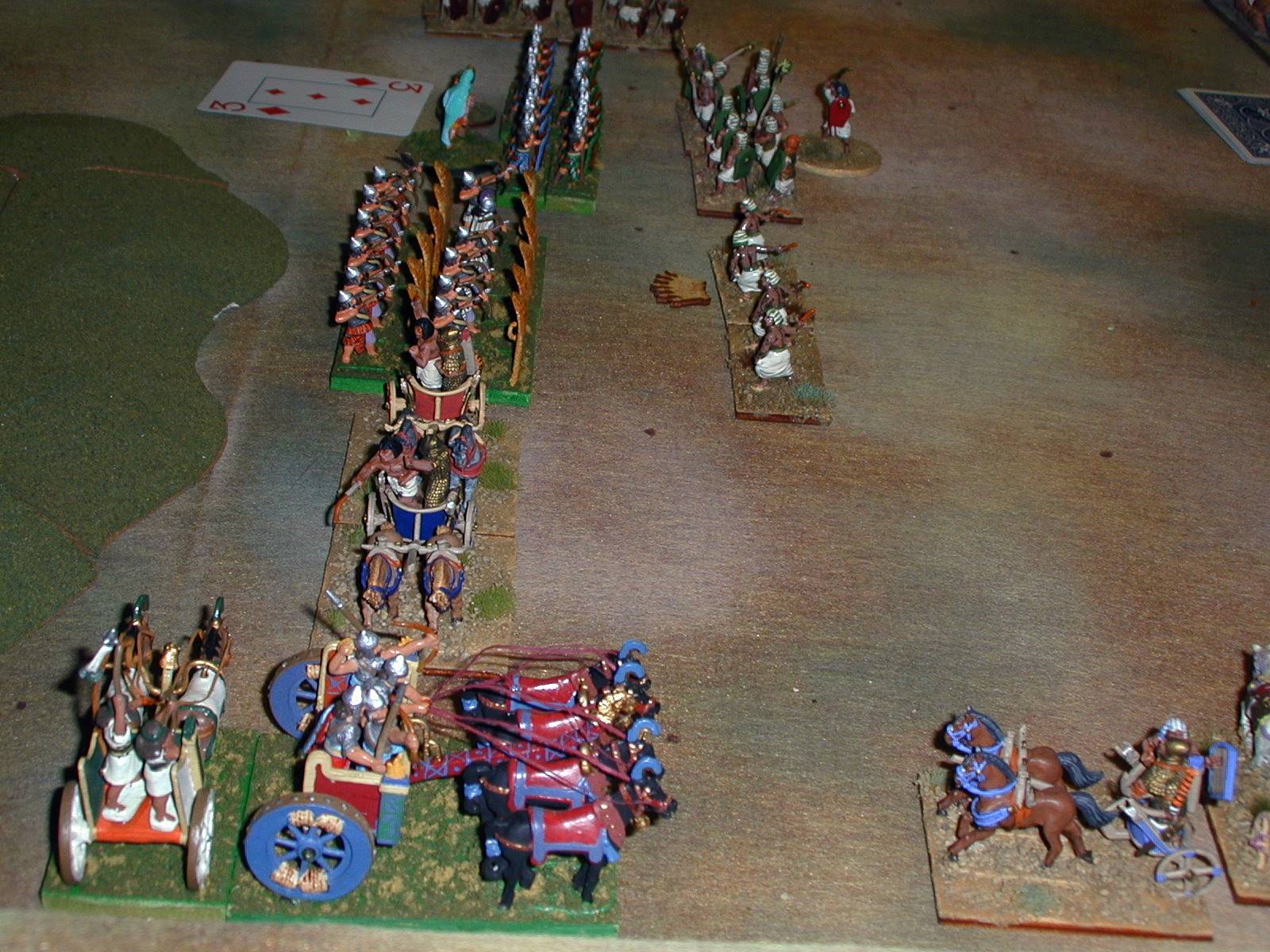
We had 4 players - on this side of the table were John, and opposing him, Joseph (age 9). On the far side of the table were Joe's Dad and his opposition, whose names escape me at the moment, unfortunately. Joe chose the Chariot table, which was probably good, as Barry and I had played with them previously. I decided to keep the same army rosters I used for that game without changes, having considered how the Egyptians might better employ their Light Chariots against the Assyrian Heavy Cavalry and Chariots. We got into the thick of it quickly, so it wasn't until about mid game that I first remembered to take a picture! Note the 2 units of Assyrian Heavy cavalry in the upper right hand corner of the picture - They managed to turn an Ace (= no actions) on every turn of the game save 1. Those guys were so "just not into it" this day!


On the Joseph and John flank, the Egyptians have taken losses, but have made the most of the mobility of their Light Chariots and Light Infantry to constantly threaten and attack the flanks of the Assyrians. A bit of terrain for the first time in one of our TTS games (one box of Oasis, and a 2 box low hill) also served to (appropriately) help the Light infantry and hinder the heavier units. 

On the opposite flank, The Assyrian position seemed much stronger... if they could just get those laggard Heavy Cavalry into the action! As it turned out, however, the Egyptians won when the Assyrians had to surrender their last Victory medal. For once, the archers on both sides managed to actually hit something, destroying several units of spearmen. In the end, the triumph of the infantry and chariots on John's flank, along with some clutch Egyptian card-play on this one, tipped the balance. Game, Jonakammun and co.!


Here's the (4 x 6 foot) table I set up for the Hussite vs Teutonic Knights game. 


I hadn't realized that Simon hasn't done the Hussite lists for TtS yet (he is working in them right now), so I had some extra work to do there.  I'll present the lists and forces I used after the rest of the pictures. 

View of the Teutonic Knights side of the table. The bulk of the figures used here are from the Minifigs "Alexander Nevsky" range of the 1970's. They are for a somewhat earlier time than 1420, but whatever!

View of the central portion of the table. I marked this ground cloth off with 6' (150mm squares) the day before the mini-convention, this time using green permanent marker dots. 


View of the Hussite center; in To the Strongest, War Wagons are a "Deep" unit. This makes them very resilient, but also tough to maneuver. They can share a Box with a unit of Light troops. I was actually running low on Hussite troops in general (I am  modeling a WW unit with the Wagon, one stand of X-Bow or hand gunners "in" the wagon, 2 stands of missile troops behind that, and 2 stands of Melee troops behind THAT, each War Wagon has 15 foot figures associated with it. Yikes! It looks like I need a few more troops, especially some Light Infantry (2 stands of 2 figures). I think I will need to add a small number of the excellent Kingmaker Hussites (now sold by 1stCorps) to my forces. 


Greg and Carl ran this "American Civil War on the frontier" action - Confederates vs Apaches at the 1st Battle of Dragoon Springs, May 5, 1862.


Cochise was among the Apache leaders, who inflicted a defeat upon the rebels in the Confederate territory of Arizona, seizing many horses and cattle. I think it turned out similarly in the game!


"There sure are a lot o' injuns, boss!"


The men in grey came back for revenge a few days later... historically, the Indian camp was sacked and the horses and livestock recaptured. For now it is peaceful awaiting the start of game 2!


In the main room was a big, 15mm Waterloo game. It looked like about 5 players a side, using "Age of Eagles" rules. There were many other tables of board games (Churchill's War being among them), and card games, too. X-wing was on the agenda for later in the day as well. 


The Waterloo game used custom terrain boards, and was evidently run previously at Historicon last year. Hougoumont is seen in the foreground


Long view of the Waterloo game, circa 2:30 PM (2016 time!) 


Following the Egypt vs. Assyria game, I could have run the Hussites, but I had promised my wife I'd be home at a reasonable hour, and we had dinner plans, so I had to pass up the opportunity. It is always wise to keep the Empress happy! The Portal did provide a complimentary lunch ( slices of some 6 foot Subway grinders, chips, and water) for all the GM's which was much appreciated, and at $7 a pretty good cash deal for attendees as well!


Before leaving, I did a little shopping, as this great place deserves our financial support. I will be needing more Tufts for basing, so these will prove useful - I especially like the Flower meadow tufts!


I also picked up this 2013 issue of WI, which covers Leipzig - appropriate, with Liebertkolwitz in the planing stages for this year's Historicon!  Thanks to Ken B and all the staff of the Portal for a fine event!


Here are the forces I set up for the Hussite game:

Hussites

3 Generals                                 12
Make Generals Heroic                3
8 War Wagons                        104
2 LI Crossbowmen, raw            6
2 LI Handgunners, raw              6
1 Cavalry                                    9
1 Light Cavalry -Lance, raw       4
1 Organ Gun  - raw                    6
4 Heroes                                    4
2 Camps                                    2
Fortifications for camps            4
TOTAL  160

Unit
Description
Save
Spec/Ammo
Pts
VMs

Attached General  Heroic
3+
Replay
5
2

War Wagons - Guns
7+
Mv/Cover  6
13
3

War Wagons - Crossbowmen
7+
Mv/Cover  6
13
3

Light Infantry, Raw, Handguns
9+
2
3
1

Cavalry - Lance
7+
Shock
9
2

Hero

Replay x 1

-

Camp w/ 2 sides fortified


3
3

Attached General, Heroic
3+
Replay
5
2

War Wagons - Handgunners
7+
Mv/Cover  6
13
3

War Wagons - Guns
7+
Mv/Cover  6
13
3

War Wagons - Handgunners
7+
Mv/Cover  6
13
3

Light Infantry, Raw, Crossbows
9+
2
3
1

Light Infantry, Raw, Crossbows
9+
2
3
1

Hero

Replay x 1

-

Hero

Replay x 1

-

Attached General,,Heroic
3+
Replay
5
2

War Wagons - Guns
7+
Mv/Cover  6
13
3

War Wagons - Crossbowmen
7+
Mv/Cover  6
13
3

Light Infantry, Raw, Handguns
9+
2
3
1

Light Cavalry, Raw - Lance
8+
Shock
4
1

Organ Guns, Raw
8+
5
6
1

Hero


-

Camp w/ 2 sides fortified


3
3

TOTALS


160
41

Medals  = Total divided by 3
Reserve Ammo = 1 chit for every unit that can fire
Demoralized Command = Lost ½ of Victory medals; Effects

Catholic Crusaders (Teutonic Knights)

4 Generals                           16
Mount 2 Generals                  2
Make 2 Generals Heroic       2
1 Household Later Knights   16
3 Later Knights                      42
2 Sergeants                          22
2 LC Turcopoles                   10
1 Mounted Crossbowmen     5
2 Spearmen                          14
1 Throwing Axe Men              7
2 Crossbowmen                    14
3 LI Crossbowmen,. raw         9
1 Artillery                                6
3 Camps                                3
2 Heroes                                2

Total 160

Unit
Description
Save
Ammo/Spec
Pts
VMs

Attached General. Mtd, Heroic
3+

6
2

Later Knights, Lance, Veteran
(Household Knights)
5+
Sv +1 Mele
Sv +1 Fire*
Sv +1 FireD
16
2

Later Knights, Lance
6+
Sv +1 Mele
Sv +1 Fire*
Sv +1 Fire D
14
2

Knights, Lance (Sgts)
6+
Sv +1 Fire D
11
2

LC Javelin (Turcopoles)
7+
2
5
1

Hero

Replay x 1

-

Camp


1
3

Attached General
2+

4
2

Spearmen
7+

7
2

Crossbowmen
8+
6
7
2

Javelinmen (Throwing axes)
7+
ShockMissil
7
2

Light Infantry Crossbowmen
8+
3
4
1

Artillery, Raw
8+
5
6
1

Camp


1
3

Attached General
2+

4
2

Spearmen
7+

7
2

Crossbowmen
8+
6
7
2

Light Infantry Crossbowmen
8+
3
4
1

Light Infantry Crossbowmen
8+
3
4
1

Camp


1
3

Later Knights, Lance
6+
Sv +1 Mele
Sv +1 Fire*
Sv +1 FireD
14
2

Later Knights, Lance
6+
Sv +1 Mele
Sv +1 Fire*
Sv +1 FireD
14
2

Knights, Lance (Sgts)
6+
Sv +1 Fire D
11
2

LC Javelin (Turcopoles)
7+
2
5
1

Light Cavalry, Crossbow
8+
3
5
1

Hero

Replay x 1

-

Camp


1
3

TOTALS


160
47

Medals  = Total divided by 3
Reserve Ammo = 1 chit for every unit that can fire
Demoralized Command = Lost ½ of Victory medals; Effects


Hussite unit types (not sure if any formed crossbowmen/handgunners are really appropriate, and Cavalry and formed melee infantry would be very limited. At the start of the revolt, many units would likely be raw, built by the later years, some might well rate Veteran status. The various Hussite sub factions would have some differences as well - the more radical perhaps warranting Veteran as Fanatics, and the more moderate having better equipped, trained, and more numerous Cavalry (pro Hussite nobles and their retainers). Mobs of pilgrims/fanatics might also be a possibility.

Unit
Description
Save
Spec/Ammo
Pts
VMs

War Wagons - Guns
7+
Mv/Cover  6
13
3

War Wagons - Crossbowmen
7+
Mv/Cover  6
13
3

War Wagons - Handgunners
7+
Mv/Cover  6
13
3

Make WW Veteran
-1
Ammo +1
3
NC

Make WW Raw
+1
Ammo -1
-3
NC

Flailmen/Halberdiers (Billmen”)
7+
2 Handed
7
2

Make Flailmen, etc Veteran
-1

2
NC

Make Flailmen etc Raw
+1

-2
NC

Crossbowmen or Handgunners
8+
6
7
2

Make Crossbow/Handgun Veteran
-1
+1
2
NC

Make Crossbow/Handgun Raw
+1
-1
-2
NC

Light Infantry, XBow or Handguns
8+
3
4
1

Make LI Raw
+1
-1
-1
NC

Cavalry - Lance
7+
Shock
9
2

Make Cav Veteran  (max 1 unit)
-1

2
NC

Make Cav Raw (⅓ or more)
+1

-2
NC

Light cavalry - Crossbow
8+
3
5
1

Light Cavalry - Lance
7+

5
1

Make Lt Cav Raw
+1
-1
-1
NC

Organ Guns, Raw
8+
5
6
1

Hero

Replay x 1

1

Attached General
2+

4
2

Make General Detached


1


Mount General on Horse


1


Make General Heroic
3+

1


Camp


1


Fortify Camp, per side


1


Crusader/Teutonic Knights unit types (adapted from the TtS Teutonic Knights listing)
I need a few Turcopole type figures - I used Renaissance Stradiots as stand ins as seen in the pictures above!


Unit
Description
Save
Spec/Ammo
Pts
VMs

Later Knights, Lance
6+
Sv +1 Melee
Sv +1 Fire*
Sv +1 Fire D
14
2

Make Later Kt Veteran(Household)
-1

2
NC

Knights, Lance (Sgts)
6+
Sv +1 Fire D
11
2

LC Javelin (Turcopoles)
7+
2
5
1

Light Cavalry, Crossbow
8+
3
5
1

Light Cavalry, Bow (Hungarians)
8+
3
5
1

Spearmen
7+

7
2

Crossbowmen
8+
6
7
2

Javelinmen (Throwing axes)
7+
ShockMissile
7
2

Light Infantry Longbowmen
8+
3
4
1

Light Infantry Crossbowmen
8+
3
4
1

Artillery, Raw
8+
5
6
1

Hero

Replay x 1


Attached General
2+

4
2

Make General Detached


1


Mount General on Horse


1


Make General Heroic
3+

1


Camp


1


Fortify Camp, per side


1