Saturday, January 14, 2023

Hessen-Darmstadt Chevaulegers


The origins of the Regiment date back to 1791. Ludwig X became Ladgraf of Hessen-Darmstadt in 1790, and was concerned about the lack of a cavalry arm in his small but well respected army. He ordered the creation of a new Light Cavalry regiment, the Hessen-Darmstadt Leichte Kavallerie Regiment.  By 1792 the Regiment was up to 4 squadrons, and when Hessen-Darmstadt joined the 1st Coalition against Revolutionary France that year, the regiment particiapated in a number of actions through 1795, generally performing with distinction. Hessen-Darmstadt thereafter adopted a policy of armed Neutrality, and sat out the wars from 1796 - 1805. In 1806, Hessen-Darmstatdt was one of the founding members of the Confederation of the Rhine, with the state being elevated to a Grand Duchy, and Ludwig assuming the title of Grossherzog Ludwig 1. With that came a renaming of the Regiment as  the Gardes-Chevauleger Regiment. In late 1806, part of the Regimnent was senty to support French forces in Prussia, where it acquired several stains on its reputation, including a duel involving the commander of a 50 man detachment escorting 3,000 Prussian prisoners of War, the confusion caused by which allowed almost half of them to escape, and then the looting of a supply train of flour! By 1807, the regiment was back in better form, serving first under Marshal Lefebvre around Danzig, and later participating in the siege of Swedish held Stralsund, and the capture of the associated island of Rugen. Marshal Lefebvre commented "... they shall say no more brave as a Frenchman, but shall now say brave as a Hessian!"


In 1809, the three squadrons of the regiment were brigaded with the Baden Light Dragoons as part of the light cavalry Division of Maraluz, during which they participated in many minor engagements, Marshal Davout commenting "France could not be better served than by these troops". In 1812, the regiment was increased to 4 squadrons and served in Russia as part of the 31st Brigade in the IX Cavalry Corps under General Fournier. They again fought with distinction in actions around Smolensk and Borodino. The regiment famously participated, in company with the Baden Hussars, in the Death Ride at the crossing of the Berezina, their charges holding off the Russian cavalry and allowing the escape of many French and allied soldiers. Only 88 men and officers made it back to their depot in January of 1813. The regiment was recruited back up to a strength of 4 squadrons, and formed part of General Beaumont's cavalry Division in the VI Corps, It fought at Dresden, and sustained heavy casualties there. It was subsequently sent to oppose the Swedes, Russians, and Prussians in Pomerania, and fought against them until after the battle of Leipzig in November, whereupon the regiment returned home, Hessen-Darmstadt having switcher her support to the Allies opposing Napoleon. The regiment saw no action in 1814, but formed part of the Hessians serving in the Allied III Army Corps under the Crown prince of Wurttemburg. It operated on the Rhine, ultimately confronting General Rapp's Frenchmen, who were ultimately compelled to retreat to the fortress of Strassbourg. 


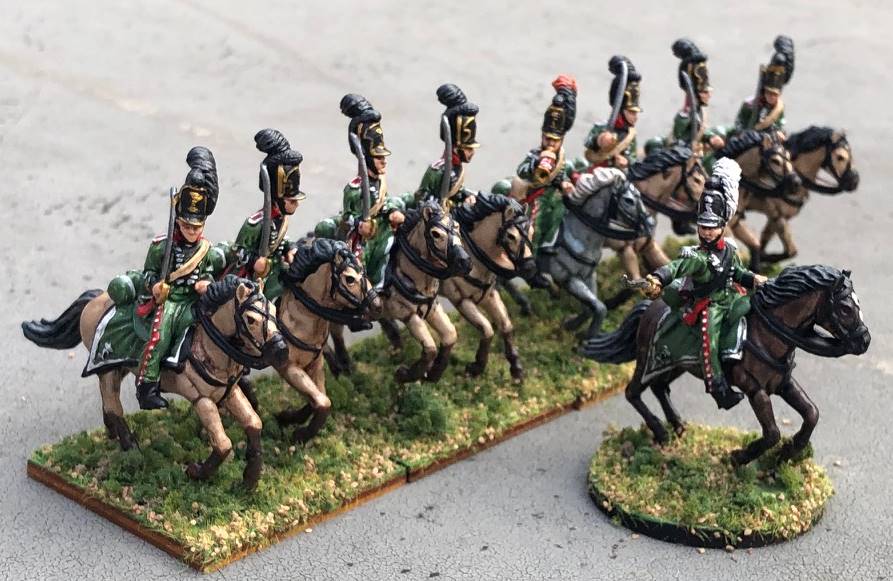
From 1790 to 1808, the Chevaulegers wore a helmet (kasket) similar to that worn by the British Dragoons in the 1770's and 1780's. Starting in 1806, a new helmet similar to the Bavarian Raupenhelm was introduced; the transition was probably complete by the end of 1808. A somewhat shorter version was introduced in 1812. The jacket was grass green with black cuffs and lapels, and was extensively ornamented with white lace. The collar and turnbacks were bright red. Shoulder straps were red piped in white. the breeches were originally straw colored, but were changed to grass green in 1809. Unusually, the belts and ammunition pouch were all buff leather. Saddlecloths were grass green, with black border, piped white on the inside edge. Trumpeters wore the same uniform as the men, but with a red tip to the plume, and (possibly) black "swallows nests" on the shoulders, piped white. Trumpet cords were red, probably mixed with white. Officers wore much the same uniform as the men, but with silver metal on the raupenhelm in place of brass, silver lace in place of white, and the silver mixed with red sash of the Hessen-Darmstadt officer corps. The uniform information come from Rawkin's book on the Army of Hessen-Darmstadt, which devotes over 30 pages to this unit. 
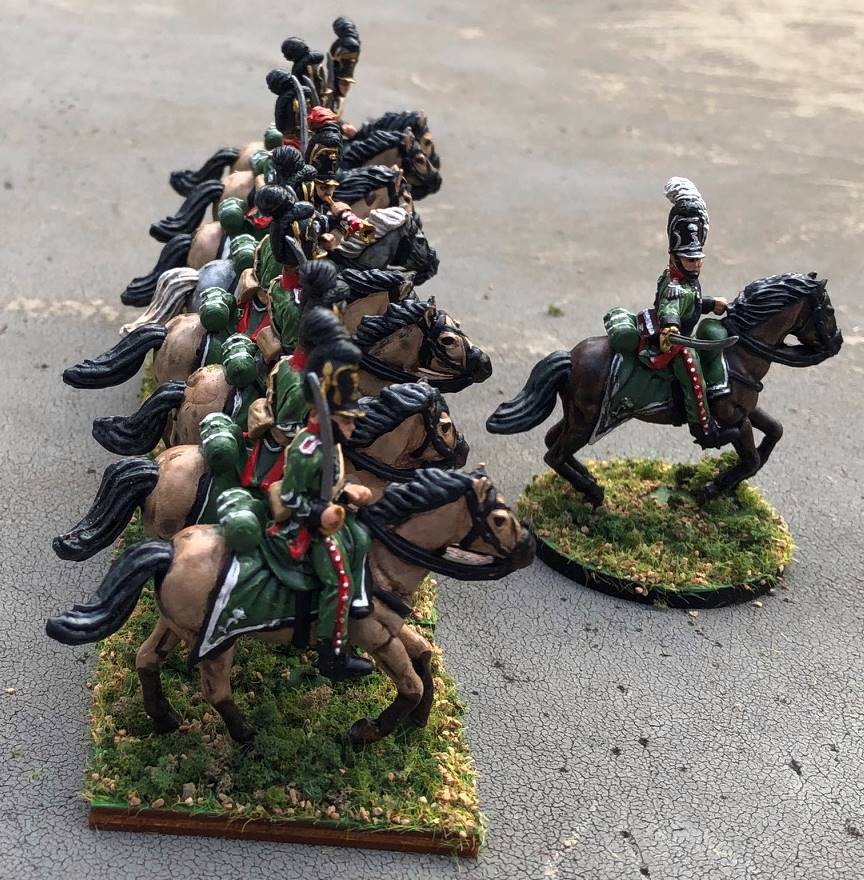

The chevaulegers were never issued any flags. I have been eager to have a unit of these fellows for quite some time, but their uniform is fairly unique, and as far as I know, no one has ever done them in 25/28 mm before. Lucas and Piano Wargames have now corrected that deficiency in fine style! 


I chose to mount the regiment on light bay horses, chiefly because it contrasted well with the uniform; the trumpeter rides a grey. I think they look quite magnificent!

Wednesday, January 11, 2023

Hessen-Darmstadt Foot Artillery

The Army of Hessen-Darmstatdt included a Corps of Artillery. During the Napoleonic Wars, it was initially it was organized into "batteries" of  (usually) 2 x 6 lber guns each, and intended as sort of Battalion artillery for the infantry units. The woodwork of the artillery carriages was painted light blue, with the metalwork on the carriages painted black. 


By 1807, the total strength of the Artillery was up to 8 x 6 lber cannon and 2 Prussian 7 lb Howitzers. An artillery company fought with the Hessian infantry contingent during the invasion of Russia in 1812; 3 gunners, 1 gun, and 3 caissons actually returned to Darmstadt.  As can be seen, the uniforms of the gunners were dark blue, with black cuffs, collars, and lapels piped red, and decorated with white lace. That lace must have been a bear to keep clean when working around black powder!  The turnbacks, like that of the infantry, were red. Shoulder straps were dark blue piped red.


In 1809, the Hessian contingent formed a brigade of 6 battalions within the Division of Cara St. Cyr (not to be confused with the future Marshal), as part of Massena's Corps. They were especially heavily engaged in the intense fighting around Aspern. An artillery contingent accompanied the battalions sent to Spain in 1809 as well. 


For the 1813 campaign, the artillery was greatly expanded to 4 companies, each equipped with six 6 lber cannons and two 7 lb Howitzers. The ginners wore a black shako with a white metal plate on the front, and short black plumes. The national cockade was white with a red center. 


Hessen-Darmstatdt was one of the founding states of the Confederation of the Rhine, formed in July of 1806, and supported Napoleon and France until after the Battle of Leipzig in November, 1813, at which point it joined the Alliance against France. Trousers were dark blue, and black "Hessian" boots with red trim were worn. 


The guns and crews are white metal, digitally sculpted by Lucas Luber of Piano Wargames, and cast in Germany. Marvelous stuff, and I am not aware of anyone else who has done figures for the Hessian artillery. 


Sunday, January 8, 2023

Snappy Nappy Campaign 2022:The French Perspective

 Well,. it has taken a while, but here are the French players perspectives on the 1812, Russia: The Northern Flank, Campaign-in-a-Day, with Snappy Nappy. Had to believe we played this almost 2.5 months ago!


Legrand's Division, After Action Report:
by Nick M.


On his way from Borovka, Legrand reaches Golovitchitsa before arriving at Kliastitzy ...


So I was Legrand, and started out moving north rapidly on a table somewhere south of Saint Petersburg.  Once there, I met up with Verdier (Mark H.), and it was immediately apparent that with both of our forces we would barely be able to maintain our control of the main road leading north.  I set up on our north flank behind the river, and began defending while the General Oudinot's light cavalry scouted north.


The enemy's forces on my side were cavalry and horse artillery, so I maintained square formation to keep the cavalry at bay, and with some luck passed Morale Checks for the artillery firing at my positions.  I sent a message asking if the north was safe because I was fully committed on my table, and knew that any enemy arriving from the north would be disastrous.  I received no reply except the General Doumerc (Steve T.) eventually requested infantry support to the north, so I sent 2 units that I could ill-afford to spare.  As soon as my infantry arrived, they were sent back and the General Doumerc told us that there was a Russian army approaching from the north.


It was decided to retreat off the table, against my protestation. We had control of a town in the southeast corner that would have neutralized the enemy's huge numerical advantage, and we had no reinforcements to the south. But we marched right through it. So we retreated to the next table which was wide open and, given more time, could have led to our complete elimination.


Overall it seems like the game is won or lost via the c and c, so I recommend staffing the c and cs as a first priority, and if you are short players just take equal armies from both sides off the board.  Also learned that while I have a lot to learn tactically from other players, maybe I shouldn't just default to their strategic suggestions ... lol.

Great experience though, with amazing detail. Looking forward to more games with you and this campaign again next year.


Early Activity Near Disna:
by Mark T.


Merle advances along the road north of Disna with the Swiss, while Corbineau's cavalry heads west to see what's at Drissa, and the first Russians arrive.


The Swiss prepare their lines as their attached Dutch unit arrives, as do Doumerc's Cuirassiers all the way from Polotsk. Note the French spy bringing up the rear.


Meanwhile the remains of Doumerc's cavalry occupy the Gamezlov area.


Corbineau's cavalry scout at Drissa observing a unit of Opolchenie at Drissa, and no bridge, while Sazanov's troops prepare are moving east.


More Russians move towards Disna as Gen Wittgenstein writes more communications to his troops in the north.


The battle at north of Disna begins as the Cuirassier's make their move, and Corbineau's cavalry return to cross the bridge and hold the Swiss left flank.


A French Cuirassier unit garrisons Gamezlov.


Back at Disna, some Russian cavalry get a jump towards the bridge, while the Croatian unit can be seen garrisoning Disna to the left.


The Russian cavalry attempt to get behind the Swiss.


But Von Deroy arrives with his Bavarian infantry and artillery south of Disna, and just in time to provide a new threat for the Russians.


The Bavarian Corp Arrives:
by Mark T. and Robert P.


The Bavarian Corp under St. Cyr with Von Deroy as vanguard arriving at Bononia, before marching to Disna.


After Von Deroy shows up at Disna, Wrede arrives behind St. Cyr's troops.


And with Von DeRoy's troops reinforcing the Swiss, Corbineau's cavalry cross the bridge forcing some Russian cavalry to retreat towards .


After St. Cyr moves west behind Von Deroy, Wrede waits for the log jam to clear.


However, while waiting, Wrede exchanges communications with St. Cyr, and in his AAR states, "As for Wrede's Bavarians-we marched ..." heading for Polotsk.


And after making the crossing proceeds in the opposite direction with some French light cavalry that give up their garrisoning duty as they all march west.


Wrede's force travels south of the Cuirassier garrison at Gamezlov, and marches along the river in their effort to reinforce the Swiss.


"We arrived at the battle ..." with artillery and the French light cavalry first.


"... and deployed, perhaps in time to salvage a grim situation", as the Swiss are being pressed, although Von Deroy nears the crossing at the bridge.


"... but the battle waned, and the men would not become engaged that day". 


Delaying Action At Golovitchitsa ...
by Mark T. and Mark H.


After the fierce fighting in the vicinity of Jakubowo and Kliastitzy, and as the remains Legrand's Division continued to extract itself as a rearguard from the combat there, the remains of Verdier's Division seek to find an appropriate spot to create an initial line of delay at Golovitchitsa.


The initial position of Verdier's Division.


As Verdier sees that plenty of Legrand's forces are bringing up the rear safely, he reassesses the terrain, and seeks a more defensive spot further way from the eventually descending Russians, and in a spot to further retreat to slowly delay the enemy.


And Legrand join's Verdier's forces for their new line of defense.


Steinheil's reserves begin to arrive.


Followed by Prince Repnin's Cavalry.


And as Kazatchkowsky arrives as well, Castex's light cavalry brigade seek to slow down the Russian forces by seeking their early deployment.


Prince Repnin responds, the French cavalry retreat.


And the Russians begin their assault.


Verdier's comments in his after action report were, "I figured if we played ALOT longer, I could have stalled them from getting to Polotsk for a long time." He was guessing there were at least 2 or 3 more boards above Polotsk.  We could hold and then retreat from the table we were on.. back to another stalling action and so on.  We were 2 divisions verse 3, and the majority of their 12 pounds were against us.  So we were tying up more than we consisted of.  Retreat was our only option in the face of those big guns... slow and methodical.  Hopefully they could win or draw at Disna ... and maybe send some reinforcements to Polotsk,"  although alas, the sun was setting on the fields of battle for the North Flank of the 1812 Russian Campaign.


From The Over-all French Commander ...
by Steve T.

Alright, its been a little while since the event so my recounting of the battle may not entirely match the pictures; besides that my memory of names is genuinely appalling. Let it be said though that my lack of "definition" does not indicate a lack of enjoyment I had during the event, this was my second Snappy Nappy Campaign-in-a-Day, and surely not my last! 

Being my second time in a Snappy Nappy Campaign-in-a-Day, it may be unusual to hear that it is my second time playing the role of over-all commander. My first time at command was an act of bravado, this event saw me leading as an act of duty when the original player in command arrived late due to a work issue. Along with the role of Oudinot as high commander I was also playing as Doumerc; I admit that the dual command was a huge advantage, not necessarily accounted for in both the design and spirit of the game, however I took it upon myself to restrain from making decisions based on knowledge from simultaneous boards.

Liberties I did take were to send Doumerc's heavy horse with Oudinot, leaving only a couple stands of light horse with Doumerc. The two commanders combined accounted for a small pittance of the French forces, so my contribution to multiple combats was minor.

The scenario seemed simple. Unsettlingly simple: The French were to march North, hopefully find a path to St. Petersburg. From the get go half of our forces would blitz North until we met the enemy, the remaining commanders were to find meet the enemy in the center of the map (or what we though was the center). 

The first 15 minutes of the event were hectic! We marched fast and reports (all written of course) came in quicker than I could have expected or respond to. What I did immediately notice was that we had crossed more than half the map towards the Northern edge, our assumed goal, without contact. I thought it could be a bad situation where the French and Russians had either passed each other or were spiraling in an attempt to out maneuver. If we were the first to be outflanked then surely we would not recover the position and our supply lines with it.

This was not the case, something possibly worse happened. Multiple French commands met multiple Russian commands in at the same table, all in the opening hour.  Disna would be a primary battleground, and having a taste of Snappy Nappy, I knew that this would not be resolved quickly!

Perhaps the GM will be disappointed to hear this, but I rushed Oudinot to join the table of Disna, eyes would be faster than messages and the combat would have to monitored, already the French were on the back foot positionally. It was later acknowledged that Oudinot's arrival, which happened to be in the flank of one Russian line, was a significant deterrent of what would have been an aggressive Russian attack! When French reinforcements arrived it was my decision to commit them to the same table. Disna became a grueling gridlock, multiple commanders on a single table and to my observation, none who wanted to be the first to attempt to break free. Disna would be fought with cannons and should have been resolved with bayonets, regardless the Russians were tied up around Disna for the event, which made the Northern push the determining factor of success. 

We came shy of our objective, it was actually my second role, Doumerc, alone who entered the final northern table whose road would lead to St. Petersburg. For the briefest moment, Doumerc, accompanied by two units of light horse needed only to ride the long road, but it would not be. Not a turn later, Russians began arriving at the far end of the final table, then more, and more. Doumerc had to turn back to warn the engaged French back down the road of the impending Russian Flank.

A retreat back South to Polotsk was initiated and not a moment too soon. It was a thrilling moment, several French commands, including Doumerc were jammed up on the single road of retreat, Russians previously held back across the river by cannons were now rushing to cut off  the retreat, emboldened by the masses of Russian reinforcements entering the table at near musket range of the French.

To my own surprise a good number of the French escaped the table and were able to set up a stand on a hill. I would learn in the campaign debrief that this was accurate to history! The game concluded with the French position outgunned and out ranged, I'm sure it would not have been a close fight. 

I will of course mention the use of spies, a fun addition but maybe under utilized. The duel was a fantastic intermission to the conflicts, in future practice I suggest that the spies be involved in the manipulation of the written orders, maybe stealing orders or planting false orders.

My concluding thoughts:

The Snappy Nappy campaign in a day events are fantastic way of conducting a large scale event and in my opinion have been 
very successful in doing so. I do think the bottleneck at Disna could have been avoided. It was the result of both the French and Russian's assuming that impassable sections of the map were actually traversable and liability to being flanked. Both forces marched to be the first to secure the location and met head on, but not in such as way as to deploy long lines, where Snappy Nappy could really shine. Had I any amount of infantry I would have led the example of breaking a stalemate by force. I as the game wound down I attempted a cavalry charge into cannons with the hopes of inspiring a more reckless approach from my allies, alas we mostly traded cannon fire. 

I'm looking forward to future events, hopefully Snappy Nappy will return to the Portal next year! Thank you again to everyone who put the time, money, and effort into a truly fantastic event, as a 27 year old hobbyist, you are an inspiration that I may sooner than later expand my efforts to run events that encourage others to participate in large scale historical wargames.

Thursday, January 5, 2023

4th Quarter and Year end statistics for 2022

The search for the elusive Tartan paint!


Expenses:

October 2022
Primer and rulers $13

November 2022
Brigade Games (Portuguese Cacadores and Line Infantry, Artillery Crews and Mounted Command)  $192.40, Heroes of Might and Magic Boardgame Kickstarter $290.44

December 2022
Alps Aflame Kickstarter (LOTS of Bavarians, some Tyroleans and Austrians, plus the sheep and cows!) $662.64


4th Quarter Total:        $ 1,158.48

3rd Quarter Total:        $1,134.13

2nd Quarter Total:          $702.21

1st Quarter Total:        $1,743.71

2022 GRAND TOTAL:  $4,738.53   (Yikes!)


Painting:

October 2022
24 ECW Highlander (120 points), 18 Indian Cavalry (180 points), 2 Indian Mounted Command (20 points) 1 Elephat w. crew (40)

November 2022
2 Elephants w/ 3 crew each ( 80 points), 6 Indian Cavalry (60 points), 20 Scots Covenanter Foot (100 points)

December 2022 
12 ECW Highlanders (60 points), 54 Hessen-Darmstadt Infantry (120 points)


4th Quarter Total:  780 points

3rd Quarter Total: 812.5  points 

2nd Quarter Total:  1050 points

1st Quarter Total:  900 points

2022 GRAND TOTAL: 3,542.5 points


2022 Painting analysis

Army

Infantry

Cavalry

Artillery

Command

Points

Napoleonic Spanish

180

160


20

360

Napoleonic Hessians

270


270

Renaissance


40

40

ECW (Scots)

480


480

Wars Roses/Late Mediev

1260


20

120

1400

Mauryan Indian

430

240

240*

50

960


Compared with the previous 2 years, Napoleonic troops are much less than usual, Wars of the Roses came out of nowhere to dominate the painting table, the Indian army was completed, with large numbers of troops painted (* includes Chariots and Elephants) and good additions made to the ECW Scots. Overall, the efforts were more focused. 


2021 - 3,890 points


Army

Infantry

Cavalry

Artillery

Command

Points

Napoleonic  French

540


540

Napoleonic Austrian

990


990
Napoleonic British270


270


Great Italian Wars
120

120

ECW (roughly 50/50 K or P)


200


200

Ancient Egyptians

200


20

220

Ancient Sea Peoples

475

330


10

815

Ancient Hittite

140

35175

Ancient Indian

120


120

Ancient Assyrian4050
30120

Ancient Libyans

200


20

220


About half Napoleonics and half Ancients, with a few Renaissance/ECW troops thrown in. 

2020 - 3,865


Army

Infantry

Cavalry

Artillery

Command

Points

Napoleonic  French

360


170

530

Napoleonic Austrian

180

160

220

185

845


ECW (roughly 50/50 K or P)

400


400


Ancient Macedonia

520

120


10

650

Ancient Roman


220


30

250

Ancient Thracian

120

200


320

Ancient Hittite

205

360


565

Ancient Canaanite

225


225


Siege Artillery


80


80


About 1/3 Napoleonic, 10% ECW, and over 50% Ancients. 

Games:

October 2022
Ramses vs Sea Peoples in Danielson, CT (TTS!); Snappy Nappy 1812 Campaign in a Day in Manchester, CT

November 2022
Pinkney's Court (FK&P - ECW) here, Konin (Napoleonic FoB3 at Jared's) 

December 2022
Burchitt's Green (FK&P - ECW here), Ocana 1809 (Napoleonic Battle Command here)


4th Quarter Totals:  6 games (all in person)

3rd Quarter Total:   6 games 

2nd Quarter Total:  3 games

1st Quarter Total:   2 games

2022 GRAND TOTAL:  17 games


Blogging:
108 posts for 2022


So, how was the 2022 performance compared with the goals set forth in January 2022?

Expenses:

Goal: Last year was nearly $3,000; I expect 2022 to be an expensive year as well, with  purchases already high in the first month. We'll see if we can hold it under $2500 for 2022. 

Result: Epic Fail! Came in at almost twice budget; Kickstarters were a Major cause of budgetary excess, and we already know Lucas has a big one planned for this Spring.

Projection: Let's aim for $3,000 or less. I have 5 major board games, each from different genres slated for delivery in 2023 from Kickstarters (Coalitions, VoidFall, Castles of Burgundy Deluxe edition, Kingmaker Remastered, and HOMM - the Boardgame) so really, why would I need any more?  I have a relatively few figures I want to add, but Lucas may well do TWO Kickstarters in 2023, and I will surely support those!
 

Painting:

Goal: Both 2021 and 2022 were all time high years for painting; I doubt I'll be able to match them for a third year in a row. We'll aim to exceed 2400 points this year. If COVID continues to limit travel, the total could exceed 3,000 points again. Major projects are a moderate sized WoTR force for use with Test of Resolve and planned games at Historicon 2022, completing the expansion of my Mauryan Indian army, all those Wurttembergers from the Kickstarter, and quite possible some additional Napoleonic Spaniards. I have plenty more Ancients and assorted Napoleonic's to paint any time the spirit moves me as well.

Result: Well over goal at 3500 points; Big WoTR/Late Medieval project completed, Mauryan Indian Army expansion completed, added significantly to my Napoleonic Spanish (Perry), and made major additions to my ECW Scots Covenanters as well. I did the Hessians instead of the Wurttembergers first!

Projection: Aim for at least 3,000 points again. Start the Wurttembergers, finish the Hessian Cavalry, Artillery, and Command, add more ERCW Scotts, and may be a few more WotR Old Glory figures. Only the later requires any new lead purchases! Napoleonics seem likely to rule the painting table in 2023 once again! 


Games:

Goal: 
I managed 26 games last year, the most in a long time. 2 games a month on average is doing quite well - Goals is 24 games in 2022. 

Result:  17 games, only 1 remote and that at the start of the year, so a bit under goal.

Projection: Aim for 18 games


Blogging:

Goal: 
2021 was a record year at 116 posts here as well. Goal is 100 posts or more for 2022. 

Result: 108 posts; goal exceeded. 

Projection: At least 100 posts for 2023. 


Rules:


Goal: 
This is the one area I fell far short in 2021. Goals there are the same or more than last year!

There at least 5 different Napoleonic rules sets in the sights - Blogger sets Eagles Cheaper than Brain Cells and 123! Napoleonics, plus a Napoleonic variant(s) for Bloody Big Battles (Jared has been using this last with his students), an updfated Morschauser set, and a playtest of Poquer when Bob Jones releases the next playtest version. . 

Verbatim from last year: Several Napoleonic Age of Sail rule sets to try as well - Grand Fleet Actions in the Age of Sail and Form Line of Battle.

Also almost verbatim from last year: For my large collection of Superior Starfleet Wars/Galactic Knights ships, play at least one game with Starmada, Stars and Lasers, and Ascension of the Galaxy (from a Kickstarter).

Result: About as little progress as last year; Did do the Morschauser rules at least, and at the very end of the year, the new set "Battle Command" by Brent Oman.

Projection: I'll likely do as poorly as in the past, but playing "Eagles" and "123!" remain a goal, and add in Absoluet Emperor (Osprey) and the new Perry Napoleonic rules "Valor and Fortitude".  I would still like to try Form Line of Battle, and Grand Fleet Actions, and now add in Black Seas (the set designated for Naval affairs on our very languid Napoleonic Imaginations Warplan 5/5 campaign. For Sci-Fi Naval, Starmada, Dtars and Lasers, and Ascension of the Galaxy remain goals. I probably will need to retire (planned for October 1, 2025) to accomplish much here!


The Scoring (from Analogue Painting Challenge)
6mm foot figure = 0.5 point
6mm mounted figure, artillery piece or crew served weapon = 1 point
6mm vehicle = 2 points

10mm foot figure = 1 point
10mm mounted figure, artillery piece or crew served weapon = 2 points
10mm vehicle = 3 points 

15mm foot figure = 2 points
15mm mounted figure, artillery piece or crew served weapon = 4 points
15mm vehicle = 6 points

20mm foot figure = 4 points
20mm mounted figure, artillery piece or crew served weapon = 8 points
20mm vehicle = 12 points

28mm foot figure = 5 points
28mm mounted figure, artillery piece or crew served weapon = 10 points
28mm vehicle = 15 points

28mm chariots w/ crew 15, + 5 for each crew figure and/or horse
28 mm Elephant 25 points plus 5 for each crew figure (my own reckoning)
 
40mm foot figure = 7 points
40mm mounted figure, artillery piece or crew served weapon = 15 points
40mm vehicle = 20 points 

54mm foot figure = 10 points
54mm mounted figures, artillery piece or crew served weapon = 20 points
54mm vehicle, limber, etc. = 30 points