Saturday, January 17, 2015

The Hos Blethan Affair - Lord Kalvan Sequel #6

    Of the several new books acquired over the Holidays, I was most eager to read this one. It was finally published in November, almost a year late, as a result of a life threatening illness by the chief author, John Carr. This side tale, set in the Paratime world of  Lord Kalvan of Otherwhen (Aryan Transpacific, Styphon's Houie subsector), which has roughly 30 Years War level military technology, is unique in that Kalvan makes almost no appearance whatsoever in its pages, although he continues to have a strong direct and indirect influence on events.


    The novel is set after the events related in the Sequel, "Kalvan Kingmaker", and immediately before those of "The Siege of Tarr-Hostigos". It chronicles the events in the Kingdom of Bletha set in motion by King Kalvan of Hos-Hostigos sending his "Chief of Intelligence", the former horse thief Duke Skanga, and a promising but somewhat hot headed Colonel from the Royal Army, Democriphon, to Hos-Bletha to uinitiate a 5th column action designed to tie up the armed forces of Hos-Bletha so that the Kingdom will not be able to send its planned contribution to join the Grand Host of Styphon, being gathered to crush Kalvan once and for all. Starting with a small band of leaders and a few companies of soldiers, the activities of Kalvan's agents range from raids to con games to Robin Hood inspired woodland outlaws, to systematically plundering the corrupt temples of Styphon and using the gold gained to fund operations. Along the way some old secrets are uncovered that further destabilize the regime of  Great King Niclophon.

    I don't want to give away any of the many plot tuns in the book so I'll merely say that I thoroughly enjoyed this book. While it lacks much in the way of battles that one might want to bring to the tabletop, there is plenty of fighting. This book was blast to read, and perhaps the closest in tone and style to the original Lord Kalvan of any of the sequels. I tore through its 650+ pages in less than a week! Highly recommended.

    At present The Hos Blethan Affair is available only in the beautifully produced but expensive limited edition hardcover book form; all of John's other works are now available in reasonably priced kindle/epub forms, either direct from John or via Amazon. John's site even has the 1st edition version of Great King's War (the first sequel to the original Lord Kalvan of Otherwhen by H. Beam Piper) available for free download.

Down Styphon!

Peter

Tuesday, January 13, 2015

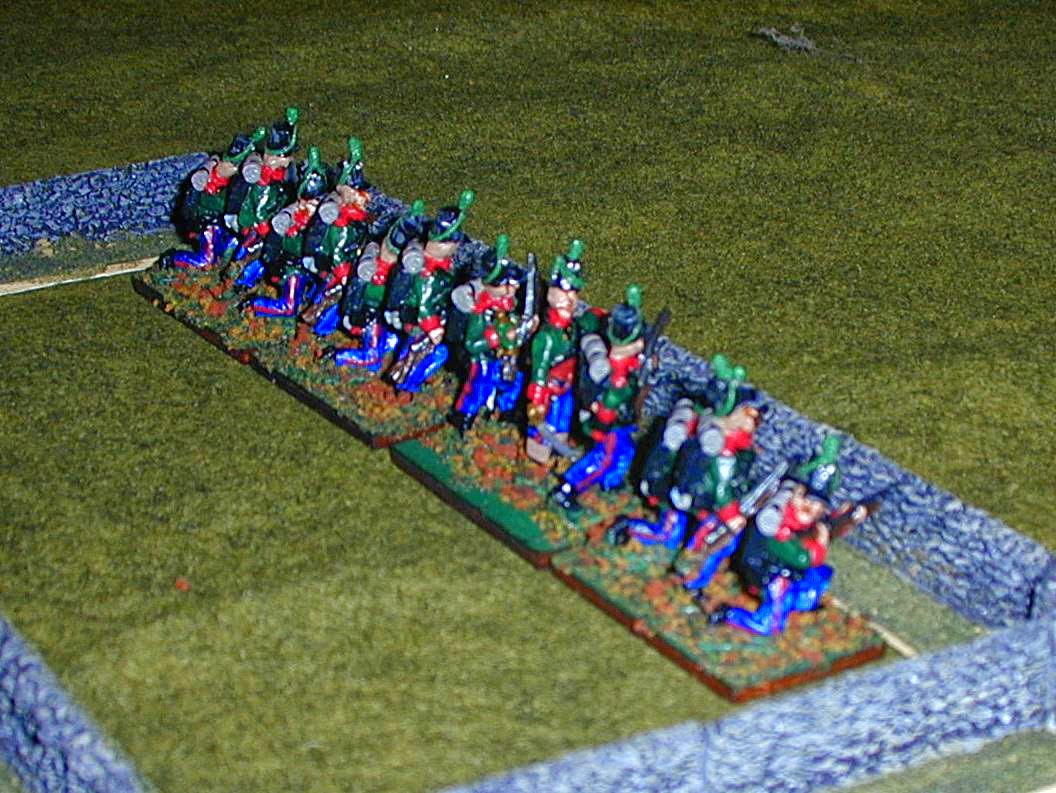
60th Infantry Regiment "Royal American", 5th battalion

    The origins of this regiment date back to 1756, when it was raised as the 62nd Regiment (Royal Americans) in four battalions from American colonists and officered largely by foreigners (mostly German) of Protestant faith - the first time a British regiment had non-British officers. The regiment was re-numbered as the 60th Regiment in 1757. It fought at Louisborg and Quebec.

    In 1797, a 5th battalion was raised on the Isles of Wight, primarily from Germans, and was equipped entirely with rifles - the first Rifle armed Regular battalion in the British army. It was also  the first Regular unit to wear a green uniform (with red facings). A 6th battalion was raised in 1799; The 5th battalion saw extensive service in the Peninsula. The Light companies of the Line battalions of the 60th were later armed with Rifles as well. A 7th Battalion, again rifle armed, was raised in 1813 for service in the Americas during the War of 1812.  Later in 1815 the Regiment's name was changed to the Duke of York's Own Rifle Corps, and then again in 18130 to The King's Royal Rifle Corps.


The 5th (Rifle) battalion of the regiment wore dark blue pants with red stripes down the outer seams - quite unique in the British infantry. 


Battle Honors awarded to the 5th battalion include "Rolica" "Vimiera" "Talavera" "Busaco" "Fuentes d'Onor" "Albuhera" "Ciudad Rodrigo" "Badajoz" "Salamanca" "Vittoria" "Pyrenees" "Nivelle" "Nive" "Orthes" "Toulouse" and "Peninsula"


The motto of the Regiment is Celer et Audax (Swift and Bold). It is said to have been conferred by  Major-General James Wolfe. Apparently, Wolfe was was greatly impressed with the alertness, intrepidity and spirited conduct of the grenadier companies of the 2nd and 3rd Battalion of the 60th Royal Americans before Quebec that he conferred it upon them. Curiously, it seems to have been forgotten later, and only officially restored to the Regiment in 1824!


The 5th Battalion fought mostly in 1-2 company detachments dispersed among the Peninsular army to bolster its skirmishing capabilities.   28mm Old Glory figures.


The 5th battalion, 60th Regiment was armed with the excellent Baker rifles. It had the green cords and short plumes of a Light unit. Another of the many detailed regimental histories of British regiments, that for the 60th (this including a number of uniform plates) can be found online at: https://archive.org/stream/regimentalchroni00walluoft#page/x/mode/2up

Saturday, January 10, 2015

Napoleonic Sailing Ships - Dutch

Prior to the Revolutionary and Napoleonic Wars, the Dutch navy had been a force to be reckoned with. The vast Dutch colonial and trade empire needed good ships and captains to protect their far flung possessions and its commercial shipping. Following the French Revolution, Dutch maritime fortunes declined, the Dutch Navy being famously captured by a regiment of French Hussars (the 8th) at Den Helder on the night of  January 23, 1795. The winter had been extremely cold, and the ships were literally frozen in place. The French suck across the ice and captured the ships while most of her crews were asleep... or so goes the standard version. It seems perhaps that the truth is more complicated, and the Dutch fleet reached an agreement with the French rather than actually being captured (Holland was in a state of civil war between the French backed Revolutionary faction and the Orangists supporting the Stadtholder [Dutch sovereign]).  Either way, the ships of the Dutch Republic - Batavian Republic - Kingdom of Holland make a nice force that can be deployed to aid the French or fight them on the tabletop.


A 20 gun Sloop. the Belgica, and a 36 gun Frigate, Utrecht


Another view of the sloop and frigate; I painted the strakes of the Dutch ships a bright red color, shading towards orange, as opposed to the dark red I used on the Spanish ships seen previously. 


Next is a trio of 74 gun Dutch "3rd rate" ships of the line. 


Dutch ships had relatively shallow drafts to allow them to navigate the relatively shallow waters of the Dutch coast and the associated estuaries.


These three 74-gun Ships of the Line are the Dordrecht, the Alexander, and the Washington.


A view of all 5 ships of the Dutch squadron.


Another view of the five Dutch ships in my collection. It looks like we'll get to try out the Close Action rules tomorrow!

Monday, January 5, 2015

Great Britain: 2nd (Coldstream) Guards

    The 2nd (Coldstream) Guards is the oldest regular regiment in continuous service in the British army, Its origins date back to the English Civil War. It was originally raised as a regiment in the New Model Army by General Monck in 1650. During the Revolutionary and Napoleonic Wars, the Regiment saw service in Egypt, fought at Copenhagen in 1807, and was sent to the Peninsula from 1809 on. There it participated in the battle of Talavera as well as the Sieges of Ciudad Rodrigo, Badajoz, Burgos and San Sebastian, the battles of Fuentes de Onoro, Salamanca, Vittoria, the Pyrenees, Bidassoa, Nive, Nivelle and the investment of Bayonne. The 2nd battalion of the regiment participated in the ill-fated Walcheren expedition in 1809.
During the 1815 campaign in the low countries, the regiment fought first at Quatre Bras, where unlike the 1st Foot Guards, it was not heavily engaged. . At Waterloo, the regiment was famously part of the defenders of the Hougoumont chateau. Its losses that day were 348 killed and countless more wounded - extremely heavy!


The 2nd (Coldstream) Guards - 28mm Old Glory Figures. I was uncertain as to whether all the companies should wear the white plumes of Grenadiers (as in the Fusilier regiments), but looking at this re-enactors website, it appears the usual company plume distinctions were preserved (verified); I will have to correct that. 


I have painted all the companies with shoulder wings, which I believe is correct*, and for the Guards, the wings are in their dark blue facing color, rather than the red used by the flank companies of Line regiments. * see comments below - further research shows that the wings were  indeed limited to the Flank companies, although the 8 center companies had broad dark blue shoulder straps piped white. 


I need to order some more GMB flags - the Foot Guards Colors were unique in that the design patterns of the King's and Regimental colors were reversed, with the Regimental colors having the overall Union flag design, and the King's colors being crimson. To make things much more complicated, there were three different versions of the King's colors for Guard regiments (Colonel's, Lt. Colonel's, and Major's), and often even duplicates of these patterns due to the wear and tear caused by the ceremonial duties of the Guards. The Regimental flags were even more abundant, one per company, each with different badges/emblems upon them. Despite this profusion of designs, only one Crimson and one Union pattern flag were carried by a battalion in the field at any one time... thank goodness!


I have chosen to paint the regiment with the white pants worn for dress occasions, as a way of making the Guards stand out more easily on the wargames tabletop. 


The motto of the Coldstream Guards is Nulli Secundus (Second to None) which is a play on the fact although that the regiment was numbered as the 2nd Foot Guards, its history of continuous service as is longer than that of the First regiment. 


With the addition of this unit, my British Napoleonic army is now up to almost 300 figures, and my total Napoleonic collection now exceeds 6,000 figures! It will probably top out at somewhat under 7,000 eventually. 

Saturday, January 3, 2015

2014 in Review, and Plans for 2015

Well, it's that time again for a retrospective on the old year and some plans for the new one.


Another doggone year at Blunders on the Danube


2014 in Review


1) Painting


January:  16 British Light Cavalry, 18 RHA, 6 guns
February:  6 Prussian Officers, 2 dogs
March:  24 Nubian Archers, 32 Sherdan Guards, 4 Crows, 2 Squirrels, 1 Skunk!
April; 24 Egyptian Archers, 4 Egyptian officers, 30 British Fusiliers
May: 45 Entomalian Fighters, 10 Entomalian Misiles, 6 Entomalian Starships, 7 Egyptian               Chariots, 5 Wolves
June: 38 Old Guard Infantry, 8 Old Guard Foot Artillery Crew, 6 Gendarmes d' Elite,12                  Brigade Models Merchant ships, 11 Terran Starships, 38 Terran Fighters, 10 Terran              Missiles
July: 9 escape pods, 2 Resin Egyptian Colossi, 20 Entomalian Starsghips, 16 Entomalian             Fighters, 10 Entomalian Missiles.
August: 14 French Artillery Crew, 4 French Napoleonic Characters, 18 Prussian Landwehr
September: 16 Austrian Hussars
October: 18 British Infantry
November:  18 British Infantry, 4 Ballistae
December 36 British Infantry

Total: 242 foot figures, 10 artillery models, 44 mounted figures, 12 animals, 7 chariots, 39 missiles/escape pods, 49 starships, 99 fighters, 2 terrain pieces, and about 60 drift markers for Galactic Knights.

Not a bad year, with a large chunk of it devoted to Starships and Egyptians, with less Napoleonics than usual.


2) Gaming


Games Played
Battle of the Trebbia (Pulse of Battle) w/ Barry
Montmiail Playtest #2 with Barry
Galactic Knights Playtest with Barry
Latema Nek WW1 at Historicon
RCW game w/ Jared and crew
La Bicocca Playtest with Jared
Legio Quatrenarius paytest with Barry
San Miguel with Die Fighting with Barry

Games Run
Hostile Realms at The TM (2 games side by side)
Montmirail x 2 at Historicon
Egypt vs Assyria with Pulse of Battle at Historicvon
4 Galactic Nights games (2 sessions of 2 each) at Historicon
Legio Quaternarius at EllisCon

8 games played, 7 games run - a pretty good year!


3) Blogging


100,446 pageviews
100 posts
A Liebster Bliog Award
Added Napoleonic Uniform Information Page/Index

A very solid year!


4) Publications


None, but working on at least one small project for 2015.


Goals - Looking to 2015


1) Painting


This year should be almost all Napoleonic until July and Historicon!

 I still have quite a few Landsknechts, Gendarmes, and other Renaissance/Late Medieval era cavalry that I can add to my existing forces if I have time - some could be used at La Bicocca.


2) Gaming


I did pretty well last year!  PLAYING 12 games a year is a stretch goal. We'll see! :-)

Use all those starships for a game or two!  

Maybe a Kalvan/TYW game with the HAHGS

Some Napoleonic Age of Sail with Close Action  - ? at Portal Con at the TM later this month.

I  plan to run a game of Die Fighting 2 (Napoleonic)  for Havoc this Spring.

Hundred Days 1815 "Campaign in a Day"  with Snappy Nappy at the Time Machine for June 2105 - really looking forwards to this one!

For Historicon 2014 I plan to do:
1)  Egypt Canaanite game with Pulse of Battle and Ken B. - need to firm up plans for this one.
2) A Napoleonic game with Die Fighting 2, maybe historical, maybe not
3) La Bicocca with Hostile Realms
4) Waterloo or Ligny with Field of Battle 2nd edition, maybe a PM/following AM doubl;e header - worked well with Montmirail in 2014. Buiggst issue is deciding which one fopr sure so as to guide painting, etc. I a, leaningh more towards Ligny.

Waterloo or Ligny with FoB2 (Probably whichever I don't do at Historicon) at the TM or at Ellis Con this Fall with HAHGS?  Hopefully Joe will ru n his Quatre Bra scenario one or more times.


3) Blogging

No major goals there - just continue posting regularly. Update some pages listing my exiting collections as time permits.


4) Publications

. Minor project started, should complete in the first half of this year. 

Wednesday, December 31, 2014

New Books and Old Shelves - Old Tales and a New Year!

Today being on the cusp between the Old Year and the New, it seemed a suitable occasion for a post combining the Old and the New as well. The later part of this year, my mother in law (a wonderful woman) moved into a (high class) assisted living arrangement at age 88. Her new apartment didn't have room for all of her furniture, so when asked if we wanted any of it, I lept at the chance to acquire some "new" old shelving. Like many historical wargamers, my book collection must weigh as much or more than my lead! (My freind, Bob Jones, would tell me it's time to give them all away and stick entirely to digital media - not happening for another decade or two, Bob!) This pair of bookshelves fit exactly beneath a window in my study/computer room. It wasn't until it was in place that I discovered that the height of the shelves *precisely* matches that of Ospreys! Thiss is great, as Ospreys have a tendency to warp etc when set on end on their own.


The new shelf in place. As you can see, I have plenty of Ospreys (don't we all?), Also prominent are works by Chandler, Gill, Petre, Arnold, Oman and many more, as well as my "Lord Kalvan of Otherwhen" sequels. Of course, I have at least 4 times as many more books on OTHER shelves, but still, these shelves have been hugely useful!


This old fashioned "Barrister's Bookcase", of the sort that often held legal books, had been in pieces in the basement of my in-laws condo since they moved there 20 + years ago. It originally belonged to my wife's paternal grandfather (his old chestnut desk, refinished, has been my desk at my office for over 30 years)  It seemed to be thoroughly broken, but it still looked like it had such promise that I decided that I'd take it and see what I could do to fix it. 


Once the pieces were laid out in my own basement, I realized that it was actually a modular unit, and although one of the 4 modules was broken beyond any reasonable chance of repair, the other three were... perfectly fine, and just needed to be stacked up in the right order to be almost as good as new. Viola! A new, classy bookshelf for my colletions!


After some consideration, I decided to install my English Civil War troops into these shelves. They are among my most attractive figures, yet the soft  metal alloy pikes mean that they don't travel away from home. They had been out on display back to my college dorm days in the mid 1970's, and so they are now once again today!  On top of the shelf is an old fashioned cast iron coffee grinder from my parent's home. The unit could use a little wood polish once I get around to it!


Close up of the ECW troops on the shelves. That left one more empty shelf - what should I put in that display case? 


Well, it turns out that I have a number of HMG Historicon trophies that had just been siting out gathering dust on top of an old refrigerator in the basement, so this presented an ideal location for displaying them. 

    The large Eagle was from Historicon 2007, the "Vietmeyer Award" for the Battle of Dennewitz, 1813, presented to me tableside by Pete Panzeri, commenting that it was for Big Battles with big figures, in the tradition established by Fred and CLS. 

    On the far left is an unpainted figure in tricorne, from Historicon 2010, the first year at Valley Forge. I actually was awarded TWO of them that year for 1809 games - one for Tarvis 1809, and the other for Sacile, 1809. Both times the presenters commented that the games looked good, were large, and had many players including youths, but that what struck them, was that it was a NAPOLEONIC game, and yet all the players were LAUGHING and SMILING and obviously having a great time. Well, yes!  

    The ACW figure was another PELA award, this time from Historicon 2011, for Znaim, 1809. Similar comments were made on presentation of that award, and the game WAS a blast. For that I thank the players at least as much as the GM. 

   The green Hussar was given to our informal "Hofkreigsrat" group of six at Historicon 2009, for the best theme game (1809 theme), for Eggmuhl. We also ran Razyn, Teugen-Hausen, Aspern-Essling, a Raid set in central Germany 1809 (Von Schill and an Austrian Streifkorps versus a motley conglomeration of Westphalians and Rhinebund minor principality troops), and of course - Wagram. 

    The final figure is of course of  The Emperor himself, and was a gift to me this Christmas from one of my patients, herself the daughter of one of the old guard physicians of our town from the pre World War 2 years. It is from her late husband's collection, as a thank you for taking on a grand daughter with severe medical and emotional problems  who had been to 4 different ER's over 2 weeks, severely ill,  without benefit. (She is now thankfully dramatically improved - it's amazing what you can learn from the patient themselves - as Sir William Osler said "If you listen to the patient, they'll tell you what's wrong with them". The sad thing is that such an obvious thing seems almost profound to doctors now days... and it did even back then, too!)

    Well, enough then of the old. What of the new? This Christmas I got several interesting new books from friends and family. In no particular order, here they are:


This latest sequel (by John Carr) to the late H. Beam Piper's wonderful novel, ":Lord Kalvan of Otherwhen, was due out quite some time ago. It turns out that John himself was very seriously ill, and hospitalized for over a month with a bone marrow transplant. He has finally recovered, and I can't wait to read this latest saga set in the Aryan Transpacific Timeline, Styphon's House Subsector. For more on Kalvan's adventures, see the label on the side bar and John's website, Hostigos.com.


From our good friends who "get" my love of history, and share it as well, comes this book about the sunset years of the Empire. I look forward to reading this one  as well!


It has been said that the only person in history who has had more books written about them than Napoleon is Jesus Christ. Thus, a new Biography of Napoleon?  Yes indeed, and it has had very favorable reviews. I haven't  read a non military history of the Emperor in many years, so I look forward to this tome as well! 


From the publisher: This book examines the rise of Sweden as the pre-eminent military power in Europe during the Thirty Years War in the 1600’s, and then follows its line of warrior kings into the next century until the Swedes finally meet their demise, in an overreach into the vastness of Russia. Focusing on the Thirty Years War, which hasn’t been the subject of a book since 1969, Lunde examines the military role of Northern and Eastern Europe from the late sixteenth century to the early eighteenth century. Ultimately, this book examines how a poor country with a population of only about 1.3 million people was able to become a military superpower against larger and more wealthy countries such as Russia, Poland, the Roman Empire, Bavaria, and Spain." With my interest in the Pike and Shot era, and my Scandinavian heritage, this one promises to be a good read as well!  Now I just need some time to curl up and read these latest additions to my library!


Ein glückliches neues Jahr!
Feliz año nuevo!
Bonne année!
Felice Anno Nuovo!
Godt NytÅr!
Próspero Ano Novo!


Which, of course is to say: a very happy, healthy, and prosperous New Year to you all, my friends!

Peter

Sunday, December 28, 2014

40th Infantry Regiment: 2nd Somersetshire

Formation and Early History

    The unit that would eventually become the 40th Regiment of the British army was formed in 1717 by the governor of Nova Scotia, General Richard Phillips, who merged eight companies of local service troops into a single regiment. In 1751 this unit was assigned the numeral 40, and 10 years later it left North America for the first time for in the West Indies. In June 1775 the Regiment was sent to Boston Massachusetts, which meant that it was already in North America on the outbreak of the American Revolutionary War. It fought in the West Indies as well as on the American mainland during the war.


The newest addition to my growing British Napoleonic Army, the 40th (2nd Somersetshire) Regiment


French Revolutionary and Napoleonic Wars, through 1808
    The regiment's first deployment during the French Revolutionary Wars was two-faceted, with its center companies fighting in Flanders and Brittany, and its light-infantry flank companies deployed to the West Indies. The regiment was reunited in the West Indies in 1795, serving on Santo Domingo and Jamaica before returning to Britain in 1798.

    In 1799 the regiment raised a 2nd Battalion for the Helder campaign in Holland. The following year the flank companies of both battalions landed at Aboukir Bay near Alexandria, Egypt. The 2nd Battalion was disbanded in 1802. From 1802 to 1804 the regiment was kept in Britain, raising another 2nd Battalion in 1804 for service in Britain and Ireland. The 1st Battalion was dispatched to South America, where it was part of the failed attempt to capture Buenos Aires in 1806.


Old Glory 28mm figures, with a GMB flag. Buff facings (and belts), gold lace for the officers. I have given this unit grey trousers instead of buff ones, though. 


Peninsular War

    The 40th was deployed to Spain and Portugal from 1808 to 1814. It was thus one of only three regiments to serve throughout the Peninsular campaign. It saw extensive action there, participating (chronologically) in the battles of Goleta, Vimiera, Talavera, and Albuhera, the siege of Ciudad Rodrigo, the assault of Badajoz, the battles of Salamanca, Vittoria, and The Pyrenees, the siege of St. Sebastian, and the battles of Nivelle, the Nive, Orthez and Toulouse. It was then sent to Canada in 1814 to fight in the War of 1812 (later participating in the fighting around New Orleans), before being quickly recalled to Europe the following year when Napoleon escaped from Elba.


Nicknames for the 40th Regiment included "The Fighting Fortieth "(for its courage in Egypt), and "The Excellers" (a pun on its Latin numeral, XL)


Waterloo:
    The 40th had recently returned from campaigning in America. The soldiers were seasoned veterans of Wellington’s Peninsular victories. With the 4th (King’s Own) and the 27th Inniskillings, they formed Lambert’s brigade. After a forced march from Ghent, they arrived near the village of Waterloo late in the evening of 17 June, and the next morning were placed in reserve behind the center of Wellington’s position.

    At about 3 o’clock, following the repulse of a massed infantry attack on the Allied left centre, Wellington ordered Lambert’s brigade into the front line to defend the vital cross-roads behind La Haye Sainte. Shortly afterwards, mistaking allied redeployment on the ridge for signs of retreat, Napoleon launched eight and a half thousand of his superb cavalry, led by Marshal Ney, in an impetuous charge against the center of the Allied line.

    The 40th, along with the rest of Lambert's brigade, formed square and held their ground against repeated attacks by French cavalry, infantry and guns, sometimes combined and sometimes separately. At times they were engaged by several columns of infantry at once, and were frequently surrounded by French cavalry, who became more and more desperate as the battle developed. Their position, some three hundred yards from the farm buildings of La Haie Sainte, was particularly exposed when, at about 6.30 pm, the farm was captured by the French. An enemy break-through in Wellington’s center appeared imminent, but despite the ferocity and persistence of the close-quarter infantry assaults, the constant and destructive cannonade of the enemy guns, and the fire of the French tirailleurs on the rising ground to their front, the Regiment yielded not a foot of ground.

    Major Heyland, commanding the 40th, was shot dead that day during an attack by massed infantry. At the end of the day around one in four of the 40th had fallen around their Colors, which were shot to ribbons (their losses totalled 167 killed and wounded). 


For their steadfastness, discipline and stubborn gallantry at Waterloo, the 40th Regiment of Foot was permitted to encircle their badges on heir Colors with a wreath of laurels, a tradition which continues to its successors of the present day.


A great on line source for this unit, said to have been "perhaps the finest Regioment in the Army today", is: Historical Records of the 40th Infantry Regiment