Saturday, January 5, 2019

Yielding to my Base instincts...


With 2018 spending already way overt budget, I tried to resist the great many Holiday sales from a wide variety of wargames manufacturers last month. 


The deal from Litko Aerosystems was particularly good, and I realized that the huge number of infantry units painted in the past year (Spanish, Highlanders, Tirolese, and more) had severely depleted my stores of my standard infantry bases for Napoleonics.  With lead for several hundred more French and Austrians each already on hand (plus a few Russians and British as well), it seemed reasonable to take advantage of the sale to replenish my stocks, to the tune of 200 bases. 


Some more WRG style bases will also be needed if I make progress on my Macedonian and ECW lead, too. 


Some more "vignette" bases for leaders were needed as well; unfortunately I managed to click the thin 1.5 mm thickness bases instead of the 3 mm thick ones I usually utilize. Oh well, it will be a good excuse to use filler to hide the stands of the individual figures!


And then there are 50 of these  60 x 150 mm bases... I wonder what I'll do with them???

Wednesday, January 2, 2019

Napoleonic Christmas Gifts!

 Every year for at least three decades, we have a "pre-Christmas" with our good friends, the Hopkins family. Both Cindee and Bob are teachers (Cindee, English and Social studies, Bob Mathematics and Statistics). in our local regional school system. Indeed, both of my daughters had each of them as teachers. Although they are largely retired now, Bob still teaches a few classes of remedial Math and Bio statistics at nearby Western Connecticut State University. Bob took advantage of semi retirement and nearly free tutition as a faculty member at WCSU to get a Master's degree in History, just because he wanted to; he wrote hos thesis on the role of electricity in World War 1. Both of them love history in much the same way that I do (and the Empress does not; the dogs are her thing!).

    Anyway, it is always a "pre-Christmas", because Bob's birthday falls on Christmas Day. Knowing my love of both history and books, they almost always give me books for Christmas. Indeed, Bob has been know to check my library to see what I don't already have! I always look forward to their gifts especially, and I never know what they will find. This years items were especially apt...


Another biography of Napoleon?  yes indeed. Reading the preface and the last few pages suggest that Zamoyski is likely to give about a balance account of this complex man and his life as it is possible to achieve.; I look forward to reading it... most likely on vacation!


These books were a complete surprise. While I have excellent references on the Austrian Army already, browsing the pages shows that they still have things to offer me. I believe these have been translated (quite well) from Italian;p the first edition printing was just in September, 2018. This volume has extensive information on the organization of the Austrian Infantry, large color blocks illustrating all of the Austrian facing colors, and a stylized illustration of the uniform of each and every regiment. It does not give details as to the variations for NCO's, officers, or musicians, though. It lists the huigh ranking officers of each unit, a campiagn history foer each, and also has colorful maps illustrating the recruiting district(Kreis) for each uinit. There are even a few illustrations of Tyrolean Rebels!


Once again similar in format, this book includes many illustrations of the uniforms of various Landwehr, the Erzherzog Karl Legion, Freikorps, and Hungarian Insurrectio. Also included is the initial Order of Battle for January 1809, at which point the decision to go to war with France had been made. Unfortunately, like its companion volumes, there is neither illustrations nor description of any flags or standards. 


Similar in format to the infantry volume, the uniform of each and every Austrian Cavalry unit is illustrated... including each of the Hussar regiments. There is also a section on the rebellion in the Tyrol, and a listing of the composition of the Grenadier battalions (necessary if you want to worry about the facing colors within each battalion. Curiously, neither book illustrates or discusses the back of the Austrian Grenadier bearskins, a controversial subject. The technical support arms are especially well covered and illustrated, which is very welcome. 


    In summary, these books (each 100 to 115 pages long) make a worthwhile addition to the library of a wargamer interested in the Austrian Army; ion particular there is information about the irregular forces that is lacking or hard to find, and abundant if stylized uniform illustrations (as well as some color prints from Knoetel and Ottenfeld). I personally wish they chose to include a lot less minute organizational details, and instead covered the uniforms in more detail as to the dress of other ranks, as well as including flag information. Also, why not cover the whole of the era from 1792 or so to 1815?  It probably would have taken another volume, but have made the work even more useful. 

Publishers website:  http://www.soldiershop.com/index.php

Is in Italian, and showing a focus on Italian subjects; well worth a browse as it seems likely more an more titles will be translated into English like these. 


Monday, December 31, 2018

Tiroler Scutzen #9, Friedrich Ursprung


The last of the Tirolese Schutzen units, this one is lead by Herr Friedrich Ursprung. 


Friedrich's men and women wear dark grey coats, pants in shades of brown, and hats in shades of green.


Concluding our narrative by Charles Morris:


    Of the two other principal leaders of the Tyrolese, Haspinger, the Capuchin, escaped to Vienna, which Speckbacher also succeeded in reaching, after a series of perils and escapes which are well worth relating.

    After the dispersal of his troops he, like Hofer, sought concealment in the mountains where the Bavarians sought for him in troops, vowing to "cut his skin into boot-straps if they caught him." He attempted to follow the mountain paths to Austria, but at Dux found the roads so blocked with snow that further progress was impossible. Here the Bavarians came upon his track and attacked the house in which he had taken refuge. He escaped by leaping from its roof, but was wounded in doing so.


   For the twenty-seven days that followed he roamed through the snowy mountain forests, in danger of death both from cold and starvation. Once for four days together he did not taste food. At the end of this time he found shelter in a hut at Bolderberg, where by chance he found his wife and children, who had sought the same asylum.

    His bitterly persistent foes left him not long in safety here. They learned his place of retreat, and pursued him, his presence of mind alone saving him from capture. Seeing them approach, he took a sledge upon his shoulders, and walked towards and past them as though he were a servant of the house.

His next place of refuge was in a cave on the Gemshaken, in which he remained until the opening of spring, when he had the ill-fortune to be carried by a snow-slide a mile and a half into the valley. It was impossible to return. He crept from the snow, but found that one of his legs was dislocated. The utmost he could do, and that with agonizing pain, was to drag himself to a neighboring hut. Here were two men, who carried him to his own house at Rinn.


    Bavarians were quartered in the house, and the only place of refuge open to him was the cow-shed, where his faithful servant Zoppel dug for him a hole beneath the bed of one of the cows, and daily supplied him with food. His wife had returned to the house, but the danger of discovery was so great that even she was not told of his propinquity.

For seven weeks he remained thus half buried in the cow-shed, gradually recovering his strength. At the end of that time he rose, bade adieu to his wife, who now first learned of his presence, and again betook himself to the high paths of the mountains, from which the sun of May had freed the snow. He reached Vienna without further trouble.

Here the brave patriot received no thanks for his services. Even a small estate he had purchased with the remains of his property he was forced to relinquish, not being able to complete the purchase. He would have been reduced to beggary but for Hofer's son, who had received a fine estate from the emperor, and who engaged him as his steward. Thus ended the active career of the ablest leader in the Tyrolean war.

Big Dogs, Little dogs!

Saturday, December 29, 2018

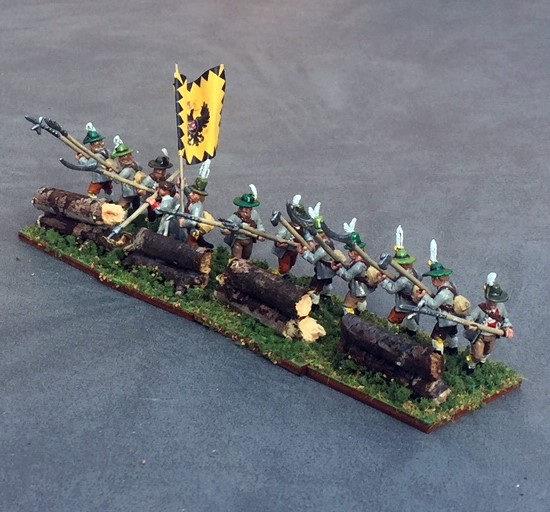
Tiroler Landsturm #6, Franz Dienstag


Freiherr Franz Dienstag commands the last of the 6 units of Landsturm in my Tyrolese forces. 


His men (and women) wear light grey coats with pants in shades of brown, and the famous green hats. 


As the last of the units, they got the "leftovers" when it came to armament... a mixture of scythes, ancient halberds, pitchforks, poleaxes, and awls!


Our narrative by Charles Morris continues, with the sad account of Hofer's end. Napoleon was not a man to have sympathy for rebels of any kind, his roots in the French Revolution notwithstanding!
    
His captors treated him with brutal violence. They tore out his beard, and dragged him pinioned, barefoot, and in his night-dress, over ice and snow to the valley. Here he was placed in a carriage and carried to the fortress of Mantua, in Italy. Napoleon, on news of the capture being brought to him at Paris, sent orders to shoot him within twenty-four hours.


    He died as bravely as he had lived. When placed before the firing-party of twelve riflemen, he refused either to kneel or to allow himself to be blindfolded. "I stand before my Creator," he exclaimed, in firm tones, "and standing will I restore to him the spirit he gave."


    He gave the signal to fire, but the men, moved by the scene, missed their aim. The first fire brought him to his knees, the second stretched him on the ground, where a corporal terminated the cruel scene by shooting him through the head. He died February 20, 1810. At a later date his remains were borne back to his native alps, a handsome monument of white marble was erected to his memory in the church at Innsbruck, and his family was ennobled.

Thursday, December 27, 2018

Michael Hopper Napoleonic Scenario Books

We interrupt your (ir)regularly scheduled Tyrolese rebels to bring you the first of several post about recent acquisitions. First among these are the excellent scenario books by Michael Hopper. I had read about these in the past on The Miniatures Page, but had never pursued them. As I was looking for some ideas about scenarios for my Tyroleans, I remembered them. A very pleasant series of emails were exchanged with Michael, and before I knew it, all 5 books were on there way to me, and delegated to my wife to be gifted to me at Christmas. (Thanks be to the Empress!)


Now, as many of you know, I myself have already authored a scenario book for 1809, intended especially for use with my favored Field of Battle rules. 


These scenarios are all generic, but especially suited to Shako, and other rules where  commands become shaken and demoralized. They will need significant adaptation for most other rules sets, I'd think.


So, what else is new in Napoleonic scenario books in that regard? Not a big deal, but not exactly an off the shelf product for most rule sets.


However, these books, which are a true labor of love on the part of Michael and his supporting players are meticulously detailed as far as the troops present and their day of battle strengths, as well as the maps and terrain.


With that detailed information in hand, the necessary adjustments are not too difficult for an experienced gamer to do/


If you look art the listing of the scenarios, they range from the huge and well known, to the small and quite obscure. 


Ordering all four (!) of the 1809 scenario books together saved on postage. Yep, that's my story and I am sticking to it!


There are enough scenarios here to play an 1809 game a month and continue for six years!


As a bonus, Michael threw in a copy of  his first, well known scenario book at a discounted price. We had played his Austerlitz scenario with Shako 2 with the HAHGS group way back circa 2007, and it worked very well indeed. 


I look forward to trying many of these out in the years to come. If you are looking for some inspirational and very useful Napoleonic scenario material, you can hardly go wrong with these. Cost is $32 - $34 Canadian per book. 

The 1809 books are available only direct through Michael. Just email him: log1cal.mh@gmail.com
My inquiries lead to at least a dozen great exchanges and discussions over the next week or two, as well as the books, which were mailed out the same day and received within just a few more days. 

Michael doesn't ask for payment until the books are received, and and you agree they are well worth the price. He provided me with a number of sample pdf scenarios to review before I ordered as well. I suggested to him that he consider releasing these as pdf files, which would save money and time on all ends, but for now he plans to stick with print format only. As I said earlier, these are a true labor of love, and making money from them is really not an important concern to Michael. 

Oh, and Michael has literally hundreds more scenarios from different years and theaters of the Napoleonic Wars in development, and will likely gladly chat with you about almost any of them! He is a gentleman and a scholar in the truest sense of those words. 

Sunday, December 23, 2018

Tiroler Scutzen #8, Ernst Stripsenjoch


The penultimate Schutzen unit is this one lead by Ernst Stripsenjoch.


They wear light grey jackets with pants in shades of green, and hats in shades of brown. 


Enst is a loud, boisterous fellow. He reminds one of that guy in your high school gym class who'd toss his athletic supporter at someone near him as he headed off to the showers! 


Resuming our narrative by Charles Morris:


   The freedom of the Tyrol was not to last long. The treaty of Vienna, between the Emperors of Austria and France, was signed. It did not even mention the Tyrol. It was a tacit understanding that the mountain country was to be restored to Bavaria, and to reduce it to obedience three fresh armies crossed its frontiers. They were repulsed in the south, but in the north Hofer, under unwise advice, abandoned the anterior passes, and the invaders made their way as far as Innsbruck, whence they summoned him to capitulate.


    During the night of October 30 an envoy from Austria appeared in the Tyrolese camp, bearing a letter from the Archduke John, in which he announced the conclusion of peace and commanded the mountaineers to disperse, and not to offer their lives as a useless sacrifice. The Tyrolese regarded him as their lord, and obeyed, though with bitter regret. A dispersion took place, except of the band of Speckbacher, which held its ground against the enemy until the 3rd of November, when he received a letter from Hofer saying, "I announce to you that Austria has made peace with France, and has forgotten the Tyrol." On receiving this news he disbanded his followers, and all opposition ceased.


    The war was soon afoot again, however, in the native vale of Hofer, the people of which, made desperate by the depredations of the Italian bands which had penetrated their country, sprang to arms and resolved to defend themselves to the bitter end. They compelled Hofer to place himself at their head.


    For a time they were successful. But a traitor guided the enemy to their rear, and defeat followed. Hofer escaped and took refuge among the mountain peaks. Others of the leaders were taken and executed. The most gallant among the peasantry were shot or hanged. There was some further opposition, but the invaders pressed into every valley and disarmed the people, the bulk of whom obeyed the orders given them and offered no resistance. The revolt was quelled.

    Hofer took refuge at first, with his wife and child, in a narrow hollow in the Kellerlager. This he soon left for a hut on the highest alps. He was implored to leave the country, but he vowed that he would live or die on his native soil. Discovery soon came. A peasant named Raffel learned the location of his hiding-place by seeing the smoke ascend from his distant hut. He foolishly boasted of his knowledge; his story came to the ears of the French; he was arrested, and compelled to guide them to the spot. Two thousand French were spread around the mountain; a thousand six hundred ascended it; Hofer was taken.

Friday, December 21, 2018

Tiroler Landsturm #5, Freiherr Luis Donnerstag


These Landsturm lead by Luis Donnerstag wear dark grey coats, green pants, and brown hats.


Some on line searching found some additional English language accounts of the War in the Tyrol that are out of copyright, and similarly romantic to Morris, whose account is not yet concluded. 


From: James Connolly, Insurrection in the Tyrol (1915)


After the total defeat of the Austrians and the capture of Vienna by Napoleon, the city of Innsbruck was retaken by a French army of 30,000 men. Hofer was summoned by the French General to appear at Innsbruck. He replied stating that he “would come but it would be attended by 10,000 sharpshooters.”


At first the peasantry had been so discouraged by their abandonment by the Austrians that a great number of them bad gone to their homes, but at the earnest solicitation of their leaders they again rallied, and hostilities re-opened on August 4th.

A column of French and Bavarians were crossing the bridge at Laditch where the high road from Balsano to the capital crosses the river Eisach. The Tyrolese under Haspinger occupied the overhanging woods, and when the troops were well in the defile they rained bullets and rocks upon them without showing themselves. Men were falling at every step, and the crushing rocks tore lanes through the ranks. 


The soldiers pressed on until the narrowest point of the defile was reached when a sudden silence fell upon the mountain side. Awestruck, the column involuntarily halted, and amid the silence a voice rang out –

“Shall I? Shall I? Stephen.”
and another answered –
“Not yet, not yet.”

Recovering, the troops resumed their march in silence and apprehension, and then as they wound deeper into the path the second voice again rang out –

“Now, in the name of the Father, Son and Holy Ghost, cut loose.” And at the word, a hinge platform of tree trunks, upon which tons of rocks had been collected, was suddenly cut loose, and the whole mass descended like an avalanche upon the soldiery, sweeping whole companies away and leaving a trail of mangled bodies behind it. Despite this terrible catastrophe the column pushed its way on towards the bridge, only to find it in flames, and a raging torrent barring their further progress. They retreated to their starting point harassed all the way by the invisible enemy and with a loss of 1,200 men.