Thursday, August 16, 2012

French Imperial Guard Cavalry, part 2 (Dragoons, Lancers, Honor Guards)


The first unit of Guard cavalry formed without antecedents dating back to at least the Consulate was the Empress' Dragoons, formed by decree in April, 1806, with the troopers drawn from each of the line Dragoon regiments on the recommendation of their colonels. The regiment initially had 2 very large squadrons plus one of velites; 2 more squadrons were added after the Battle of Friedland in 1807.


This side view shows the attractive uniforms of the regiment, officially renamed the Regiment des Dragons de L'Imperatrice, and presented by Napoleon to his wife, Josephine, in 1807. The men of the regiment formed a deep attachment to the Empress and her cause, and were very distraught, as were many in the Army, over the Imperial divorce in 1810. Josephine was allowed to retain the title of "Empress" even after the divorce, and I have little doubt that the Dragoons continued to see themselves as "her" regiment, rather than that of her replacement, the former Hapsburg princess, Marie-Louise!


A rear view of the regiment; which wore a somewhat more elaborate version of the helmet worn by their line counterparts, adorned with an imitation leopard skin fur turban. Chestnut mounts were used for this regiment whenever possible, aside from the trumpeters, who were mounted on grey or white horses as usual.


A side view showing the regiment's standard (by GMB designs once again), and the officer's substitution of gold for all the aurore items of the troopers (aiguillette and saddle blanket edging, mostly). 


This frontal view shows that the full dress habit coat was very similar to that of the Grenadiers a Cheval, aside from substituting dark green for the dark blue of the Grenadiers. These are Foundy figures once again; one of their best, in my opinion. I painted this unit about 4 years ago, using staining techniques and some black lining, and was very happy with the result; thus no Magic Wash seemed necessary, so I spared this unit the indignity!  


    The next regiment of cavalry added to the Imperial Guard was the Polish Light Horse (Chevau-Legers Polonais de la Guard), organized in 4 squadrons in April 1807. In 1809, they became the Regiment de Chevau-Legers Lanciers de la Garde, following the Battle of Wagram. With the addition of the Dutch Lancers (see below), the regiment was renamed the 1er Regiment de Chevau-Legers Lanciers de la Garde. In 1811, the regiment added first a 5th squadron, and then  2nd regiment (mostly recruited in Lithuania), named the 3eme Regiment de Chevau-Legers de la Garde, was raised. As a result of the disaster in Russia, in 1813 the 2nd regiment was disbanded, but the original 1st regiment added first a 6th and then a 7th squadron; ultimately the first three squadrons were designated Old Guard, the next three Middle Guard, and the last, Young Guard; by the end of that year the regiment was back down to four squadrons once again. 


A rear view of the Polish Lancers of the Guard; note the crimson portemanteau and the blackened wood of the lances; the lance pennons were always crimson over white.


This side view shows many details of what I think is arguably the most elegant uniform of the entire Napoleonic Wars; the blue is considerably darker than it appears in the pictures. Once again, an application of Magic Wash to these figures, which I originally painted more than a decade ago, really brought out the details, especially on the white cords and plumes.


The opposite side view shows the uniform of the trumpeter well; a white jacket with crimson facings, crimson pants with white stripes, and the top of the czapska white with crimson cords, and a white over crimson plume, as contrasted to the troopers who have crimson tops to their czapskas, with white cords and plumes.


The frontal view shows additional details; the aiguillette was moved from the left shoulder to the right when the lance was adopted. These are Foundry figures with a GMB flag once again. The short lived 3rd Chevau-Leger Lanciers (Polish/Lithuanian) regiment evidently wore an identical uniform to the first, except with yellow lace/piping and yellow metal buttons in place of the white ones of the 1st regiment.


    The next unit to join the Cavalry of the Guard came by a rather circuitous route; the Grand Duchy  of Cleves-Berg was bestowed upon Marshal Murat in 1806; inn 1807, Murat ordered the formation  of a cavalry unit, the Hussars of the Grand Duke of Berg. Having three squadrons plus an elite company of Garde du Corps, the unit underwent a further series of name changes including Regiment du Grand-Duc de Cleves, Chevau-Legers de la Grand Duchesse, and then Regiment de Chevau-Legers du Grand Duc de Berg. In 1808, a fourth squadron was added, and the first squadron entered the Imperial Guard. Two squadrons of the regiment were transferred to the newly formed Chassers a Cheval du Grand Duc de Berg. In January 1809, the Chevau-Leger regiment was disbanded, and the men sent to the Chasseurs a Cheval of Berg and the Guard Cavalry regiments. The unit adopted the lance in late 1809, and joined the Imperial Guard in December, 1809. In March of 1812, a second regiment was raised; both regiments were disbanded at the end of 1813, when their territory was over run by the allies and the Confederation of the Rhine dissolved. 

    The evolution of the uniforms of this unit was equally complex, but it always featured facings in amarante ( a light purplish pink hue), Murat's favorite color. This is nicely detailed on the Histofig site, including 2 plates illustrating the various changes. Suffice it to say that the original unit wore white (cream for the elite company), with amaranth facings and pants, but the uniform changed to a dark green jacket and pants with amaranth distinctions when it was transformed into Chasseurs a Cheval, and when the lance was adopted, a czapska with an amaranth top (and amaranth over white lance pennons) was adopted. The Lancers of Berg spent most of their existence fighting in Spain, but the second regiment participated in the 1812 invasion of Russia, and both regiments fought in Germany in 1813.


    With the dissolution of the Kingdom of Holland in 1810, and the incorporation of its territories into metropolitan France, the former Dutch Royal Guard Hussars became the 2eme Regiment de Chevau-Lager Lanciers de la Garde Imperiale in September, 1810. The regiment had 4 squadrons at its creation, with a 5th squadron added in 1812. In January, 1813, the regiment was increased to 8 squadrons, and then 10 squadrons in March of that year; at that point the first five squadrons were designated as Old Guard, and the second five as Young Guard. 


A rear view of the 2nd Light Horse Lancers of the Guard, often referred to as the "Dutch" or "Red" Lancers.; note the czapska of the trumpeter on the left; white top with scarlet piping and cords. Foundry figures.


A lateral view of the regiment shows the light blue jacket and pants (faced red) of the trumpeter, adorned with  mixed red and yellow cords, aiguillette, etc.  Standard once again is by GMB designs; Foundry figures. 


A view from the other side highlights the contrast between the dark blue saddle blankets with yellow edging, and the red uniform faced dark blue. This unit has also benefited from delayed application of the Magic Wash. ** 8/1/14:  Deadhead on TMP kindly pointed out that the lance pennons for the Red Lancers should be white over scarlet, the opposite of that pictured above. I'm not sure why thaty is, buit I checked several sources and he is inded correct. 


The head on view captures the full splendor of this magnificently attired unit; the "sunburst" brass plaque on the front of the czapska has a white center with a brass "N" in the center.


    A relatively obscure unit of the Imperial Guard were the Lithuanian Tartars of the Guard, raised in July 1812. Although a regiment was planned, only a single squadron was ever raised. There is a decent brief (if nationalistic) history and illustrations here. The remaining men were absorbed into the 3rd Scout Lancers of the Guard in 1813 (see below).

   Faced with the desperate need to rebuild his cavalry after the debacle of the Russian invasion, and yet severely short of both horses and funds, in 1813 Napoleon ordered the formation of four regiments of Gardes d"Honneur. These were to be raised from the sons of noblemen and the wealthy, and were to equip and mount themselves at their own expense; in return they would receive Guard pay and guaranteed promotion to 2nd Lieutenant after a year's service. "In the Guard, but not of the Guard", they were resented by the other guardsmen, and many were unwilling soldiers, deserting at the first opportunity, although they evidently fought well enough upon encountering the enemy. The Army reportedly nick-named them "The Hostages"! The four regiments wore an identical hussar style uniform, with a dark green dolman (faced scarlet) and pelisse (trimmed with black fur), and scarlet pants. The buttons, cords, and lace on the pelisse and dolman were white, as were the decorative knots on the front and the piping on the outer seam of the pants. The shako was scarlet with white upper and lower bands, cords and tassels, and white metal chin scales. The sole distinction between the four regiments was their plumes; all were dark green on the bottom, with the color of the tip varying by regiment: red for the 1st, blue for the 2nd, yellow for the 3rd, and white for the 4th regiment. Trumpeter's dress was uncertain; reversed colors, Imperial Livery, and also sky blue pelisses and dolmans (sky blue uniforms being common to most of the trumpeters of the Guard, see examples above) with scarlet pants and black fur colpacks all being possible - perhaps all three variations may have existed, especially with the men equipping themselves!

   In late 1813, three regiments of Scout Lancers were added to the Guard, named the 1er, 2e, and 3e Regiments d’Eclaireurs de la Garde Imperiale. These were a deliberate attempt to counter the marauding Cossack hordes. The First regiment was attached to the Grenadiers a Cheval, the Second to the Empress Dragoons, and the the Third regiment to the 1st (Polish) lancers of the Guard. Each unit's uniform was quite different from the others.

   On might also briefly mention the Gendarmerie d' Elite of the Guard, which had a mounted arm. The police of the Guard, these men seldom saw combat on the battlefield. This earned them the nickname of "The Immortals"! There uniform was reminiscent of that of the Grenadiers a Cheval.

This concludes our whirlwind tour of the Cavalry of Napoleon's Imperial Guard; see part 1 for the Chasseurs a Cheval, Grenadiers a Cheval, and Mamelukes of the Guard.

Peter

Sunday, August 12, 2012

French Imperial Guard Cavalry -Part 1 (Chasseurs and Grenadiers a Cheval, Mamelukes)

   Napoleon's Imperial Guard was of course the direct descendant of the Consular Guard, which was established only 18 days after the coup d' etat of 18 Brumaire (November 10, 1799)  which resulted in General. Bonaparte ultimately becoming 1st Consul (December 24, 1799); it was regularized by decree on January 3, 1800. The cavalry complement of the initial formation of the Garde Consulaire was 2 squadrons of  "light cavalry", and a company of Chasseurs a Cheval. The Chassuers a Cheval were themselves descended from the Guides of the Army of Italy (later, the Guides of the Army of Egypt).

    The Chasseurs a Cheval were increased to full squadron Jan 13, 1800, then 2 squadrons August 6th, 1801, and 4 squadrons October 1, 1802. They officially became the Chasseurs a Cheval of the Imperial Guard on May  18, 1804. The regiment continued to grow, adding velite companies and later Young Guard companies to reach 8 squadrons by 1813. Probably the most famous regiment of the Imperial Guard cavalry, it ordinarily supplied the personal escort for the Emperor and his immediate entourage. Napoleon's often depicted green coat was the undress uniform of a Colonel of the regiment.


Here is the famous regiment of Chasseurs a Cheval of the Guard in full dress uniform. Note the white fur trim to the officer's pelisse, his leopardskin shabraque, and the green leather boots.Being an officer in the Guard was an expensive proposition!


Rear view of the Chasseurs a Cheval de la Garde Imperiale. Note the trumpeter, mounted on a grey horse (the troopers were all supposed to be mounted on dark bays). The trumpeter, instead of reversed  colors, wears a sky blue dolman dark red/maroon pelisse, a white colpack with a dark red over sky blue plume; the trumpeter's lace and cords are all red mixed with yellow. 


This side view shows the shabraque better (dark green, edged with aurore, with a red border) as well as the red trimmed aurore bag or flamme of the Chasseur's fur colpacks.


A frontal view of this elite regiment. Note the sumptuous trumpet banner; figures are Foundry, flag by GMB.


    In 1799, General Kleber, left behind in Egypt by Bonaparte, formed a company of Syrian Janissaries to which were later added Mamelukes; they later became the Mamelukes of the Republic in July, 1800. A Squadron was ordered added to the Consular Guard in 1801, later reduced to a company, and attached to the Chasseurs a Cheval. The officers were French, and over time, more and more of the troopers were as well. The fashion conscious Parisians loved their exotic costume, and along with the passion for Egyptian themes spurred by collections and writings of the savants returning from Egypt, costumes inspired by the Mamelukes became the rage among the women of the capitol. 


Here's the small unit of Mamelukes that form part of my guard cavalry. The specifications for their uniforms were much looser than for standard European cavalry. Originally, the "cahouk" or cap that the turban is wrapped around was supposed to be green, "the color of the prophet", but by 1805 and later it was most commonly bright red or crimson. 


The sleeved chemise shirt could be in a variety of colors including shades of blue, green, red, yellow, and/or white, and was usually worn with a sleeve less waistcoat, heavily embroidered with decorations and piping, which could themselves be in a variety of colors, including black.


The baggy pants were invariably either red or amaranth. Note the color and design of the saddle blankets; these were fringed, rather reminiscent of an oriental rug.


In addition to a standard, the Mamelukes had four troopers bearing horse tail queues, two black, one red , and one yellow. The figures are Minifigs.


    The  "2 Squadrons of Light Cavalry" established at the formation of the Consular Guard in 1799 were swiftly transformed into the Grenadiers a Cheval de la Garde des Consuls in December, 1800, and then the Grenadiers a Cheval de la Garde Imperiale in May 1804, at which time the regiment had 4 squadrons and a strength of a little over 1,000 men of all ranks. At various times squadrons of velites and later Young Guard squadrons were added, but the regiment never had more than 6 squadrons total
.

We start with a rear view of the Grenadiers a Cheval; this shows the red patch on the back of the bearskin headdress, which bears an aurore cross, as well as the cords of the aiguillette, worn on the right shoulder, in common with all of the remaining French Guard Cavalry regiments. 


This side view nicely displays the uniform of the trumpeter, resplendent in sky blue jacket faced crimson, white bearskin with gold mixed with crimson cords and sky blue over white plume; note also the saddle blanket in crimson trimmed with gold, and the officer, whose uniform has gold items where those of the troopers were aurore.Their standard had a somewhat unique design (flag by GMB once again). 


A head on view of the Grenadiers a Cheval of the Guard; the trumpeters aside, all the men were mounted on black horses. NCO's (not shown) had the cords on the bearskin, sword knot, trefoil epaulette and the aiguillette all with mixed scarlet (2/3) and gold (1/3), similar to their foot guard equivalents.


    I painted all of these units more than 10 years ago, and my painting has improved considerably since then. A few months ago, I applied Magic Wash to these figures, and it really improved them a lot, nicely picking out the detail in the cords and especially the white bearskin and colpack of the trumpeters. The Grenadiers a Cheval also have black lining of the saddle blankets, which was done when they were originally painted. Together, they are much closer to doing justice to these very fine figures.

   Part 2 will cover the later additions to the Cavalry of  the Imperial Guard, including the various Lancer regiments, as well a a few odds and ends in passing. Until then... shout "Vive l'Empereur!"

Peter

Wednesday, August 8, 2012

Maloyaroslavets, 1812 (Historicon 2012, pt 5)

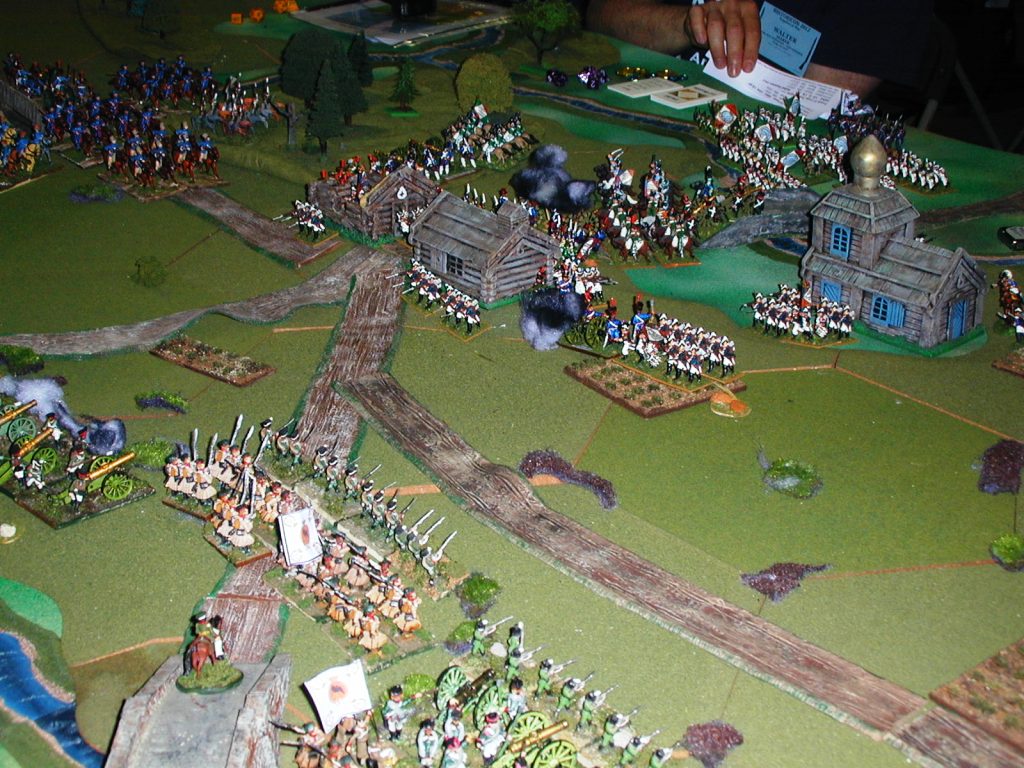
     This game was run on Saturday afternoon; the scenario and playtest were previously posted. Walter, Jamie, and Gabriel played on the French side of the "Traffic Jam" as Gabriel so aptly put it, while Tim was one of the Russian players; Dave and Michelle later took some of the Reserve commands, if I recall correctly. There was one error in the deployment that effected the game; the Russian Reserve Artillery shouldn't have entered until late in the game (the 5th Russian MOVE card, I think), but instead started on the table in March column at the start of the game!


The French start with just a single Division over the sole bridge and deployed in the village of Maloyaroslavets; The river is class III (hardest to cross at baseline) but only for Infantry, and even then the units have to roll for failed crossing and Unit Integrity losses due to hypothermia, and are all Out of Command when they finally do reach the far bank. In addition, the bulk of the table is Class II rough terrain for Movement only, reducing the rate of advance by 50% for all units not moving on a road. 


The French get lucky and turn a LOT of MOVE cards early on; note the laggard French line unit stuck in the stream with the pig (Out of Command) and the rock (one UI lost) from a failed attempt to cross this MOVE.


The Russian forces, by contrast pulled very few MOVE cards all game; however, their artillery was unlimbered, and what they *did* turn instead was a ton of ARTILLERY FIREPOWER cards; especially with the addition of the Reserve batteries, the Russians really pounded the French units as they each crested the ridge and showed their face, so things were actually working pretty well for them despite their relative immobility!


A horde of Cossacks cross the stream, at the bridge and otherwise (the stream was merely class II, a minor obstacle only), threatening the French right flank. 


The French pour reinforcements into the battle quite rapidly with all of the MOVE cards they turned, but the terrain is still making their advance very slow...


This was about the forward point that the French got all games; now some fresh Russians are starting to arrive as well, including... still more Russian artillery!


The French have little success in expanding their bridgehead beyond the village, and especially are finding it hard to deploy their own Artillery units!


The Russian Infantry advances to engagement range on their left, but seems content to just support their Artillery in their right.


Walter has set up a defensive line in the woods on the French right flank. 


Overview of the battle at this point, the French have sole control of Maloyaroslavets itself, but can do little else except bring on more reserves!


Gabriel's French commands try to extend the French left flank and thus threaten the Russian right flank without enduring the heavy artillery fire.


The view of the Battlefield from the French left flank; almost all of their forces are finally deployed, but still very crowded. The pounding inflicted bu the Russian artillery means French Morale Points have dwindled rapidly! 

The Russians launch their first assault on the village, as still *more* of their artillery comes on!!


Walter's Italian Cavalry defeats several units of Cossacks; Dave M has assumed their command, and on the next ARMY MORALE card rolls a D20 for officer survival... and rolls a "1". A field ambulance is seen picking up the wounded general, and all of his troops become Out of Command!

It is too little, too late, and the French Army reaches zero Army Morale. With little prospect of overcoming the huge deficit in Morale points, the French concede, dooming the army to the Northern route over lands already picked clean, and the bitter cold of the Russian winter to come...

Peter


Monday, August 6, 2012

Mars la Tour 1870, Tough Ombres WW2, and WW1 East Afrika (Historicon 2012, part4)

    Since this post is sort of a potpourri, I thought it might also be a good place for a few observations about my own Historicon 2012 experience, games aside. Joe arrived on time at my home on time, and along with making some last minute phone calls related to my medical practice, we departed form Western Connecticut at about 8:45 AM. As planned, that meant we missed the rush hour traffic on the Tapan Zee Bridge; we had a very smooth drive straight down, encountering minor delays of a bout 5 minutes each time in the Baltimore/D.C. area, still, we avoided the rush hour traffic and arrived at our hotel just after 3PM; can't complain about that, and I wasn't pushing the speed by any means. Joe and I talked almost non stop about gaming, some new rules for the Napoleonic "Imaginations" Napoleonic campaign we're doing using Warplan 5/5, our upcoming games, and just about everything else; really made the time fly by. We stayed in the Country Inns and Suites by Carlson in Fredericksburg, just one exit North of the Convention Center on I-95. Our room wasn't ready, and we hadn't eaten for the whole long trip down, so we headed out for a late fast food lunch. By the time we finished that and a brief exploration of the immediate area we were in (lost of chain stores and restaurants, nothing much else), our room was  almost ready; we had a suite that we were sharing with Tim C., arriving from England. In a miracle of transatlantic precision planning (i.e., luck), he arrived a few minutes after we did. After unpacking, settling in, and chatting for a bit, we headed over to scope out the Convention center and pick up our pre-reg badges; there we were given some inside tips for GM's about parking and loading/unloading for game set ups, and met Barry. After that, we had a comfortable and very satisfactory sit down dinner at the outback Steakhouse in the huge shopping complex that abuts the Convention Center; after the long drive, I enjoyed a flight of Margaritas (I must have been thinking about Eric's Puebla game scheduled for the following day, LOL).

The convention center is modern, and the vast majority of the games were in the cavernous main Hall - space for a great many games there. The dealers area was immediate adjacent, with the Flea Market ("Wally's Basement") in the rear of the dealer's area, behind the food concession tables. There seemed to be more than adequate space for everything. Some games were in a set of 5-6 smaller rooms on the other side of the main hall... a very short walk to/from anything on the site. I spent several hours perusing the dealer's area, but was tempted by very little; in fairness, I had come without any major purchases in mind, as I need to do some work figuring out exactly what I need for my next project(s). I'm a pretty disciplined shopper, and as almost all of my purchases are Historical in nature, most often I have the companies bring my order to the con, or make note of items for consideration next year. Still, I spent a record low in the Dealer area for me - under $10! I will, however, be making up for that with a significant mail order within the next month or so.

  As many have noted, the area immediately adjacent to the center has a plethora of dining options, including just about every chain restaurant that you ever heard of, and quite a few you didn't (maybe some you didn't want to know about. either, like the "Bailey's" Barry, Joe, Tim, Dave, Michelle, Gabriel, Greg and I ate at Saturday night. Food was fine, just weird atmosphere, LOL! The food at the convention center was certainly acceptable; nothing more or less than you'd expect - not up to the standard of the Host in the last few years before the move, but certainly acceptable. Bathrooms have been discussed ad nauseum; could certainly be better but not much different than the other sites, and not exactly the reason I go to Historicon, LOL! The noise level in the main gaming hall, though really got to be an issue, especially Friday night. I've been doing this for the last 10 years or more, so I'm used to noise, but this really was LOUD - Barry, Joe and I ALL had ringing in the ears by the end of that night. That is the one thing that really needs to be addressed in some fashion for next year. The tables supplied were great, the chairs... substandard is the best word for it; an upgrade there for next year would be welcome. There were plenty of games across a wide spectrum, including some stunning ones (the big Crimean War table comes most readily to kind in that regard), and everyone seemed to be enjoying themselves. I had a few  generic but generous glasses of wine for $5 from the bar there, and some pretty good and equally generous Whiskey Sours for $6.50, so no complaints there. Overall, despite the longer drive distance, I would (and will) happily return again next year!


In reverse chronological order, here are some of the other Piquet/Field of Battle family games that were run at Historicon this year; I can't comment too much on these as I was busy running or setting up my own games.

On Friday night, near the big Borodino game, a handsome transcontinental effort was put on by Freddie A. and Jeff G. from California, using Rob C's figures from upstate NY! The action is East Afrika, the time - World War One:

Very effective, evocative terrain. Rules used were Piquet: Barrage!, with some elements of Din of Battle, 2nd edition thrown in, I believe. 


Just the thing to go with the handsome armies!  I'd love to see this one again, too! I know Adolfo was one of the players along with Ian B, Tim C., and others; anyone care to chime in with some comments  about the action? There are a few more (and better)  pics and a promise of a write up on Adolfo's blog.


The following are some pics of a hypothetical Franco-Prussian  battle fought as a pick up game on Saturday night. This used a stripped down version of the terrain from my Maloyaroslavets game (report forthcoming), and run by Tim C. using his 15mm troops and Field of battle, 2nd edition. 


Greg K, Tim C, Gabriel and Dave M, all looking a bit tired after three very full days of gaming as they survey the field.


Dave M (caught in a typical pose, LOL), Michele, Eric, and Hal were also in on the action. I can't say too much more as I was pooped from running my earlier game, and spent the time shooting the breeze with Adolfo, Joe, and others.


The next two of photos a re random shots I took of Tim's formal Franco-Prussian War game, Mars la Tour, fought on August 16, 1870.


An exchange of firepower!
Once again, I'd welcome additional information and/or photos about Tim's game.


On Saturday AM, Dave M. ran a series of Demonstration type games using Field of Battle: WW2, entitled "Tough Ombres"; note the very effective Litko markers for suppressed stands.


Now Piquet/Field of Battle veterans, Alex and son Thomas were among the participants. I didn't have much chance to talk to you guys this time out. I had meant to buy Thomas a beer/drink in honor of his 21st birthday which fell just prior to the convention - hit me up for it next year, Thomas!


Dave M explains the finer points of the rules as Steve looks on.


  It was great to have so many fellows running and playing Piquet/Field of Battle games at Historicon this year!  I missed getting any pics of the 25mm Anchor of Faith Cropredy Bridge ECW game the Canadian guys (Peter Friesen and friend) were running, but did get to talk to them briefly while they were setting up. As always, the best part of going to this great convention is meeting, chatting, and playing with friends old and new! Thanks to HMGS and its officers, the convention staff, and the staff at the Fredericksburg Exposition center for a great time, and a convention that ran very smoothly, especially for a new site in a new state. Most folks are quick to complain, but slow to give praise where it is due, and even slower to volunteer their own time. So, once again, congratulations and a big tip of the chapeau for a job well done. See you next year in Fredericksburg!

Phew; just one last Historicon post to go, covering the Battle of Maloyaroslavets on Saturday afternoon.

Peter

Friday, August 3, 2012

Maximilian Adventure: San Isabel and Puebla (Historicon 20012, part 4)

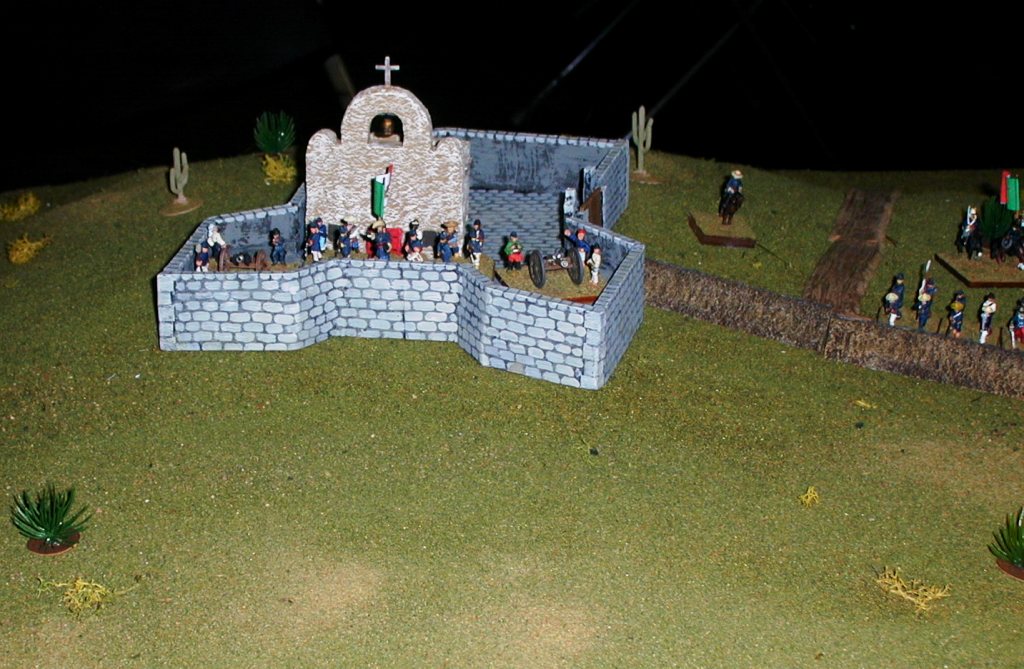
Eric B. ran two games on Thursday set in Mexico in the era of the Maximilian Adventure in Mexico.  The first game was the Battle of Puebla in 1862, and the 2nd was San Isabel set in 1866. His own gorgeous 15mm figures were used, and Eric scratch built the Fortresses, hills, etc needed for the game.  Once again, I lack experience photographing 15mm games, and these shots don't really do the games justice; still, here they are! Eric is the author of several sets of wargames rules, including Din of Battle, 2nd edition (available from Piquet, Inc.).


The Mexican forces are to the left, in the fortresses, village, and on the flank; the Europeans ( a very varied lot) are to the right.


Close up of the town...


and the fortress.


The European attackers.


The mission and the defenders.


The Mexicans seized the Initiative early on... and advanced on their would-be assailants!


An exchange of volleys in the village area.


French attackers close on the Mission as well.


Mexican reinforcements (?)


Ground level view; Mexicans threaten the European left flank!


European Artillery bombarding the Mexican positions; note the century Cacti, etc enhancing the terrain.

And, from Gabriel's blog, another overview picture:

I think the Mexicans emerged victorious; this would after all, become the date of Mexican Independence - Cinco de Mayo!   I have no idea if any Tequila was consumed in the course of the game... but I would hope so! I was too busy with my own game to get any pictures of the 2nd battle, which I believe was quasi-fictional. Eric did a great job, but did look exhausted. Having put of two games in the same day myself on a number of occaissions, I know the feeling. Great work, though! Having done all the work already (see Eric's own blog) now, Hopefully Eric will run this one again at future conventions!

Peter