Showing posts sorted by relevance for query 300 austrians. Sort by date Show all posts

Monday, October 14, 2019

The 300 Austrians

Back at the last Historicon in Frederiscksburg, in 2017. I acquired the somewhat insane amount of roughly 300 Old Glory Austrian Napoleonic Infantry for $100. It's been 2 years, and I just now decided to finally sort out exactly what I had on hand!  This was prompted by the 90 Austrian Line that I am painting right now, which will exhaust my supply of same, otherwise. While the bulk of the figures were in there original bags, there were quite a few more that were loose and somewhat mixed up.


2 bags of 30 German Line in Shako, 2 bags of 30 German Line in Shako,  Attack-March, 1 bag of German Line in Shako, Road March (I especially like these!), and 1 bag of German Grenadiers, 180 figures in all.


Next, it was time to sort out the loose figures


The loose figures included 1 group of 30  more German Line in Shako, Advancing,plus another 18 of same, 17 more Germ an Line in Shako Attack-March, 8 more German Line in Shako Marching,  4 Falling wounded and 1 lying wounded, 13 German Line Command in Shako (3 standard bearers, 4 drummers, 4 Officers, and 2 NCO's, plus 3 mounted colonels sans horses), 7 German Grenadier command (4 standard bearers, 2 drummers, 1 officer) plus a spare Grenadier Marching, and 4 wounded Grenadiers., plus another 12 German Line command, but these in Helmets. That's 118 more figures, just shy of 300 altogether.

With my usual scheme (18  figures per unit), that's enough to make

2 units of Grenadiers
7 units of Line Advancing
7 units of Line Attack-March
3 units of Line Marching.

I'd need to add 3 sets of Old Glory Line command (20 each) to have the necessary cadres... assuming I ever paint anywhere near that many of them!


Still, I can paint a LOT of Austrians in a fairly short time; these 90 are nearing completion and will be appearing on the blog soon!  :-)

Saturday, October 24, 2020

The 300 Austrians, Redux!

 Regular readers may require the 300 odd Old Glory Austrian Infantry I acquired for $100 at Historicon 2011. Late last year I finally got around to cataloguing them and painting 5 units in  Helmet, and then earlier this year another 2 Hungarian units "casual marching".  To make the best use of the remaining figures required a few additional pack of Old Glory figures, which were dutifully acquired (with the 40% discount courtesy of the Army Card). With the approach of cooler weather, I decided that I should organize the figures into units and do all of the prep work and priming before winter sets in. It turned out that I had sufficient lead on hand to form 2 new units of  Grenzer, 2 units of Grenadiers, 6 units of  Austrian German Line in Shako Advancing, 5 units of Austrian German Line in Shako March-Attack (1 will be painted as Hungarian), and one 1 Line in Shako, Casual Marching. (to be painted as Hungarian as well) There were also 8 quite useful casualty figures, which I also prepped and primed. That's 296 in all (and there a re still a few more figures left over, including some foot and mounted officers that may well be drafted as commanders) 


Here's what almost 300 Austrians look like, ready for painting.  Hey, they're almost half done after being sprayed with  white primer! :-)


The second task was to figure out which units to paint, taking into account my already substantial collection of Austria Infantry. That lead to the following list and planning:


Existing Austrian Line (H = Hungarian) Facing Color/ Buttons Make Pose

IR# 25 Zedtwitz Sea Green Minifigs Helmet Advancing
IR# 22 Coburg Yellow Minifigs Helmet  Advancing
IR# 49 Baron Kerpen Light Grey Helmet  Minifigs Advancing
IR# 40 Graf Mittrowsky Crimson Helmet  Minifigs Advancing

IR# 4 Deutchmeister Light Blue Minifigs Helmet  March-Attack
IR# 9 Czartoryski Apple Green Minifigs Helmet  March-Attack
IR# 1 Kaiser Polish Crimson Minifigs Helmet  March-Attack
IR# 17 Furst Hohenlohe (Reuss-Plauien)  Helmet  Medium Brown Minifigs March-Attack

IR# 21 Gyulai Sea Green Old Glory Helmet  Advancing
IR# 59 Jodis Orange Old Glory Helmet  Advancing
IR# 10 Reiske Bright Green Helmet  Old Glory Advancing
IR# 15 Zach Red Old Glory  Helmet Advancing

IR#42 Graf Erbach Orange-Yellow Helmet  SashSaber March-Att
IR#38 Wurttemburg Rose Pink Helmet  SashSaber March-Att
IR#24 Baron Strauch Dark Blue SashSaber March-Att
IR#18 Reuss-Greitz Pompadour SashSaber March-Att

IR# 61 St. Julien (H) Grass Green* Minifigs Advancing
IR# 32 Esterhazy (H) Light Blue* Minifigs Advancing
IR# 58 Baron Beaulieu (H) Black* Old Minifigs Advancing
IR# 51 Baron Splenyi (H) Dark Blue* Old Minifigs Advancing

IR#31 Benjowki (H) Emperor Yellow* SashSaber March-Att - Shako
IR# 34 Davidovich (H) Crab Red* SashSaber March-Att - Shako
IR# 48 Vukassovich (H) Steel Green* SashSaber March-Att - Shako
IR# 53 Jellacic (H) Pompadour* SashSaber March Att - Shako

IR #12 Manfredini Dark Brown Old Glory Advancing
IR #21 Prinz Rohan Sea Green Old Glory Advancing
IR #30 De Ligne Pike Grey  Old Glory Advancing
IR #41 Kuttulinski Sulfur Yellow   Old Glory Advancing
IR #50 Stain  Violet  Old Glory Advancing

IR #39 Duka  (H) Poppy Red/silver buttons - Old Glory Marching, campaign - Shako
IR# 19 Alvinczy (H) Sky Blue/silver buttons - Old Glory Marching, campaign - Shako

Future units:
IR #2 Hiller (H(), Kaiser yellow/brass buttons, OG Marching, campaign, Shako
IR #62 Franz Jellacic (H), Grass Green/pewter buttons, Old Glory, Marching

IR #3 Erzherzog Karl Sky Blue,/pewter buttons, Old Glory Advancing
IR #8 Erzherzog Louis Poppy Red/brass buttons Old Glory Advancing
IR #11 Erzherzog Rainer Rose pink/pewter buttons Old Glory Advancing
IR #14 Klebeck Black/brass buttons Old Glory Advancing
IR #36 Kollowrat Gris de Lin (Lilac) /pewter buttons Old Glory Advancing
IR #54 Froon Apple Green/pewter bottons Old Glory Advancing

IR #26 Hohenlohe Bright Green/brass buttons Old Glory March=Attack
IR #29 Lindenau Light Blue/pewter buttons Old Glory March=Attack
IR #44 Bellegarde Madder Red/pewter buttons Old Glory March=Attack
IR 63 Bailet Light Brown/brass buttons Old Glory March=Attack


Grenzer
GR# 2 Octocaner Yellow Foundry
GR# 5 Kreutzer Bright Red Foundry
GR# 16 1st Wallachian Bright Green Foundry
GR# 12 Deutschbanater Light Blue Essex
GR# 15  2nd Szeckler  Rose Red Old Glory
GR# 9 Peterwardeiner  Light Pike Grey  Old Glory

Future units:
GR# 3 Ogulin, Orange/brass buttons Foundry
GR #17 2nd Wallachian, white coats (Foundry OG, mixed figures) Parrot Green/pewter buttons


Grenadiers
1st Grenadiers Grass Green* Minifigs Firing
2nd Grenadiers Yellow (H) SashSaber March Attack
3rd Grenadiers Light Grey Minifigs Advancing
4th Grenadiers Red Minfigs March Attack
5th Grenadiers Blue Minifigs March Attack

Future units:
6th Grenadiers Orange Old Glory Advancing
7th Grenadiers Pompadour (H) Old Glory Advancing


HI labeled each of the units (M1 = 1st unit in March-Attack pose), and painted the assigned facing color for that unit on the tongue depressors that I use to hold the figures during painting. 


C1 = Casual marching pose unit 1; both of these units will be Hungarian, so I painted on a line of Azure Blue to remind myself of that when it comes time to paint them! 


A = Advancing pose, G = Grenadier unit.


Z = Grenz unit, with a line of Brown to remind me this one gets brown coats. 


One of the Grenadiers will be Hungarian.


One of the Grenz units will have the white coats for variety. Note the casualty figures as well!


All packed up for storage until their turn on the painting table arrives!


Tuesday, July 9, 2019

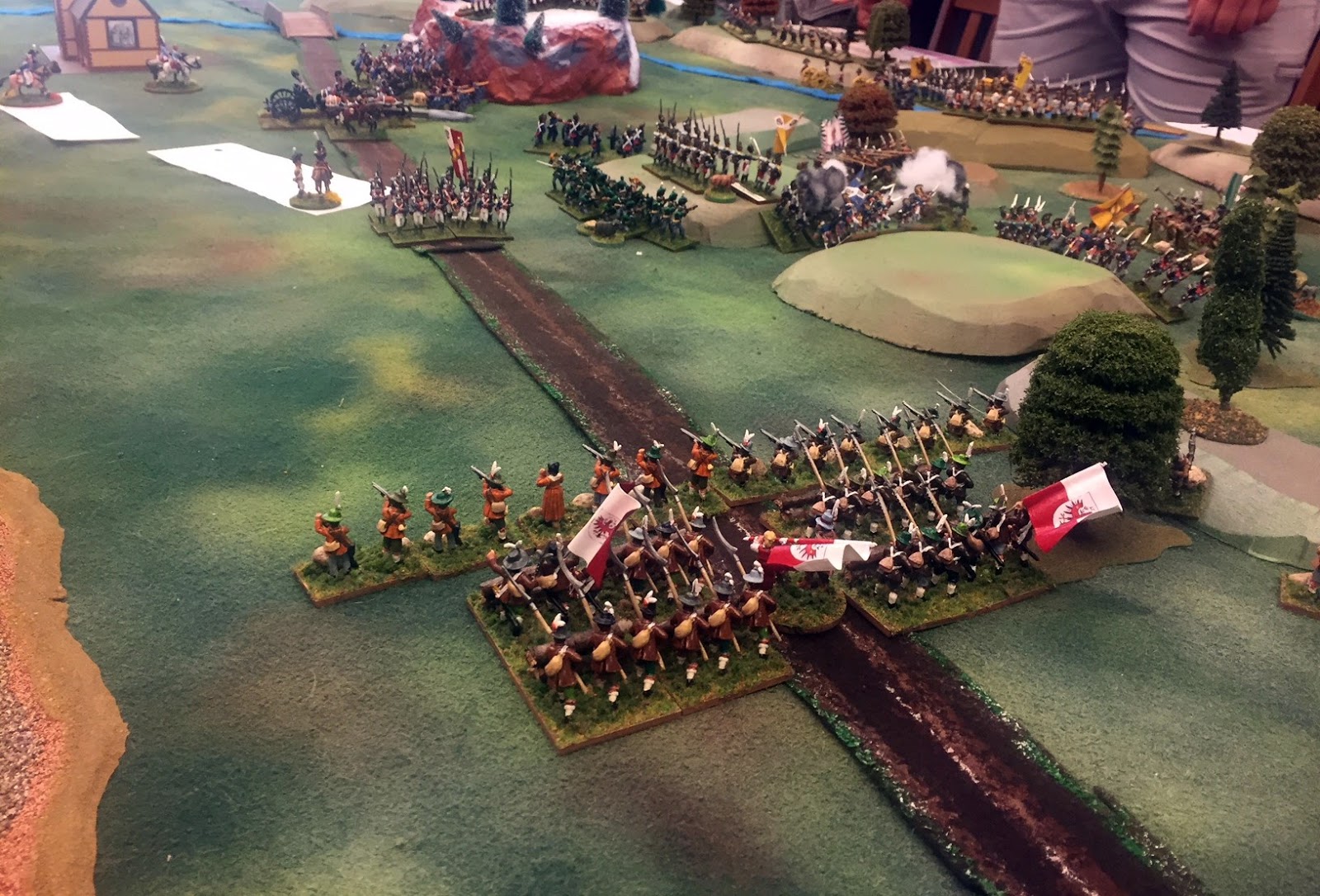
2nd Battle of Berg Isel, May 29 1809: Scenario and play test for Historicon

After the Franco-Prussian game Saturday, we shifted countries and eras to play test my revised scenario for this battle, with changes inspired by the version Michael Hofer developed for his scenario book, "Blood along the Danube, 1809". I used Badeners as stand ins for half of the Bavarians (I was already using almost all that I own) , and I used Landwehr and Freiwilliger as stand ins for the Tyroleans of Reisenfells command,  and substituted Spechbacher for Teimer, and moved Teimer to the other side of the table (a map reading error). With those caveats, here we go:\


Second Battle of Berg Isel: May 29, 1809

Table Size: 6 x 10 feet

Troop Scale: 1 Infantry unit = 600 men, 1 Cavalry unit = 300 men, 1 Artillery = 6 guns.

Background: After retaking the Tyrol, believing the rebellion largely crushed, Wrede's Division was withdrawn, ultimately to fight at Wagram a little over a month hence. This left just Deroy and his 3rd Bavarian Division, with assorted attachments, to hold the Rebellious province. It would not prove enough. On May 25th, an attack was launched on the outskirts of Innsbruck by some 6,000 Tyrolean insurgents supported by 1200 Austrians. Their attack was repulsed, and the combat terminated by a heavy rainstorm. However, 4 days later, the numbers of insurgents in the area having swelled to 12,000, the Tyrolians attacked again with their main force at Berg Isel, while additional detachments seized the bridges over the Inn at Volders and Zirl.

Map: Mount Isel and the foothills of the Alps are wooded Class III mountainous terrain; they are impassable to Artillery (except the Tirolese wooden guns) and cavalry. However, all Tirolese (but NOT the Austrians) treat these as Class II terrain for movement.
The River Inn is unfordable, while the River Sill is a Class II stream. The buildings of Innsbruck, part of which is shown on the map, are Class II. The Abbey and Schloss have been fortified by the Bavarians and are Class III Terrain.

Scenario Rules:
Tyrolean Scutzen represent partisans armed primarily with firearms and largely lacking bayonets, etc. They will count as armed with Rifles, however! They must be deployed in Skirmish order or Line formations only, and are DOWN 1 additional in Melee. They have only 2 UI per unit.
Tyrolean Landsturm represent peasants armed with polearms and spears and a few antiquated firearms. They must be deployed in Attack Column or Line and are Up 2 additional in Melee, but Down 1 for fire. In addition, they suffer no penalty for being charged by Cavalry frontally. They have only 3 UI per unit.
Tyrolean Wooden Gun moves like Tyrolean infantry (including in Class III Terrain), but must “limber” and “unlimber, and reloads on the Artillery Firepower cards. It has but 1 UI.
Andreas Hoffer, an Innkeeper by trade and the heart and soul of the Tyrolean revolt is UP 2 on his LD when attempting to rally any Tyrolean troops.
Joachim Haspinger, a charismatic red-bearded Capuchin priest, Makes any unit he is attached 2 Up 2 in melee; however, if he has been engaged in a melee since the last Army Morale Card, he will roll a D12 instead of a D20 for being hit.
If any of the four buildings of Innsbruck proper are occupied by enemy troops, the Bavarians lose 1 Morale Point for each such building, for as long as the building remains controlled by the enemy.

Deployment: As shown on the map.

Reinforcements:
Speckbacher: Roll a D6: On 2nd MOVE card, enters on a 1, 3rd MOVE card 1,2,3,4, 4th MOVE card – automatic
Teimer: Roll a D6: On 4th MOVE card, enters on a 1, 5th MOVE card 1,2,3,4, 6th MOVE card – automatic

Victory Conditions: The game ends after the 9th Austrian MOVE card is played and acted upon (nightfall). If the Austrians have un dispuited control of Berg Isel, or the Tirolese control any of the 4 buildings of Innsbruck, AND their opponent fails Army Morale, they score a Major Victory. Otherwise, if the enemy fails Army Morale without accomplishing the above results, it is a Minor Victory. Any other result is a draw.


Austrians: No C-in-C, use LD 8 for initiative purposes.
Sequence Deck: Abysmal
23 Infantry, 1 Cavalry, 2 Artillery; Army Morale Points: 28

GM Ignaz Freiherr von Buol-Barenburg LD 8, CR 16”
2 Austrian Line DD 6, CD 10
1 Austrian Jager DD8, CD 12
6lb Foot Battery DD6, CD 12
1 Squadron Chevau-Leger DD6, CD 10
(only 1 Unit Integrity)

Andreas Hoffer LD 8*, CR 20”
3 Tyrolean Schutzen* DD 4, CD 10
2 Tyrolean Landsturm* DD 4 CD 8
1 Wooden Gun* DD 4, CD 8

Joachim Haspinger LD 10*, CR 20”
3 Tyrolean Schutzen* DD 4, CD 10
2 Tyrolean Landsturm* DD 4 CD 8

Joseph Speckbacher LD 12, CR 24”
3 Tyrolean Schutzen* DD 4, CD 10
2 Tyrolean Landsturm* DD 4 CD 8


Martin Teimer, LD 8, CR 16”
2 Austrian Volunteers DD 4, CD 10
3 Austrian Landwehr DD 4, CD 8


3rd Bavarian Division, GL Bernard Erasmus von Deroy
LD 10, CR 20”
Sequence Deck: Average
10 Infantry, 2 Cavalry, 3 Artillery 15 Morale
12lb Foot Battery DD 6, CD 12

GM Justus von Siebein LD 10, CR 20”
1 Baden Jager DD 8, CD 12
4 Baden Line DD 6, CD 10
6 lb Foot Battery DD 6, CD 10

GM Vincenti LD 10, CR 20”
1 Bavarian Light DD 8, CD 12
4 Bavarian Line DD 6, CD 10
6 lb Foot Battery DD 6, CD 10
GM Seydewitz LD 10, CR 20”
Baden Dragoons (3 UI) DD6, CD 10
Bavarian Chevaulegers (2 UI) DD6, CD 10


After the play test, I am going to move the set up for the Bavarians back 3" so that they start outside the Class II terrain. 


Early in the game - Innsbruck to the right, Berg Isel in the center. 


A view from the opposite end of the table.


Tyrolean Rebels under  Hofer swarming through the rough terrain. 


The Bavarians (Badeners used  as stand ins for half of the Bavarians) are surprisingly aggressive in taking the battle to the Rebels!


More action on the other side of Berg Isel.


Artillery deployed to make the most of limited fields of fire in the center.  Bavarian General Vincenti is hit on Berg Isel. 


Speckbacher;'s command enters on a Triple Move!


Not long afterwards,  Teimer's command enters from the opposite direction  on a Double Move. Elsewhere, Hofer goes down with a wound as well!


Speckbacher's men continue to advance with alacrity... as both sides reach zero Army Morale Points simultaneously!


Speckbacher's Shutzen threaten the rear of Von Siebein's troops. 


   This game was hugely fun, as usual thanls in no small measure to the players themselves. In the end, however, it was the Bavarians who prevailed, the Rebels withdrawing into the alps and safety. Historically, after fending off Tyrolean attacks all day, Deroy and his command slipped away under cover of darkness, abandoning Innsbruck, where they had become increasingly isolated.


Wednesday, March 11, 2020

FML Franz Rosenberg and Cuirassier Generals


FML Franz Rosenberg - Orsini was from the Itian portion of the Hapsburg empire.

This Foundry figure depicts him as being rather portly. 


He commanded a Brigade under Herzerzog Karl in Germany, and a  wing of the Army of Italy at the second Battle of Caldiero in 1805. In 1809, he commanded the IV Corps, and fought at Eggmuhl, Aspern-Essling, and Wagram. 

I have paired him with the mounted Colonel of a Hungarian regiment, a figure that was part of the "300 Austrians, likely from Front Rank. 

FML Franz Rosenberg - Orsini. 


A pair of Cuirassier officers to lead the Divisons of these elite horsemen.


Note the elongated gold triangles on the chest of the Cuirasses, supposedly emulating the gorgets of other nation's officer corps. 


As my Cavalry regiments have 8 figures and Foundry cavalry figures come in groups of three, the two surplus officers are thus promoted to Field grade! 


One rides a Chestnut and the other a Bay. 

Different colors of flowering tufts also differentiate the two officers. 


It is difficult to tell, but the near figure wears the uniform of the green faced KR #4 , while the far figure wears that of the black faced KR #6.

Saturday, January 23, 2021

I.R. #54 Froon

Well, it's time for a return to painting Napoleonics; after all, the 300 Austrians aren't going to paint themselves!


This is Infanterie Regiment #54, recruited in Bohemia.


It has "apple green" facings and pewter buttons.


The Inhaber of the Regiment was Feldmarschalleutnant Karl, Graf  Callenberg, from 1769 - 1805, and  Feldmarschalleutnant Josef, Freiherr Froon von Kirchrath, from 1805 to 1821.


In 1809, the regiment formed part of FML Hohenzollern-Hechingen's II Corps. \


It fought at Ratisbon, Aspern, Wagram, and Znaim.


These are definitely Old Glory figures (many were still in the original bags of 30 figures), but I think they originate from different molds than today's 25mm Old Glory figures. They are chunkier and better sculpted; indeed, at first I thought they might be Foundry figures when I was sorting them out. They were acquired second hand in 2011, but had obviously been sitting unpainted for at least 10 or 20 years before that! 

Wednesday, June 30, 2021

Hungarian Grenadiers

The "300 Austrians" project has seen a lot of Line infantry battalions raised for the Kaiserlick cause, so it was time to paint up one of the Grenadier battalions. 


Historically, each grenadier battalion was made up of 6 (or sometimes only 4) Grenadier companies, each regiment in the army contributing 2 companies, so most such battalions would have a mix of 3 different facing colors.  Messy, messy, messy!


Therefore,  my Grenadier battalions are ahistorically uniform in terms of facing and button colors... in this case, Pompadour.


. I used Delta Ceramcoat "Dusty Mauve for the facings, and they have the pewter buttons of I.R. # 53, Jellacic, recruited in Croatia. 


Now, properly the battalion should be carrying a spare yellow Ordinarfahne of the senior regiment contributing companies to the battalion (these flags pretty much all look the same regardless of regiment anyway.) The only time the Grenadiers carried the white flags was briefly in 1805 during the Mack reforms, when the Grenadiers were returned to their parent regiments, 


During that time, the infantry regiments were reorganized to have three,. 4 company battalions, with the Grenadiers being the first 2 companies of the Leib Battalion. Well, at least "the unfortunate General Mack" had one good idea!  I have always liked the look of the Grenadiers (only) carrying the white flags, so history be damned!  In this Kaiser's army, that's how it is done. 
Whether you agree or disagree, the beautiful white Leibfahne seen here is by Adolfo Ramos. 

Wednesday, July 14, 2021

Croatian Portal Insurrectio, 1809

Commenting on one of my very old posts on The Landwehr Collection, it was recently suggested to me that I should consider raising a unit of the Croatian Insurrectio. I didn't think too much of it at the time, but I had yet another of the "300 Austrians" to raise as Grenzer, and with my last unit, I now have 7 of them. Did I really need 8 Grenzer units?  Probably not! 


The vaguely described uniform of the Croatian Insurrectio seemed close enough to use the figures for such a unit, as seen above!


Here's what Dave Hollins has to say on the subject in Osprey Men at Arms 299, "Austrian Auxiliary Troops 1792 - 1816". Ten Croat battalions were mustered. The Personal Insurrection of the Komitates had 1,042men, the Portal Insurrection of the Komitates had 10,000 men, the Littoral (coast) Insurrection 2,,450 troops. Volunteers numbered 29, the Banderial Insurrection totalled1,644 men, plus 5 Slavonian battalions (5,000 men).  Banderial troops wore black shakos with rank rings for NCO's, a brown gunjac (Croatian laced jacket), an infantry style light blue waistcoat with small brass buttons, and Croatian cut light blue trousers with light blue knots. A grey greatcoat and black Hungarian shoes, an infantry saber or handschar dagger, and red or natural leather work completed the uniform, which was otherwise as the Hungarians. The Personal and Portal Insurrection was equipped as the Banderial, with the exception of madder red shakos..."


Enrico Acerbi provides a detailed description of the raising of these troops in his book, "the Austrian Army 1805 - 1809, vol. 2), but no uniform information at all. A related article on the Napoleon series gives similar information, with one illustration each of an officer and a soldier of the Croatian insurrection without any further comment or description. 


With that limited information at hand, this unit is how I interpreted all of that. Of course, I HAD to have a unit with the madder red shakos, right?!


Hollins says of the flags "most were adorned with the provincial emblem on the reverse, and a local or religious emblem on the obverse", and that they were "roughly the same size as the Line flags". Also " A Croatian flag from 1797 is made of damask, and displays the Croat red/white checkerboard as the background; on the reverse are the Warasdin arms and above them the inscription "Vexilum Comitatus Varadinensis, Occaissione Generalis Nobilium Insurrections Contra Gallum Finibis Regni" and below " Et Comitatus Aproximanten Indictae in Ano 1797 Erectum", and on the obverse the Madonna and child.  Obviously, I went with a much simpler generic design for my flag - the red and white "checkerboard" emblem of Croatia on a light blue field, with red/white flames around the border. 


So there you have it - a fairly unique looking unity likely to have even the most dyed in the wool Napoleonic grognard scratching their head and saying, "Who the heck  ARE those guys?!"